






2015 Genesis Sedan Thread

Lexus Champion
Joined: Sep 2012
Posts: 3,438
Likes: 88
From: SoFlo

LOL the resemblance is uncanny. Wow.

Lexus Fanatic


Joined: Jan 2005
Posts: 20,225
Likes: 266
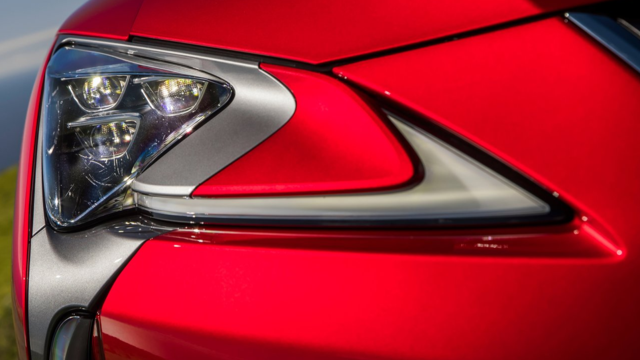
I kind of agree with you there, but I do know some people specifically chose the halogen lights and don't like the HID. I don't know why, but there are people out there like that. So I guess having a choice is still a good thing. Those that want it pay for it. Those that don't save a little.
I don't care. As long as you have the freedom of choice. Sometimes people just want what they want, the way they want it. I've always said that I wouldn't mind paying extra for convenience in life. So for products I don't mind paying more to get what I want.

CL Community Team


Joined: Aug 2006
Posts: 12,524
Likes: 216
From: San Francisco, CA
I think it all boils down to practically nobody likes halogens or plain looking headlights. Automakers know they can charge >$1000 to customers for the upgraded look. People are always willing to spend that kind of money to get the look they want

Lead Lap
Joined: Jun 2011
Posts: 437
Likes: 0
From: NC
2015 Hyundai Genesis First Drive
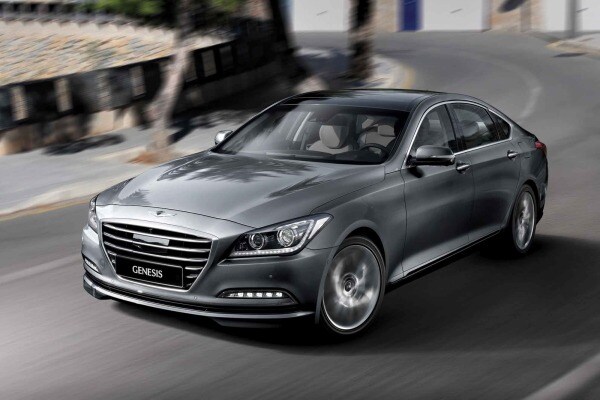
After a couple laps around a tight and twisty handling loop at Hyundai's proving grounds outside Seoul, Senior Ride and Handling Engineer Young Jin Hyun asks if we can feel a difference between the different drive modes of the 2015 Hyundai Genesis.
He's referring to the new Intelligent Drive Mode Select (IDMS), a driver-adjustable system that alters the transmission, steering, stability control and suspension settings of the redesigned sedan. Often these systems deliver barely perceptible changes, but we find the Sport mode noticeably more aggressive than the standard setting.
"Good," he says. "My job would not be done if it didn't make a real difference."
As an engineer he finds satisfaction in the results, but his insistence that the new system make a notable difference is indicative of the way Hyundai approached this new Genesis sedan. The first time around, the Genesis was all-new, so delivering on the basics was the main goal. Now that the Genesis is well established, it has to offer something more than just affordable luxury.
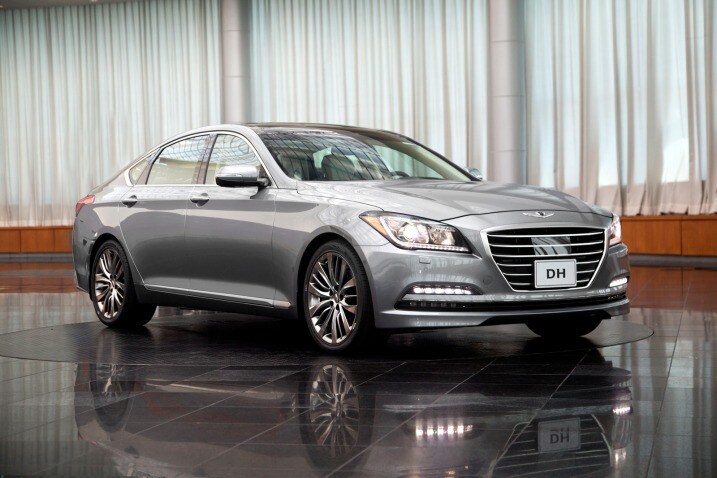
Here's How It Intends To Beat the Germans at Their Own Game
Built on an all-new rear-wheel-drive platform, the 2015 Hyundai Genesis is similar to the previous sedan in most dimensions. A nearly 3-inch-longer wheelbase is the only drastic change, one that puts this Genesis well above both the BMW 5 Series and Mercedes-Benz E-Class when it comes to space between the wheels.
That might seem like a trivial comparison, but Hyundai used both German competitors as benchmarks for the new Genesis. Hyun pointed out earlier that this Genesis uses more high-strength steel and has better torsional rigidity than the latest 5 Series. To the average buyer, that means a car that feels more refined on the road, even if that road is dead straight and perfectly smooth.
Hyun's team also upgraded this Genesis with standard variable-ratio electric steering and a newly optional all-wheel-drive system Hyundai calls H-TRAC. The former allows for a degree of adjustability in the feel of the steering that goes a long way toward delivering the noticeable changes in the various drive modes. The latter adds both improved all-weather drivability and better on-demand performance in dry conditions.
In normal driving, the H-TRAC system uses a 40/60 front-to-rear torque bias for a more natural feel. Dial up the Sport mode and the bias immediately adjusts to a 20/80 front-to-rear split that can be further ratcheted up to a 10/90 bias under certain conditions.
Read more: http://www.edmunds.com/hyundai/genes...road-test.html
ClubLexus Stories
Celebrating Lexus & Toyota from Around the Globe
8 Tips for Improving Your Hybrid or Plug-in Hybrid's Efficiency!
Michael S. Palmer
10 Best Lexus Models No One Remembers
Joe Kucinski
TRD Off-Road Premium: Best 2026 4Runner, Except This One Thing
Michael S. Palmer
Top 10 Lexus & Toyotas to Drive Before You Die!
Joe Kucinski
Top 10 Lexus/Toyotas With The LEAST 5-Year Depreciation
Joe Kucinski
Lexus LC500 Convertible Auction: A Preview of Rising Values?
Brett Foote
GX 550 vs TX 550: Best 3-Row Luxury Lexus Family Hauler
Michael S. Palmer
9 Best Lexus Models You Can Buy for Half Price (And 1 You Shouldn't!)
Joe Kucinski
2026 Lexus NX Buyer's Guide: Models, Features, Prices & More!
Brett Foote


Lexus Test Driver
Joined: Mar 2008
Posts: 9,992
Likes: 246
From: California

Lead Lap
Joined: Nov 2013
Posts: 477
Likes: 0
From: il
design is safe. execution is good. unlike internet board warriors, consumers will buy into the design. they always do. it will stand out from its natural competition - avalon, 300, ES, etc.
but it's still far away from where it wants to be.
but it's still far away from where it wants to be.

Lexus Test Driver
Joined: Jul 2013
Posts: 1,019
Likes: 0
From: NSW
This rivals the 5 series, E, GS at 3 series price
And unlike the other brands which b!itched out. Hyundai is offering a V8 with 416HP (yeah I'm also looking at you LEXUS)

Lexus Test Driver
Joined: Jul 2013
Posts: 1,019
Likes: 0
From: NSW
Thanks for the fix. But one thing I don't understand is how did Hyundai manage to make 429HP from their 5.0L while Lexus only managed 416HP from the 2UR-GSE 5.0L in the ISF that's crammed with tech.
Such as ; It’s an all-alloy quad-cam, 32-valve with high-flow cylinder heads, dual VVT-I with electric VVT-iE inlet camshaft actuation, titanium inlet valves, high-lift camshafts, dual D-4S fuel injection, dual intake air system, tuned length surge tank, variable scavenge oil pump and stainless steel dual exhaust system.
So why does the Tau V8 have an extra 13HP and extra torque over the 2UR-GSE?
Tau V8

2UR-GSE

Such as ; It’s an all-alloy quad-cam, 32-valve with high-flow cylinder heads, dual VVT-I with electric VVT-iE inlet camshaft actuation, titanium inlet valves, high-lift camshafts, dual D-4S fuel injection, dual intake air system, tuned length surge tank, variable scavenge oil pump and stainless steel dual exhaust system.
So why does the Tau V8 have an extra 13HP and extra torque over the 2UR-GSE?
Tau V8
2UR-GSE
Last edited by yowps3; Nov 26, 2013 at 08:57 PM.