Has anyone done this upgrade with an AWD? Do you see the same result? Did you ever see issues with ab normal tire wear? I haven't owned tired long enough to know, I replaced all four when one blistered badly and the rest were fairly worn, wasn't looking out for this at the time.
Thanks all
Thanks Jeff.
EDIT: I just installed the RC-F bushings and I am very pleased. Bolts all broke without and fuss. Total time was only 2 hours, even though I was taking my time.
I really can notice the difference on the highway. The slop is gone. Lane changes are much more crisp. Even driving around town it is noticeable.
For reference I have an AWD 250, 48k on it. Only suspension mod I have is the damper which I had installed immediately prior.
Unfortunately it sounds like I have joined the squeaking LCA bushing club. FIGS, what brand/type of lubricant do you recommend? Did you ever get a chance to make a video showing the process?
I have already re-greased my sway bar bushings and Megan UCAs using lithium grease as recommended by Megan but the squeaking persists.
Quote:
Originally Posted by itsmike177
Got the Figs front LCA bushings installed about 1.5 years ago, and with CA weather turning "cold" recently, the bushings are groaning/squeaking badly. (Front tire wear is definitely a non-issue now.)
How does one "easily" reapply the grease?
I don't see how one can just remove the LCA nut and push out the inner sleeve to clean and regrease the bushings "inner crosshatches?"
Won't the weight of the car on the LCA Spindle prevent the inner sleeve to move?
And even if one is able to "push out the inner sleeve," won't the LCA spindle be in the way of accessing the inner crosshatches?
Thanks for anyone's input.
Quote:
Originally Posted by LiquidSF
About to have these installed. Do you have an estimate on how many miles you drove in those 1.5 years?
Quote:
Originally Posted by itsmike177
Around 22000 miles. They groaned last winter, but not as bad as this winter season.
Quote:
Originally Posted by FIGS
Grease should be applied on the leading edge of the tube when reinstalling it. The tube can be removed with the car jacked up by placing a pry tool between the LCA and the tube then once exposed you can use locking pliers and a buffer like cardboard to grip the tube and pull it out the rest of the way. It can be done, or you can just remove the entire bracket and do it on the bench using an arbor press or deadblow and a socket.
Also, check your sway bar bushings. we have found the sway bushings to be more problematic that these bushings in terms of retaining lubrication. I can look at making a video when we get some spare lift time.
Mike
Quote:
Originally Posted by FIGS
OK I will see what I can put together the next week or so.
Thanks FIGS, the grease silenced the squeaking I was hearing while going over driveway entrances, speed bumps, and road imperfections! Not looking forward to removing and reinstalling the LCA bushings every few years though...hopefully they will stay quiet for longer this time.
Quote:
Originally Posted by FIGS
Grease should be applied on the leading edge of the tube when reinstalling it. The tube can be removed with the car jacked up by placing a pry tool between the LCA and the tube then once exposed you can use locking pliers and a buffer like cardboard to grip the tube and pull it out the rest of the way. It can be done, or you can just remove the entire bracket and do it on the bench using an arbor press or deadblow and a socket.
I tried with a flat head screwdriver and the corner of a 15" pry bar but it dug into the tube until it took a nick out of it and slipped out without moving the tube so I had to completely remove the LCA bushings. There is very little space between the metal rod that the nut threads onto and the inside of the tube, and the tube is inaccessible from the non-nut side. Maybe it would be possible to remove the tubes with the bushings on the car if they were freshly lubed but I couldn't find a way to do it with my dried out bushings. Maybe some JB weld on the end of a flat head screwdriver would work but idk how hard it would be to separate them afterwards.
Here are a few pictures for reference. The grease is silicon based.
I used a few scrap sections of 2x4 with a 2lb mallet and the 22mm 1/2" socket/extension used earlier for removing the nut to tap the inner tube out.
After getting it started I was able to hold one side with the 2x4s stacked on the other side to get enough height to fully remove the tube.
I only used 1 of the 2 grease packets from FIGS to lubricate both bushings and probably half of it had to be wiped off after reinserting the tube.
The cross hatches seem to be holding up well.
I removed the front wheels this time and used a 15" pry bar in the position shown below (since I misplaced the spare tire wrench) to get enough deflection to remove and reinstall the LCAs. It did seem a bit easier without the wheels.
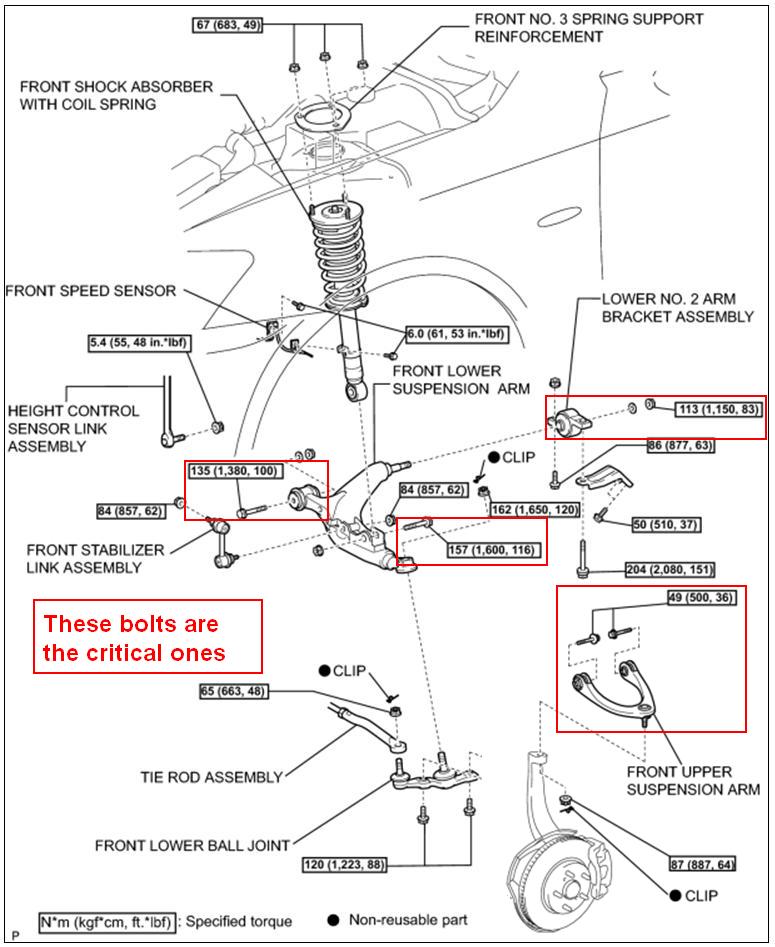
And here is the torque spec chart since it took me a while to find it in another thread and it is important to set the proper ft. lbs. when reassembling!
Quote:
Originally Posted by lobuxracer
This diagram has everything you need for the front:
Thanks FIGS, the grease silenced the squeaking I was hearing while going over driveway entrances, speed bumps, and road imperfections! Not looking forward to removing and reinstalling the LCA bushings every few years though...hopefully they will stay quiet for longer this time.
I tried with a flat head screwdriver and the corner of a 15" pry bar but it dug into the tube until it took a nick out of it and slipped out without moving the tube so I had to completely remove the LCA bushings. There is very little space between the metal rod that the nut threads onto and the inside of the tube, and the tube is inaccessible from the non-nut side. Maybe it would be possible to remove the tubes with the bushings on the car if they were freshly lubed but I couldn't find a way to do it with my dried out bushings. Maybe some JB weld on the end of a flat head screwdriver would work but idk how hard it would be to separate them afterwards.
The cross hatches seem to be holding up well.
I removed the front wheels this time and used a 15" pry bar in the position shown below (since I misplaced the spare tire wrench) to get enough deflection to remove and reinstall the LCAs. It did seem a bit easier without the wheels.
!
Thank you for the wirte up.
Yes it looks like there was inadequate grease from the factory and we have taken steps to relube all bushings at this point to avoid further issues. If they were not so dry, the tube would have ejected much easier.
Also silicon is not the same as silicone. You can read up more on that here. Silicon is naturally occuring and you can think of it as the bases for quartz or sand. It has a hard lubricating property like a ceramic coating. http://www.livescience.com/37598-sil...-implants.html
Thank you for the wirte up.
Yes it looks like there was inadequate grease from the factory and we have taken steps to relube all bushings at this point to avoid further issues. If they were not so dry, the tube would have ejected much easier.
......
Thanks Mike
@FIGS
Perhaps do a trial run with a modification to the current design adding a grease zerk to the bracket and a couple of internal channels to disperse the silicone lubricant?
Drill and tap bracket for zerk fitting. Hole should be biased off center towards the thrust side near the outside of the bracket by the outer mounting bolt so its protected from road rash.
Install bushing.
Drill through the aluminum bracket into the bushings inner core.
Grease bushing and install steel core.
This may or may not be needed but a spiral cut channel from the drilled hole could aid the flow of lubricant to the thrust face. Although there is no guarantee the silicone lubricant will make it to all of the thrust surface, this will reduce the need for disassembly.
I did this to a previous vehicle and it works!!! The bushing never spun in the housing and the lubricant extends the bushing life removing the stiction effect of a dry bushing that hinders suspension travel. i.e. when these go dry it takes a certain amount of rotational force to break free allowing the suspension to move.
I have spare brackets from 350 we could do a test run on if you need a test vehicle. And I'm sure the greater population would rather lube these during an OCI than take their car apart. Cost is virtually nil and takes maybe 5min of time and a 30 cent fitting = happy customers!
@FIGS
Perhaps do a trial run with a modification to the current design adding a grease zerk to the bracket and a couple of internal channels to disperse the silicone lubricant?
Drill and tap bracket for zerk fitting. Hole should be biased off center towards the thrust side near the outside of the bracket by the outer mounting bolt so its protected from road rash.
Install bushing.
Drill through the aluminum bracket into the bushings inner core.
Grease bushing and install steel core.
This may or may not be needed but a spiral cut channel from the drilled hole could aid the flow of lubricant to the thrust face. Although there is no guarantee the silicone lubricant will make it to all of the thrust surface, this will reduce the need for disassembly.
I know you are trying to helpI did this to a previous vehicle and it works!!! The bushing never spun in the housing and the lubricant extends the bushing life removing the stiction effect of a dry bushing that hinders suspension travel. i.e. when these go dry it takes a certain amount of rotational force to break free allowing the suspension to move.
I have spare brackets from 350 we could do a test run on if you need a test vehicle. And I'm sure the greater population would rather lube these during an OCI than take their car apart. Cost is virtually nil and takes maybe 5min of time and a 30 cent fitting = happy customers!
I know you are trying to help, but since we have been manually adding grease to the interface the problem seems to be remedied. I know its pretty typical, especially in offroad applications, to add a fitting for grease. This presents a few problems, particularly with this design. The system currently is a closed system that promotes grease circulation from one side to the other via the diamond knurl pattern. Adding an internal passage would allow input of grease but it would also allow a pocket for the grease to occupy when loaded which may cause cavitation. Also, in order for a perfect passage to be made it would need to be molded in, making the mold significantly more expensive. Polyurethane requires a very steep shear angle to machine properly. Typical drill bits would not do a great job of this, we actually grind our own tools when it comes to machining the material.
The last and perhaps the most practical problem is that the grease we use is not available in a grease gun sized applicator. It is packaged in packets and tubs. The film layer that is left behind provides significant lubrication as well as weather resistance over temperature so once coated, even if all the grease were to leave it would still last a very long time.
I am open to further suggestions but the thread has not been bumped since Feb 2017 and not to mention we have thousands of these in service all over the world in ongoing use. We have not heard a recent complaint so we try to focus on the problems in front of us, maintaining reasonable stock levels and further product development.
Does anyone have the torque spec for the 4 bolts on the Front lower cross member support that needs to be removed to access the nut on the bushing? Best info I could find is 37#ft
BTW I just installed the FIGS LCA bushings and the crush tube in the bushing came dry from FIGS. After reading this thread I decided to push them out and check them. Sure as sheit, no lube. Why install the the crush tubes at the factory dry? These were just purchased 2 months ago from FIGS directly.
I have a 20 ton press and bought only the bushings for my car. What I did to separate the rubber from the sleeve in the old bushing after pressing it out of the bracket was to just press it out using a seal install disk Smaller than the steel sleeve and the press. Habor freight has the seal tool kit for $30. The oil in the bushing will squirt out the bottom, so have a catch pan below it. But did not require any heat to come out.
=> this gave me the old sleeve now To install the new bushing. No special tools were needed. Just a press.
Old bushing Old sleeve in position Ready to be pressed


 Not looking forward to removing and reinstalling the LCA bushings every few years though...hopefully they will stay quiet for longer this time.











 .
. 
