


MPG @ various MPH

Thread Starter
Intermediate
Joined: Jul 2009
Posts: 284
Likes: 4
From: nc
 MPG @ various MPH
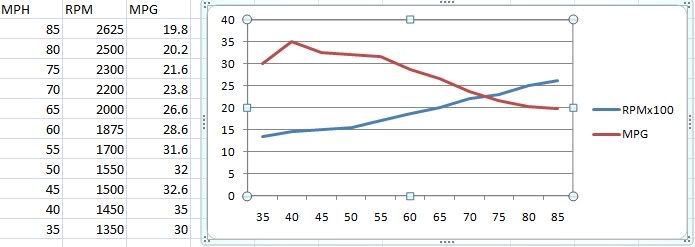
drove down to the coast this friday & decided to utilize the long stretches of flat road to get some mpg avg's
ran various speeds for 10mile stretches to & from the beach & averaged the results
surprisingly & unfortunately the best mpg was @ a speed slower than i want to travel
also surprised mpg was a high as it was @ 85mph
ran various speeds for 10mile stretches to & from the beach & averaged the results
surprisingly & unfortunately the best mpg was @ a speed slower than i want to travel
also surprised mpg was a high as it was @ 85mph

Pit Crew


Joined: Sep 2004
Posts: 154
Likes: 12
From: Florida
I have found the MPG computer to vary quite a bit from min to min, so I doubt it's a reliable measure of current gas consumption. The cumulative "AVG MPG" number seems to correlate better with actual (calculated) consumption.

Lexus Test Driver
Joined: Dec 2009
Posts: 1,146
Likes: 7
From: AZ
That would explain why when I'm on the freeway my avg mpg does not go up radically. I drive about 75 mph. That will teach me. Thanks for the chart, it may not be dead on but I think it gives people something to go by.

Intermediate


Joined: Jan 2010
Posts: 419
Likes: 55
From: PA
jskennedy,
My wife would say that you need to get a life!!! You and I may have similar backgrounds (engineering) which leads me to do things just like your chart.
This is a great depiction of why Richard Nixon lowered the speed limits to 55 mph back in the 70's when oil supplies were a problem.
Thanks for the time and effort.
My wife would say that you need to get a life!!! You and I may have similar backgrounds (engineering) which leads me to do things just like your chart.
This is a great depiction of why Richard Nixon lowered the speed limits to 55 mph back in the 70's when oil supplies were a problem.
Thanks for the time and effort.
Thread Starter
Intermediate
Joined: Jul 2009
Posts: 284
Likes: 4
From: nc
mine had less variance @ higher speeds
the #'s i posted were all collected from the avg-mpg
i've compared the avg-mpg reading to the actual miles-driven divided my gallons-pumped-in-tank & it's always been amazingly accurate
Trending Topics
Thread Starter
Intermediate
Joined: Jul 2009
Posts: 284
Likes: 4
From: nc
ClubLexus Stories
Celebrating Lexus & Toyota from Around the Globe
8 Tips for Improving Your Hybrid or Plug-in Hybrid's Efficiency!
Michael S. Palmer
10 Best Lexus Models No One Remembers
Joe Kucinski
TRD Off-Road Premium: Best 2026 4Runner, Except This One Thing
Michael S. Palmer
Top 10 Lexus & Toyotas to Drive Before You Die!
Joe Kucinski
Top 10 Lexus/Toyotas With The LEAST 5-Year Depreciation
Joe Kucinski
Lexus LC500 Convertible Auction: A Preview of Rising Values?
Brett Foote
GX 550 vs TX 550: Best 3-Row Luxury Lexus Family Hauler
Michael S. Palmer
9 Best Lexus Models You Can Buy for Half Price (And 1 You Shouldn't!)
Joe Kucinski
2026 Lexus NX Buyer's Guide: Models, Features, Prices & More!
Brett Foote
CL Community Team


Joined: Aug 2006
Posts: 12,524
Likes: 216
From: San Francisco, CA
The car should get the best mpg at speeds near 55 and it does decrease rapidly after that. However, I think you normally do get more than 20 at 75. On flat stretches at 80, my RX330 which is less fuel efficient than the 3.5 engine can get 23-24mpg. THere are many factors such as wind and even a minor gradient change to affect those numbers drastically.
Thread Starter
Intermediate
Joined: Jul 2009
Posts: 284
Likes: 4
From: nc
The car should get the best mpg at speeds near 55 and it does decrease rapidly after that. However, I think you normally do get more than 20 at 75. On flat stretches at 80, my RX330 which is less fuel efficient than the 3.5 engine can get 23-24mpg. THere are many factors such as wind and even a minor gradient change to affect those numbers drastically.
what are you basing your 55mph claim on ?
Thread Starter
Intermediate
Joined: Jul 2009
Posts: 284
Likes: 4
From: nc
i believe the 55mph # comes from the nixon era
3 speed trannys may have been the norm back then
the best mpg should come from the lowest speed you can drive in the highest gear
never really watched the shifts that much, but i'm betting the RX shifts to 6th around 40mph
i'm pretty confident in my 40mph # for best mpg
my test is far from exact science, but i bet the #'s are good within a couple of mpg
CL Community Team
Joined: Aug 2006
Posts: 12,524
Likes: 216
From: San Francisco, CA
There has got to be a bit more than just lowest RPM on the 6th gear. It is about the energy needed to hold a speed, so I would think you need to take into account the momentum and force that pushes the car forward balanced with the energy needed to maintain the speed.

Driver School Candidate
Joined: Oct 2007
Posts: 10
Likes: 0
From: texas
Fantastic post. Don't get too caught up on the variables since this is a ballpark estimate. It will definitely give people a good idea on what to expect when they drive at certain speeds. Of course YMMV.

Rookie
Joined: Feb 2010
Posts: 60
Likes: 0
From: NY
Wow, those are impressive numbers! Unfortunately, I haven't see anything close to that in the past four months I've had the car. I don't know if I'm doing something wrong or if the computer in my car isn't working properly. I have only put the highest octane gas in my car since I got it - 93.
For example, the calculations on my dash usually averages 13 mpg for local driving and when I combine it with highway driving at about 65 mpg it goes up to 17 mpg the most. Also, my mph (miles per hour) calculation on the dash is always around 18. How come it always stays at 18 when I never drive that slow. When I first got my car, I brought up this subject and was told that idle time is calculated into the mph calculations, but I am not idle that much to bring my 40 mph local driving and 65 mph highway driving down that far. Also, I was told that my mpg averages would go up after a few gas fill-ups, but it's always the same.
This is what I do - when I fill up a tank of gas with 93 octane, I reset the odometer to 0. Is this the proper way to get the correct mpg calculations? And, I don't know what else could be wrong with the mph calculations.
Suggestions please . . .
For example, the calculations on my dash usually averages 13 mpg for local driving and when I combine it with highway driving at about 65 mpg it goes up to 17 mpg the most. Also, my mph (miles per hour) calculation on the dash is always around 18. How come it always stays at 18 when I never drive that slow. When I first got my car, I brought up this subject and was told that idle time is calculated into the mph calculations, but I am not idle that much to bring my 40 mph local driving and 65 mph highway driving down that far. Also, I was told that my mpg averages would go up after a few gas fill-ups, but it's always the same.
This is what I do - when I fill up a tank of gas with 93 octane, I reset the odometer to 0. Is this the proper way to get the correct mpg calculations? And, I don't know what else could be wrong with the mph calculations.
Suggestions please . . .