



Will blue gas kill Tesla?

Thread Starter
Lead Lap


Joined: Aug 2011
Posts: 4,709
Likes: 549
From: Ca
 Will blue gas kill Tesla?
Will blue gas kill Tesla? New emission-free liquid hydrocarbon can fuel a 300-mile trip on a full tank compared to the average Elon Musk-owned electric cars that go 250 miles on a single battery charge
By Stacy Liberatore For Dailymail.com10:12 AEDT 19 Feb 2021 , updated 10:13 AEDT 19 Feb 2021
+531 comments
- Blue gas is starting to make waves in the industry and could replace Tesla
- It's an emission-free liquid hydrocarbon fuel that gives 300 miles on a full tank
- The fuel consists of carbon monoxide and oxygen, but is still in early phases
Called Blue gas, it is a liquid hydrocarbon fuel consisting of carbon monoxide and oxygen that can be used in vehicles built from 2002 – and it is 100 percent emissions free.
It also propels vehicles 300 miles on a full tank, while Tesla’s power system provides up to 250 miles on a full battery, on average.Blue gas does not involve lithium, or batteries or rare earths, takes a shorter time to fuel up and lasts longer than electric vehicles – making it a potential ‘Tesla killer.’
+5Blue gas is a liquid hydrocarbon fuel consisting of carbon monoxide and oxygen that can be used in vehicles built from 2002 – and it is 100 percent emissions freeParts of the US and the globe are planning to eliminate gas-powered vehicles as early as 2023 in a bid to reduce emissions and combat climate change.
The move is not just a boost for the environment, but it is a good sign for electric car makers like Tesla.
Link: Will blue gas kill Tesla? New emission-free liquid hydrocarbon fuels a 300-mile trip on a full tank | Daily Mail Online
Last edited by peteharvey; Feb 18, 2021 at 11:26 PM. Reason: Thanks bit; my cell phone deleted that original link.
Thread Starter
Lead Lap
Joined: Aug 2011
Posts: 4,709
Likes: 549
From: Ca
https://spacecoastdaily.com/2020/07/...erthrow-tesla/


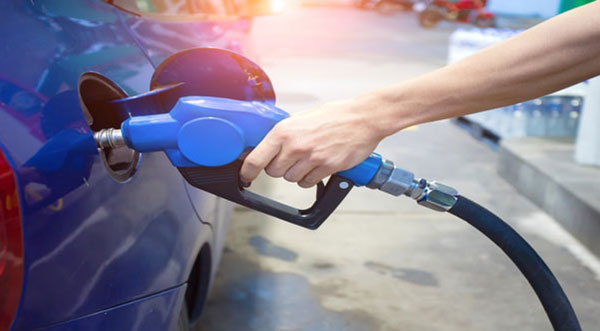
If you keep up with news regarding technological advances, you have probably heard of the ongoing debate between blue gas vs. Tesla. (Outsider Club image)If you keep up with news regarding technological advances, you have probably heard of the ongoing debate between blue gas vs. Tesla.
The argument is worth looking into as we have been trying to find a solution to the age-old problems we have been trying to solve.
For a while, we believed that battery-operated cars could be the answer to pollution from vehicles. That was until the name, ‘blue gas’ surfaced.
If you are still wondering how blue gas could be better than battery-operated cars and if it could actually compete against Tesla’s advanced technology, here are some key points to keep in mind.
What is Blue Gas?
Blue gas is essentially a liquid hydrocarbon fuel, which is made of basically carbon monoxide and oxygen. What makes this gas stand out is it uses natural gases and creates the fuel by a carbon-neutral process.
Moreover, another interesting aspect of this gas is that instead of polluting exhaust emitted from cars, vehicles using blue gas-only emit water and heat. You might be wondering what makes this gas unique as battery-operated cars are known to be environmentally friendly as well.
Due to the different advantages it automatically has over battery-operated cars, StocksReviewed says “Blue Gas” could end Tesla.
Recharging vs. Refueling
One of the biggest drawbacks of Tesla cars is that it takes a long time for them to charge. The time might be a small price to pay if it is good for the environment, right?
However, blue gas is also environment-friendly as previously mentioned and on top of that, it does not take nearly as long to refuel the vehicle.
Imagine going on a road trip with your Tesla only to find that your car is low on battery. You will have to charge the car for hours before you could hit the road again. With battery operated cars, you have to be proactive with the care of your vehicle.
Not only are cars using blue gas easier to refuel, but they also last longer than battery-operated cars. This is one of the aspects of the debate which is harder to determine because there are a lot of variables, such as the speed and air conditioner, which may affect the results.
However, a Tesla car with a full battery can go up to 100 miles without disturbances, on the other hand, a car running on blue gas can keep going for a bit over 300 miles on one tank of gas.
This alone proves how blue gas is more efficient having longer road time as well as requiring less time to refuel.
Are They Good for the Environment?
The highlight of both these sources of energy is the fact that they are clean and good for the environment however, a lot more comes to the surface when you dig deeper. The whole essence of batteries is the very reason why they are not the most environmentally friendly addition to your car.
One of the problems with Tesla cars that cannot be avoided is the demand for lithium which is bad for the environment. As battery cars become more popular, people will start to see a shift in popularity because of the batteries which contain lithium.
This will lead to more entities racing to mass-produce lithium for supplying to companies such as Tesla. However, behind the scenes, we are actually replacing one problem with another. In order to produce just a ton of lithium, 500 gallons of water are required.
Areas, where lithium is produced, are already facing problems with water shortages and the use of chemicals is also affecting the fish in the water bodies.
Additionally, batteries are manufactured with different materials and it is more difficult to recycle them. The reason why batteries are seen as a threat to the environment is because it is not economically feasible to meltdown and reuse its components.
Is Blue Gas Safer?
In all honesty, blue gas is not entirely risk-free but it is relatively safer to handle. Even though the gas is combustible it is still an extremely light element. In other words, even if you come across a gas leak it will not pool on the ground and should dissipate fairly quickly due to its lightweight nature.
So, even if there are chances of an accident, the properties of the gas itself lower the chances of it occurring.
The Drawbacks of Blue Gas
Blue gas seems to be an absolute dream come true however, it does have its drawbacks.
Though blue gas has quickly earned its position as a competitor to Tesla and has many large brands investing in it, it should be acknowledged that it is still in its beginning phase.
In other words, there is still a lot to learn as companies move forward with this gas. This is one of the primary reasons why people are still skeptical about a gas that seemingly has so far ticked all the boxes.
Moreover, the problem of accessibility also needs to be considered when weighing the pros and cons of blue gas. Both Tesla and blue gas face this problem however, its impact is harder on blue gas.
It is undeniable that hydrogen fueling stations are not as widely available as normal gas stations. Unless this problem is solved, car companies will be less inclined to invest in manufacturing cars which use blue gas as the demand for it will be low.
However, it is safe to say that this problem is not completely unsolvable.
Final Thoughts
Finding and using clean energy sources is important as the exhaust from vehicles alone is dangerous for the environment.
It is evident that blue gas earned its name as the “Tesla Killer” fairly. It seems to be a better and cleaner alternative to Tesla cars as it is more efficient and better for the environment.
With all these facts laid in front of you about Tesla and blue gas, it is time for you to pick a side. What do you think? Will Tesla emerge victoriously, or will blue gas win this race?
Will Blue Gas Overthrow Tesla?
By Space Coast Daily // July 22, 2020 If you keep up with news regarding technological advances, you have probably heard of the ongoing debate between blue gas vs. Tesla. (Outsider Club image)If you keep up with news regarding technological advances, you have probably heard of the ongoing debate between blue gas vs. Tesla.
The argument is worth looking into as we have been trying to find a solution to the age-old problems we have been trying to solve.
For a while, we believed that battery-operated cars could be the answer to pollution from vehicles. That was until the name, ‘blue gas’ surfaced.
If you are still wondering how blue gas could be better than battery-operated cars and if it could actually compete against Tesla’s advanced technology, here are some key points to keep in mind.
What is Blue Gas?
Blue gas is essentially a liquid hydrocarbon fuel, which is made of basically carbon monoxide and oxygen. What makes this gas stand out is it uses natural gases and creates the fuel by a carbon-neutral process.
Moreover, another interesting aspect of this gas is that instead of polluting exhaust emitted from cars, vehicles using blue gas-only emit water and heat. You might be wondering what makes this gas unique as battery-operated cars are known to be environmentally friendly as well.
Due to the different advantages it automatically has over battery-operated cars, StocksReviewed says “Blue Gas” could end Tesla.
Recharging vs. Refueling
One of the biggest drawbacks of Tesla cars is that it takes a long time for them to charge. The time might be a small price to pay if it is good for the environment, right?
However, blue gas is also environment-friendly as previously mentioned and on top of that, it does not take nearly as long to refuel the vehicle.
Imagine going on a road trip with your Tesla only to find that your car is low on battery. You will have to charge the car for hours before you could hit the road again. With battery operated cars, you have to be proactive with the care of your vehicle.
Not only are cars using blue gas easier to refuel, but they also last longer than battery-operated cars. This is one of the aspects of the debate which is harder to determine because there are a lot of variables, such as the speed and air conditioner, which may affect the results.
However, a Tesla car with a full battery can go up to 100 miles without disturbances, on the other hand, a car running on blue gas can keep going for a bit over 300 miles on one tank of gas.
This alone proves how blue gas is more efficient having longer road time as well as requiring less time to refuel.
Are They Good for the Environment?
The highlight of both these sources of energy is the fact that they are clean and good for the environment however, a lot more comes to the surface when you dig deeper. The whole essence of batteries is the very reason why they are not the most environmentally friendly addition to your car.
One of the problems with Tesla cars that cannot be avoided is the demand for lithium which is bad for the environment. As battery cars become more popular, people will start to see a shift in popularity because of the batteries which contain lithium.
This will lead to more entities racing to mass-produce lithium for supplying to companies such as Tesla. However, behind the scenes, we are actually replacing one problem with another. In order to produce just a ton of lithium, 500 gallons of water are required.
Areas, where lithium is produced, are already facing problems with water shortages and the use of chemicals is also affecting the fish in the water bodies.
Additionally, batteries are manufactured with different materials and it is more difficult to recycle them. The reason why batteries are seen as a threat to the environment is because it is not economically feasible to meltdown and reuse its components.
Is Blue Gas Safer?
In all honesty, blue gas is not entirely risk-free but it is relatively safer to handle. Even though the gas is combustible it is still an extremely light element. In other words, even if you come across a gas leak it will not pool on the ground and should dissipate fairly quickly due to its lightweight nature.
So, even if there are chances of an accident, the properties of the gas itself lower the chances of it occurring.
The Drawbacks of Blue Gas
Blue gas seems to be an absolute dream come true however, it does have its drawbacks.
Though blue gas has quickly earned its position as a competitor to Tesla and has many large brands investing in it, it should be acknowledged that it is still in its beginning phase.
In other words, there is still a lot to learn as companies move forward with this gas. This is one of the primary reasons why people are still skeptical about a gas that seemingly has so far ticked all the boxes.
Moreover, the problem of accessibility also needs to be considered when weighing the pros and cons of blue gas. Both Tesla and blue gas face this problem however, its impact is harder on blue gas.
It is undeniable that hydrogen fueling stations are not as widely available as normal gas stations. Unless this problem is solved, car companies will be less inclined to invest in manufacturing cars which use blue gas as the demand for it will be low.
However, it is safe to say that this problem is not completely unsolvable.
Final Thoughts
Finding and using clean energy sources is important as the exhaust from vehicles alone is dangerous for the environment.
It is evident that blue gas earned its name as the “Tesla Killer” fairly. It seems to be a better and cleaner alternative to Tesla cars as it is more efficient and better for the environment.
With all these facts laid in front of you about Tesla and blue gas, it is time for you to pick a side. What do you think? Will Tesla emerge victoriously, or will blue gas win this race?
Last edited by peteharvey; Feb 18, 2021 at 11:29 PM.

Lead Lap
Joined: Apr 2016
Posts: 512
Likes: 169
From: Alberta
No it won’t as cost per mile will be too high. Problem with all these exotic fuels, Hydrogen included, is both the actual cost to produce them and the hydrocarbon input cost to make them. It remains far more economical both in cost and least harm to environment just to burn the hydrocarbon or convert it directly to electricity
Trending Topics

CL Community Team


Joined: Feb 2007
Posts: 9,339
Likes: 600
From: IL
The Spacecoast article is horribly written, and full of inaccuracies. here's one gem:
I haven't driven the Tesla Leaf. Anybody here that has?
However, a Tesla car with a full battery can go up to 100 miles without disturbances, on the other hand, a car running on blue gas can keep going for a bit over 300 miles on one tank of gas.
I haven't driven the Tesla Leaf. Anybody here that has?
ClubLexus Stories
Celebrating Lexus & Toyota from Around the Globe
8 Tips for Improving Your Hybrid or Plug-in Hybrid's Efficiency!
Michael S. Palmer
10 Best Lexus Models No One Remembers
Joe Kucinski
TRD Off-Road Premium: Best 2026 4Runner, Except This One Thing
Michael S. Palmer
Top 10 Lexus & Toyotas to Drive Before You Die!
Joe Kucinski
Top 10 Lexus/Toyotas With The LEAST 5-Year Depreciation
Joe Kucinski
Lexus LC500 Convertible Auction: A Preview of Rising Values?
Brett Foote
GX 550 vs TX 550: Best 3-Row Luxury Lexus Family Hauler
Michael S. Palmer
9 Best Lexus Models You Can Buy for Half Price (And 1 You Shouldn't!)
Joe Kucinski
2026 Lexus NX Buyer's Guide: Models, Features, Prices & More!
Brett Foote
Lexus Fanatic

Joined: Oct 2003
Posts: 94,328
Likes: 236
From: Virginia/D.C. suburbs
Here's another article (and viewpoint) on the subject....although they see it as coming more from hydrogen than carbon or oxygen.
https://stockhouse.com/news/newswire...ment-hype-real
Omri Wallach, Stockhouse
7 Comments| February 19, 2020 1
+ Favorites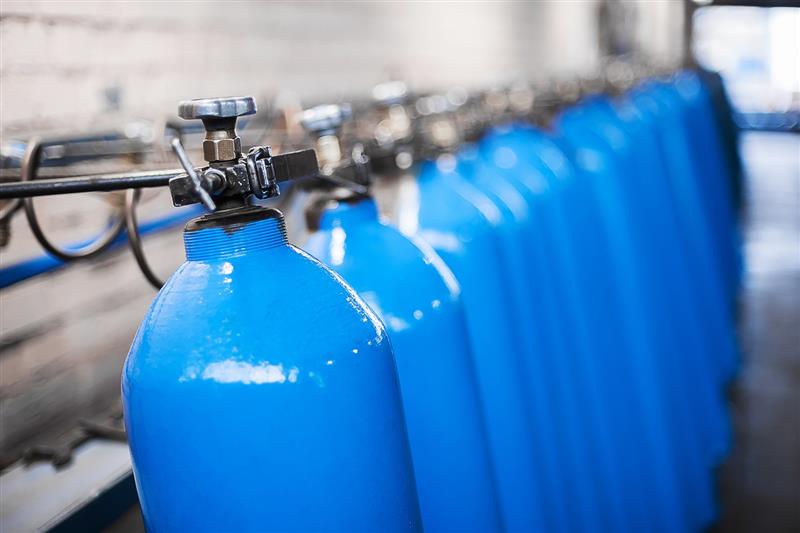
You can’t deny it anymore: the future of the motor vehicle industry is in emission reductions. While many naturally tie that future to electric vehicles, many automakers and a group of investing experts see a different product rising and stealing the multibillion-dollar market: “blue gas.”
First, credit where credit is due. The rising success of Tesla Inc. (NASDAQ:TSLA) has quieted a lot of naysayers decrying the electric vehicle market, and for good reason. What was once an expensive product with a very limited range has gotten cheaper, can go farther, and has more charging stations being set up by the day. That’s why basically every major car manufacturer has its own take and attempts at squashing Tesla’s electric vehicle dominance with their own models.
But while they’ve been resentfully building out their electric fleets, automakers have been not-so-quietly developing their own solution to carbon emissions. The products being developed still use gas, but one with zero harmful emissions. The gas in question is hydrogen, and for energy investors specifically, “blue” hydrogen.
What makes the “blue” version different than regular hydrogen is that it’s produced by a carbon neutral process that uses natural gas alongside carbon capture and storage. It’s a big step up from the current “grey” hydrogen used by the majority of the market that doesn’t store the carbon, while not quite as hard to attain as “green” hydrogen created using renewable energy sources.
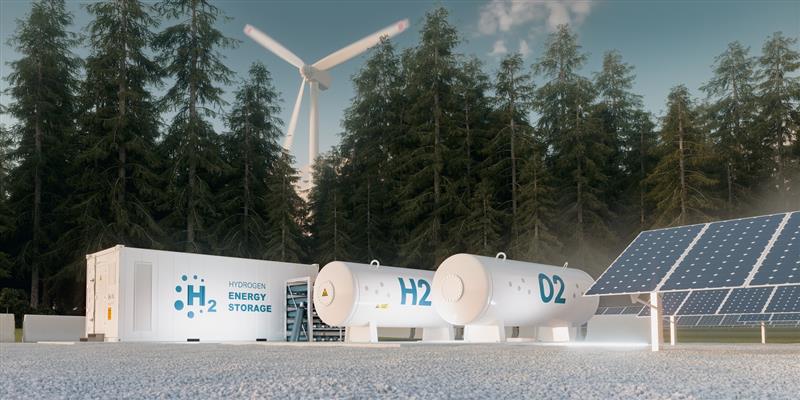
(Concept design of hydrogen generated and stored using renewable energy)
The benefits of vehicles that run on hydrogen fuel cells over electric vehicles are numerous, especially for the existing industry. The biggest benefits are in range and speed, as hydrogen fuel-cell vehicles have shown to have an increased range over Tesla’s vehicles on one tank, and they’re filled up like regular gas vehicles, a significant increase over the time it takes for a full EV battery charge.
That’s piqued the interest of long-haul vehicle fleets of trucks, buses, and trains. It’s a market that Tesla is desperate to enter, but the advantages of fuel-cell vehicles and simplicity in switching over from diesel machines has already won some contracts. On the train front, a zero-emission fuel-cell train is being commissioned in southern California, and hydrogen-powered trains are already operating in Germany and coming to France and the UK. Anheuser-Busch InBev (NYSE:BUD) started testing semi-tractor trucks from start-up Nikola Motors, and the Port of Los Angeles signed a deal for hydrogen fuel cell utility trucks from Toyota Motor Corp. (NYSE:TM).
In fact, Toyota is shaping up to be the biggest disrupter to the electric vehicle market by expanding the hydrogen vehicle market. Despite Tesla CEO Elon Musk decrying fuel-cell tech as “mind-boggingly stupid” and not possible to achieve success, Toyota has ramped up production of its Mirai fuel-cell sedan and invested in the installation of a hydrogen fill-up network.
Yet despite articles hailing hydrogen and blue gas as Tesla’s largest threat and biggest competitor, the hype is incredibly forward-thinking and dependent on a number of factors. Electric vehicles have a massive first-mover advantage in the market, with more charging stations, better batteries, greater market penetration, and reduced prices compared to launch. Tesla’s investments in growing out the industry has started to yield profit, change, and most important of all for new vehicle types, normalcy. Meanwhile, for all of their advantages, hydrogen fuel-cell vehicles are more expensive than EVs and the network for filling up hydrogen is comparably non-existent.
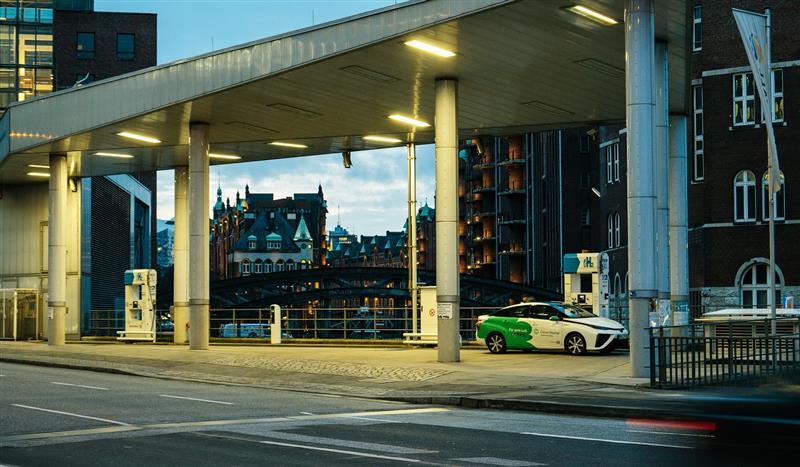
(Hydrogen-powered Toyota Mirai being fueled up in Hamburg, Germany)
For what it’s worth, a lot of the investment potential in hydrogen fuel-cells relies on governments committing to the idea, and so far, promises from the Asian and European markets have seen fuel-cell stocks surge. Investors should look at producers like FuelCell Energy Inc. (NASDAQ:FCEL)Plug Power Inc. (NASDAQ:PLUG) and Ballard Power Systems Inc. (TSX:BLDP). Even diesel giant Cummins Inc. (NYSE:CMI) has bought out a fuel-cell company.
Further commitment, however, will require a significant increase in supply and true shift to the “blue gas” itself. Almost all of the fuel-cells on the market today use the market standard “grey” hydrogen, which is attractive on paper for having zero emissions, but still releases carbon into the atmosphere during production. Governments are all for the idea of “blue” and “green” hydrogen which will help them meet emission reduction standards, but the industry needs to ramp up supply and bring costs of production down.
And while some investors might be hearing about “blue gas” and hydrogen fuel-cells shaking up the market for the first time, others will recognize a story that made the rounds a few times in the past decade. The tech has evolved, yes, and the rollout of fuel-cell vehicles has begun, but the long-term fundamentals are the same. Until some big commitments and investments accelerate in the field and bring down costs as they have with electric vehicles, “blue gas” won’t rise to the top.
New to investing in Oil and Gas? Check out Stockhouse tips on How to Invest in Energy Stocksand some of our Top Energy Stocks.
For more of the latest info on Oil and Gas, check out the Energy Trending News hub on Stockhouse.
https://stockhouse.com/news/newswire...ment-hype-real
Is The “Blue Gas” Investment Hype Real?
Omri Wallach, Stockhouse
7 Comments| February 19, 2020 1
+ Favorites
You can’t deny it anymore: the future of the motor vehicle industry is in emission reductions. While many naturally tie that future to electric vehicles, many automakers and a group of investing experts see a different product rising and stealing the multibillion-dollar market: “blue gas.”
First, credit where credit is due. The rising success of Tesla Inc. (NASDAQ:TSLA) has quieted a lot of naysayers decrying the electric vehicle market, and for good reason. What was once an expensive product with a very limited range has gotten cheaper, can go farther, and has more charging stations being set up by the day. That’s why basically every major car manufacturer has its own take and attempts at squashing Tesla’s electric vehicle dominance with their own models.
But while they’ve been resentfully building out their electric fleets, automakers have been not-so-quietly developing their own solution to carbon emissions. The products being developed still use gas, but one with zero harmful emissions. The gas in question is hydrogen, and for energy investors specifically, “blue” hydrogen.
What makes the “blue” version different than regular hydrogen is that it’s produced by a carbon neutral process that uses natural gas alongside carbon capture and storage. It’s a big step up from the current “grey” hydrogen used by the majority of the market that doesn’t store the carbon, while not quite as hard to attain as “green” hydrogen created using renewable energy sources.
(Concept design of hydrogen generated and stored using renewable energy)
The benefits of vehicles that run on hydrogen fuel cells over electric vehicles are numerous, especially for the existing industry. The biggest benefits are in range and speed, as hydrogen fuel-cell vehicles have shown to have an increased range over Tesla’s vehicles on one tank, and they’re filled up like regular gas vehicles, a significant increase over the time it takes for a full EV battery charge.
That’s piqued the interest of long-haul vehicle fleets of trucks, buses, and trains. It’s a market that Tesla is desperate to enter, but the advantages of fuel-cell vehicles and simplicity in switching over from diesel machines has already won some contracts. On the train front, a zero-emission fuel-cell train is being commissioned in southern California, and hydrogen-powered trains are already operating in Germany and coming to France and the UK. Anheuser-Busch InBev (NYSE:BUD) started testing semi-tractor trucks from start-up Nikola Motors, and the Port of Los Angeles signed a deal for hydrogen fuel cell utility trucks from Toyota Motor Corp. (NYSE:TM).
In fact, Toyota is shaping up to be the biggest disrupter to the electric vehicle market by expanding the hydrogen vehicle market. Despite Tesla CEO Elon Musk decrying fuel-cell tech as “mind-boggingly stupid” and not possible to achieve success, Toyota has ramped up production of its Mirai fuel-cell sedan and invested in the installation of a hydrogen fill-up network.
Yet despite articles hailing hydrogen and blue gas as Tesla’s largest threat and biggest competitor, the hype is incredibly forward-thinking and dependent on a number of factors. Electric vehicles have a massive first-mover advantage in the market, with more charging stations, better batteries, greater market penetration, and reduced prices compared to launch. Tesla’s investments in growing out the industry has started to yield profit, change, and most important of all for new vehicle types, normalcy. Meanwhile, for all of their advantages, hydrogen fuel-cell vehicles are more expensive than EVs and the network for filling up hydrogen is comparably non-existent.
(Hydrogen-powered Toyota Mirai being fueled up in Hamburg, Germany)
For what it’s worth, a lot of the investment potential in hydrogen fuel-cells relies on governments committing to the idea, and so far, promises from the Asian and European markets have seen fuel-cell stocks surge. Investors should look at producers like FuelCell Energy Inc. (NASDAQ:FCEL)Plug Power Inc. (NASDAQ:PLUG) and Ballard Power Systems Inc. (TSX:BLDP). Even diesel giant Cummins Inc. (NYSE:CMI) has bought out a fuel-cell company.
Further commitment, however, will require a significant increase in supply and true shift to the “blue gas” itself. Almost all of the fuel-cells on the market today use the market standard “grey” hydrogen, which is attractive on paper for having zero emissions, but still releases carbon into the atmosphere during production. Governments are all for the idea of “blue” and “green” hydrogen which will help them meet emission reduction standards, but the industry needs to ramp up supply and bring costs of production down.
And while some investors might be hearing about “blue gas” and hydrogen fuel-cells shaking up the market for the first time, others will recognize a story that made the rounds a few times in the past decade. The tech has evolved, yes, and the rollout of fuel-cell vehicles has begun, but the long-term fundamentals are the same. Until some big commitments and investments accelerate in the field and bring down costs as they have with electric vehicles, “blue gas” won’t rise to the top.
New to investing in Oil and Gas? Check out Stockhouse tips on How to Invest in Energy Stocksand some of our Top Energy Stocks.
For more of the latest info on Oil and Gas, check out the Energy Trending News hub on Stockhouse.
Last edited by mmarshall; Feb 19, 2021 at 08:25 AM.




Look it’s 2008 again. Honda Fcx clarity who?
it was the best design in 100 years and why didn’t it work? Find me a hydrogen vehicle refilling station ......I’ll wait.
https://www.greenoptimistic.com/jame...-car-20081216/
anything that isn’t dinosaur driven (which includes all electric sources) will be blocked until every oil executives grandkids die.
it was the best design in 100 years and why didn’t it work? Find me a hydrogen vehicle refilling station ......I’ll wait.
https://www.greenoptimistic.com/jame...-car-20081216/
anything that isn’t dinosaur driven (which includes all electric sources) will be blocked until every oil executives grandkids die.

Lexus Test Driver
Joined: Jan 2007
Posts: 7,460
Likes: 232
From: CA
Look it’s 2008 again. Honda Fcx clarity who?
it was the best design in 100 years and why didn’t it work? Find me a hydrogen vehicle refilling station ......I’ll wait.
https://www.greenoptimistic.com/jame...-car-20081216/
anything that isn’t dinosaur driven (which includes all electric sources) will be blocked until every oil executives grandkids die.
it was the best design in 100 years and why didn’t it work? Find me a hydrogen vehicle refilling station ......I’ll wait.
https://www.greenoptimistic.com/jame...-car-20081216/
anything that isn’t dinosaur driven (which includes all electric sources) will be blocked until every oil executives grandkids die.
CL Community Team
Joined: Feb 2007
Posts: 9,339
Likes: 600
From: IL