


MM Retro-Write-Up...First-Generation Honda Insight


Thread Starter
Lexus Fanatic


Joined: Oct 2003
Posts: 94,521
Likes: 261
From: Virginia/D.C. suburbs
 MM Retro-Write-Up...First-Generation Honda Insight




IN A NUTSHELL: The first American-Market Gas/Electric Hybrid…and, in some ways, the most humble.
In today’s rapidly-electrifying automotive landscape, which brings us more gas/electric hybrids and pure-battery-electric vehicles to the market each year, it is difficult to imagine that, a scant 20 years so ago or so, the idea of an actual production vehicle with anything other than a gasoline or diesel-powered internal-combustion engine was about as foreign to the average American mind as an honest politician. True, GM, mostly on a lease-basis, had introduced the battery/electric Impact to a limited market in the Southwest, were the (usually) good weather limited the drain on the vehicle’s battery. There are a few other pure-electric vehicles, usually very small and quirky, like the one-person Corbin Sparrow….wth even smaller sales/lease-numbers. A few manufacturers offered natural-gas/propane-powered vehicles, E85 or ethanol-powered vehicles where those fuels were readily available, and fuel-cell/hydrogen vehicle technology was in its infancy. However, none of these alternate-fuel vehicles, despite some Government contracts for them at the time, ever made any real inroads on the American market.
Very slowly, however, that began to change in the year 2000, the dawning of a new century……and of a new automotive century. Honda, who had been a very innovative manufacturer in the past with new engine technology like the CVCC (Controlled-Vortex-Combustion), VTEC (Variable-Valve-Timing), and multiple-vales-per-cylinder, often derived from well-known Formula-1 efforts, added a new first, that year, with the first mass-production gas/electric hybrid vehicle available in the U.S., although it had previously been introduced to its Japanese home-market. In January 2000, the first of the Honda Insights started reaching American dealerships. Toyota was also working on plans to introduce its first hybrid Prius model here to the U.S., but the first Priuses would not arrive until almost eight months later, in August of 2000.
At first, the new Insights came in very slowly, trickling in at a snail’s pace. I had the privilege of being one of the first people in the D.C. area who was not an automotive journalist to sample an Insight, at least in part because an ex-Toyota salesperson I had known for years had jumped-ship and was now working for the Honda dealership right across street at Tysons’ Corner, VA. (We had bought my late Mom’s 1994 Corolla wagon from him). He gave me a buzz and let me know that a silver Insight was on the way….so I was there at the dealership when it came in. They did a quick unload, processing, slapped a (legal) Virginia Inspection sticker on the windshield so it could be test-driven, and the rest was up to me.
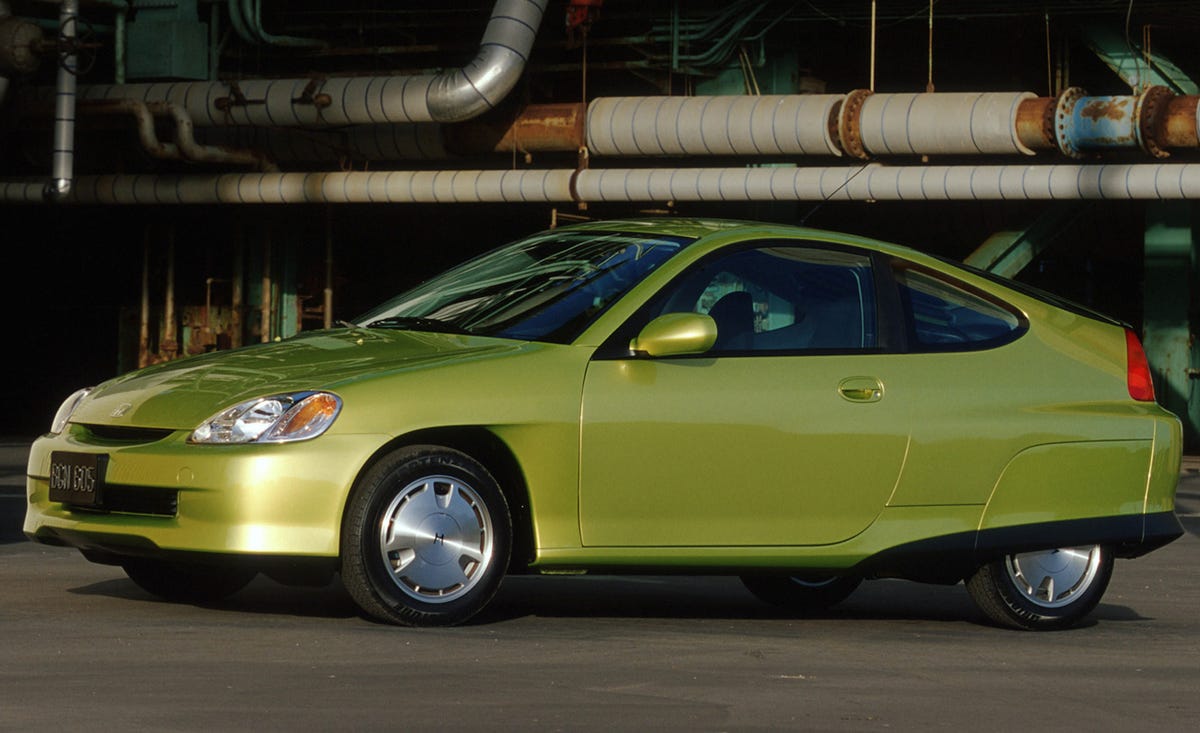
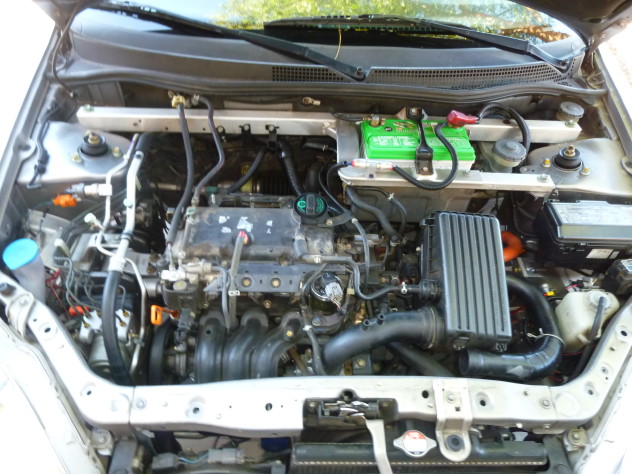
Before I had even done the exterior-review or gotten in, I had known, right from the start, from the previous images and advance-articles on this car, that some significant compromises had been made on it in the name of Stretch-Your-Gas-Dollar-to-the-Limit fuel-economy and ultra-low-emissions….even more so than with Toyota’s upcoming Prius. Just how many compromises, though, were evident from its design. It appeared to be related to the former 2-seat Honda CRX’s tiny platform, but in a much more quirky manner. Large, odd-looking flaring-skirts covered both rear fenders….which presumably smoothed out the aerodynamics a little. Those skirts extended into the huge rear bumper and bulged out the back of the car like a Southern Sheriff’s Beer-Gut. The large, heavy battery-pack (they were not as compact or efficient back then as they were now) took up so much room behind the 2 seats that, together with the extremely-raked rear roofline (again, for aerodynamics and mileage) there wasn’t much room for anything in the cargo area that wasn’t small, low, and flat, like maybe your briefcase lying on its side. Like a small sports-car, it sat about an inch off the ground with its lower-body fairings (again, for aerodynamics)…so getting in and out of it, although not as difficult as with the Mazda Miata or Lotus Elise, was somewhat of an exercise in stooping/lifting and and/or turning your body into a Bachmann Pretzel. Under the small/non-insulated hood, the tiny 1.0L non-turbo three (which makes even the small 1.3L turbo-three in my Buick Encore GX look large) and the 13 HP/10KW IMA (Integrated-Motor-Assist) electric motor took up virtually all of what space there was available. The thin bodywork, doors, and glass lacked even rudimentary insulation……curb weight had been paired to the bone, more or less Lotus-style, in the search for maximum fuel-economy…which, of course, it delivered in spades, with real-world gas-mileage into the 60s, or even better in some circumstances. A look at the specs showed that only 350 lbs. of weight could be carried….that’s the weight of cargo AND passengers combined, so, for all intents and purposes, for a guy my size, it was a one-person car and a modest amount of my luggage( what would fit, that is)…weight-wise, a salesperson couldn’t even travel with me, as he a was also a good-sized guy like me. A quick look at the components underneath the car (what you could actually see, at least) showed minimal brakes/suspension/steering parts….again, weight-savers, and the fact that hybrid vehicles often don’t need strong brakes because of their regenerative-braking-systems, where the coasting-drag on the motors slows the vehicle down and recharges the battery. In short, From what I remember, three or four colors were offered….black, silver, red, and a Neon-shade of yellowish/grass-green, (possibly white, but I don’t specifically remember it). In general, I liked the green the best. IMO, this was more of a toy (although, for the time, a rather sophisticated one mechanically) than what I would all a true automobile for American-sized people.
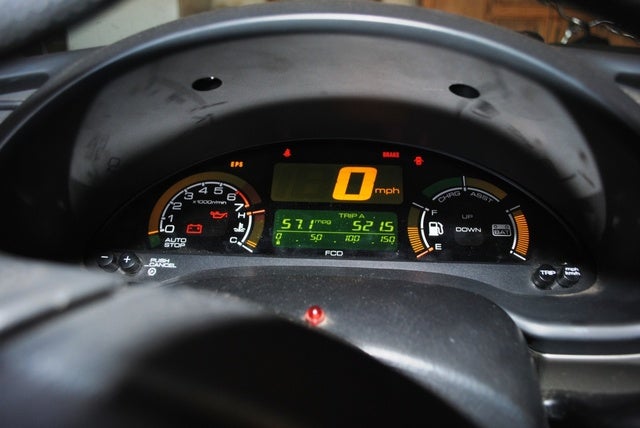
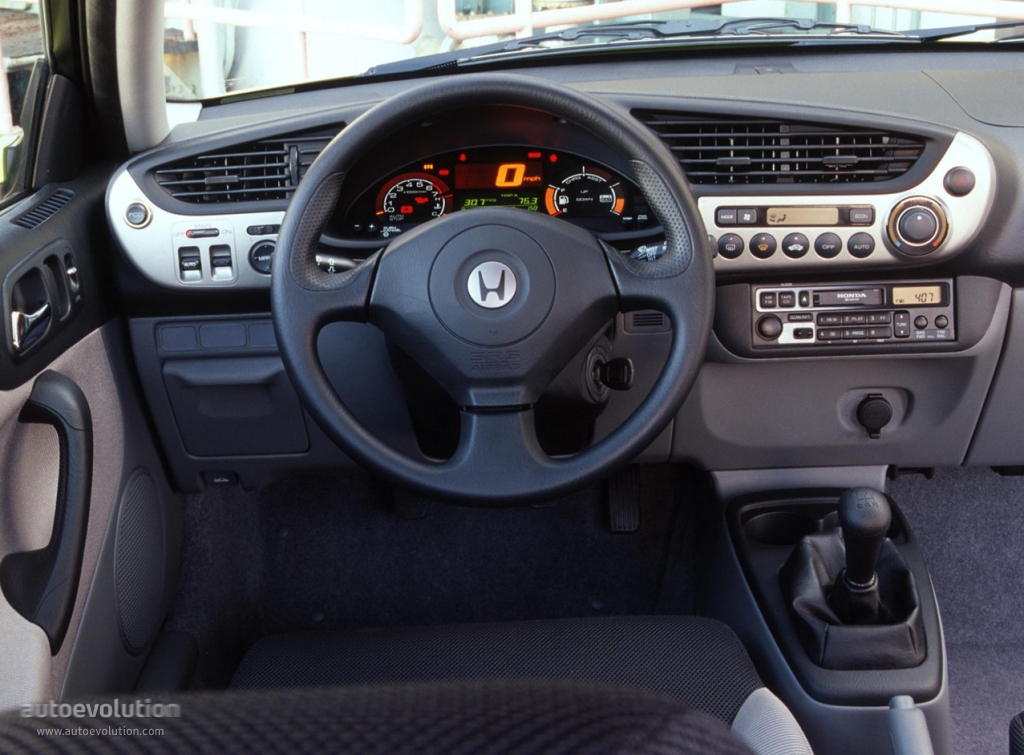
And, compared to most traditional gas-vehicles of the time, it also drove like a toy. First-Generation Insights had a choice of a 5-speed manual or a CVT. I don’t totally recall which one my test-car had, but I think it was the 5-speed. Road/tire-noise, with the lack of insulation, came through into the cabin like a drum. Even small-to-moderate bumps with the lightweight suspension upset the car noticeably….some Hondas of that period were well-known for a lack of suspension-travel to absorb bumps. Steering/handling response was quite good considering the narrow economy-oriented tires…the light weight also helped there. The brake pedal had the typical early-hybrid twitchiness, since the regenerative-braking did most of the work. Instrumentation was (mostly) a jumble of video-patterns/stick-graphs/and hybrid-functions instead of the usual analog needle-gauges. Some sources list the original Insight as a Parallel-Hybrid, but I disagree. From what I remember (and from its powertrain manners), it was a Series-Hybrid, where the IMA electric motor was simply connected to the back of the gas engine, and serves as its starter and torque-boost when needed…such as on the engine start/stop system at idle. True Parallel-Hybrids (such as the Toyotas) allowed operation of either the gas or electric power plant independent of the other one. The wheezy little gas engine would shut off at idle, then restart with a jerk when you took your foot off the brake….I learned to keep some distance from the car ahead of me, at idle, just in case it jerked a little more than I was expecting. In short, yes, this was an amazingly (for the time) gas-frugal vehicle. To say anything else would not be a realistic comment, but, unfortunately, it required a LOT of compromises, lack of comfort, and, lack of performance. It was clearly not the car for the vast majority of the American motoring public, particularly guys my size, and he sales figures bore that out.
Also helping to dampen the sales-numbers of the First-Generation Insight was the introduction of the aforementioned Toyota Prius in August of that year. The Fist-Generation Prius, though not a big comfy or roomy sedan by any means, was, far more so than the Insight, a vehicle that was actually usable for a number of Americans…and its own sales-numbers proved it. It was not quite as gas-frugal as the Insight…nor would one expect it to be, from its larger/heavier/more comprehensive four-door design….but a lot of people liked it in spite of its quirky dash and controls. It was an instant hit, and went on to become the Media-Poster-Child of Environmentalists, Hollywood celebrities, Schoolteachers/Professors, and, in general, those who wanted a car that was not a conventional car….or who disliked conventional automobiles.
So, the Insight never became much of a sales-success, and, today, still isn’t a success even with its much larger Third-Generation four-door version….although the present four-door person, like the Prius, is a vehicle that actually offers some versatility and is usable for small families. And, although (except for its first eight months in 2000) it always did play second-fiddle to the Prius in sales-numbers, automotive history cannot take away the fact that, like it or not, as far as American-market hybrids go, it was the first.
And, as Always, Happy Car-Memories.

MM
Last edited by mmarshall; Feb 9, 2021 at 06:55 PM.

Lexus Champion


Joined: Oct 2002
Posts: 11,204
Likes: 11
From: The Woodlands, TX
owned a 5-spd for a couple years - I sold it for about $3500 more than I bought it for. Bought used for $8500, sold for $12000 (when gas high) and bought a Prius instead simply because I wanted a bit more refinement/cruise control/backup cam/space/etc.
I managed almost a 1000 miles on a few tanks of gas and averaged over 70mpg on my 54 mile RT commute.
Personally I thought it was a great little commuter car - not great for high speed freeway driving but most of my commute as about 50mph, right in its highest MPG speed. A/C blew ice cold, handled very nimble and with the 5-spd manual transmission it wasnt bad at all.
First thing I did was take that ugly huge antenna off the roof and installed a stubby.
I managed almost a 1000 miles on a few tanks of gas and averaged over 70mpg on my 54 mile RT commute.
Personally I thought it was a great little commuter car - not great for high speed freeway driving but most of my commute as about 50mph, right in its highest MPG speed. A/C blew ice cold, handled very nimble and with the 5-spd manual transmission it wasnt bad at all.
First thing I did was take that ugly huge antenna off the roof and installed a stubby.
Last edited by bagwell; Feb 9, 2021 at 07:39 PM.


Thread Starter
Lexus Fanatic
Joined: Oct 2003
Posts: 94,521
Likes: 261
From: Virginia/D.C. suburbs

Thread Starter
Lexus Fanatic
Joined: Oct 2003
Posts: 94,521
Likes: 261
From: Virginia/D.C. suburbs
I managed almost a 1000 miles on a few tanks of gas and averaged over 70mpg on my 54 mile RT commute.


Trending Topics
Lexus Champion
Joined: Oct 2002
Posts: 11,204
Likes: 11
From: The Woodlands, TX
LOL, when did you drive one?
It was a purpose built vehicle - not to ride like a Lexus, not to accelerate like a V8...just maximum MPG in an efficient package.
The Honda Insight equipped with the innovative Integrated Motor Assist (IMA) was the first gasoline-electric hybrid automobile to be sold in USA. IMA couples an all-new and compact 61 cui, 3-cylinder engine and an ultra-thin electric motor for outstanding efficiency. That combined with a rigid aluminum body structure and world-class aerodynamic design gives the Insight the ability to travel as far as 70 miles on a gallon of gasoline and still meet California’s stringent Ultra-Low Emission Vehicle (ULEV) standard, making it the world’s cleanest, most fuel-efficient gasoline-powered automobile.Honda has traditionally believed that cars should operate in harmony with their environment and society. This credo has prompted continuous research and product development in the field of low-emission, high-mileage vehicles over the past 30 years. One of the first results of this work was the Honda CVCC Civic, launched in 1975. It had a special Compound Vortex Controlled Combustion that allowed it to meet the new emissions regulations of the time, without the need for a catalytic converter. In 1985 the Honda 1.3-liter CRX HF was the first "high-mileage" Honda, followed by the 1992 Honda Civic VX, with its lean-burn, VTEC-E engine. Moreover, in 1996 Honda introduced the Civic HX Coupe featuring a VTEC-E engine and highly efficient continuously variable transmission that made it the first automobile equipped with an automatic transmission to make it into the EPA’s top ten list.
After having decided on using a hybrid gasoline-electric propulsion system for the Insight, the first step in its development was to identify a set of performance goals for the car. The main goal was that of achieving the highest fuel economy possible. Honda engineers set as a target 70-plus miles per gallon and above. Ultra-low emissions were an equally important engineering goal, as well as safety and performance. Honda engineers wanted the Insight to have a level of performance comparable to that of a 1.5-liter engine automobile. Finally, the Insight, like all Hondas, would have to be durable, reliable and built to Honda standards of quality, comfort and drivability.
The Insight drives just like any other automobile. Its range is limited only by its 10.6-gallon gas tank. No external power supply is needed for recharging. It is a full-featured automobile, backed by the Honda reputation for durability, quality and reliability.
At the heart of the IMA system is a compact, 61 cui, 3-cylinder gasoline automobile engine. The engine uses advanced lean-burn VTEC-E technology, low-friction design features and lightweight materials such as aluminum, magnesium and special plastics, in combination with a new lean-bum-compatible NOx catalyst, to achieve a new level of efficiency and low emissions in gasoline-engine technology.
The electric component of the IMA system consists of an ultra-thin, 2.3-inch wide permanent-magnet electric motor operating in parallel with the gasoline engine. Electricity for the motor is stored in a 144-volt nickel-metal hydride battery pack and controlled via an advanced electronic Power Control Unit (PCU).Unlike a pure battery-powered electric vehicle, the Insight does not require an outside source of electric power. Electricity for the system is generated primarily by regenerative braking.
In addition to being light, the Insight’s futuristic-looking aluminum body is also highly aerodynamic in both its shape and details, and boasts one of the lowest coefficients of drag (0.25) of any mass-produced automobile sold worldwide.
Since a lightweight vehicle has better performance and fuel economy than a heavier one, the Insight’s body is made from aluminum alloy. Aluminum weighs only one-third as much as steel. In addition, aluminum alloy is highly versatile and readily lends itself to a wide variety of manufacturing techniques. Lastly, aluminum is extensively recycled, which helps lower its cost.
At highway speeds, the airflow around a vehicle becomes turbulent. Turbulent air generates considerably more drag than smooth-flowing (laminar) air. In addition, as speed increases, the power required to overcome turbulence-induced drag rises exponentially. To combat the effects of drag, Honda engineers designed the Insight’s body to be highly aerodynamic. Its 0.25 coefficient of drag (Cd) is one of the lowest of any mass-produced automobile in the world. In comparison, the Honda Civic Hatchback, with roughly the same 1.9 square-meter frontal area as the Insight, has a Cd of 0.36, and needs around 32 percent more power to operate at the same speed as the Insight.
The Insight’s futuristic, aerodynamic shape is both distinctive and functional. The low, rounded nose is designed to part the air with a minimum of turbulence, and also affords the driver and passenger an unobstructed forward view. Louvers in the cooling-air inlets have been carefully designed to minimize turbulence. The headlight assemblies blend smoothly into the contour of the fender, and the fenders have large-radius curves in order, to minimally disturb the air flowing around them.
To minimize frontal area and drag, the windshield is steeply raked, and its edges blend smoothly with the sides and cabin roof. The trailing edge of the hood and cowl are shaped to smoothly divert airflow over the windshield wipers.
The roof tapers to the rear of the vehicle in a teardrop shape. The cabin’s ample glass area affords good outward visibility in all directions, and also lends a light, airy feeling to the interior. The glass rear hatch has an additional panel that lets the driver see what is immediately behind the vehicle - an especially useful feature when backing up.
The Insight’s gently curved sides and wheel wells are also designed to minimize air turbulence. The plastic-resin front fenders extend downward below the centerline of the wheel and incorporate a small air dam in front of the wheel. To further minimize turbulence, the trailing edge of the wheel well is inset and faired into the body. Disc-shaped aluminum wheels also help smooth airflow around the wheel wells.
Another important aerodynamic detail that greatly contributes to the Insight body’s low coefficient of drag is the careful management of underbody airflow. The Insight body features a flat underbody design that smoothes airflow under the car. Areas of the underside that must remain open to the air, such as the exhaust system and the area around the fuel tank, have separate fairings to smooth the airflow around them.
Design goals for the Insight’s chassis centered around achieving sporty and responsive handling, good ride characteristics and world-class safety, all while contributing to the overall goal of reaching the highest fuel efficiency possible. To meet this challenge, Honda engineers developed an innovative new chassis design that takes advantage of the high strength-to-weight properties of aluminum and plastic.
The unit-body part of the Insight’s body uses stressed sheet-metal panels to absorb and distribute structural and suspension loads, much like an ordinary steel unit body. However, with the Insight’s body all of these panels, including the roof, floor, front and rear wheel wells, rear quarter-panels, bulkhead, and even the doors and hood, are made of aluminum alloy. These stressed panels are reinforced in key areas by aluminum-alloy frame members.
It is these aluminum frame members and their cast-aluminum connecting joints that make the Insight’s hybrid body so unique. In a steel unit body, frame members are formed by stamping in large presses and then joined to the body by welding. However, the Insight uses extruded frame members. Extrusions are drawn from a die in much the same way that tubing is made, and like tubing are of constant cross section. Once formed, extrusions can be easily made into complex three-dimensional pieces, such as a curved windshield frame. They also do not require any additional machining or finishing after they are formed.
Primary motive power for the Insight is provided by the system’s 61 cui, 12-valve, 3-cylinder, VTEC-E gasoline engine. Although the engine alone provides sufficient driving performance, even in sustained uphill driving, a permanent-magnet electric motor mounted between the engine and transmission provides power assistance under certain conditions, such as initial acceleration from a stop. In addition, since the electric motor is used only for power assistance and not for primary motive power, it too can be made smaller and lighter relative to the full-size traction motors in other hybrid systems.
As the IMA gasoline engine enters it’s mid to high rpm operating range, the electric motor assist ceases and power is solely supplied by the engine, which is operating in its high-rpm 4-valve mode.
Power for the electric motor comes mainly by recapturing energy from the forward momentum and braking of the vehicle, rather than from the gasoline engine. When the Insight is coasting or its brakes are applied, and the vehicle is in gear, its electric-assist motor becomes a generator, converting forward momentum into electrical energy, instead of wasting it as heat during conventional braking (vented front disc/rear drum brakes are still the main means of braking). If the charge state of the IMA battery is low, the motor/generator will also recharge while the Insight is cruising, however, the advantage of regenerative braking is that it eliminates the need for a large, on-board electrical generating system, like the ones used on most parallel hybrid gasoline-electric drive-trains.
This beneficial spiral of decreasing weight, reduced size and complexity and increased performance continues with the IMA nickel-metal hydride battery pack (a technology Honda pioneered in its EV PLUS electric car), which is also smaller and lighter in weight than the ones used in other hybrid systems. The batteries are located under the cargo compartment floor, along with the IMA system’s Power Control Unit (PCU).
Compared to a comparable internal-combustion-powered drive-train, like that in a Honda Civic, the Insight’s IMA system boasts an impressive 24-percent improvement in efficiency in combined-mode city and highway driving, while meeting California’s stringent Ultra-Low Emission Vehicle (ULEV) standard.
Some of the advanced technologies used in the Insight’s IMA gasoline engine include its compact VTEC-E cylinder head, nitrogen-oxide adsorptive catalytic converter, integrated cylinder head and exhaust manifold, and plastic-resin intake manifold, valve cover and water-pump pulley. Magnesium alloy is used to make the oil pan, and the IMA engine also boasts numerous advanced friction-reduction techniques that help minimize frictional power loss.
Fuel induction is via an advanced version of Honda’s sequential programmed fuel injection, and the ignition is a direct type with individual ignition coils for each cylinder and long-lasting iridium-tipped spark plugs.
Honda engineers designed a completely new 5-speed manual transmission for the Insight. Like the rest of the Insight, its new transmission is designed to be as lightweight and as compact as possible, and is sized to the power requirements of the IMA system. The new transmission weights just 91 pounds and is 9.25 pounds lighter and almost a half an inch shorter than the current Civic manual transmission.
In order to minimize power loss within the transmission, the gears have been carefully machined to reduce rotational mass. The transmission’s lubricating system has also been redesigned to provide more efficient lubrication with a smaller oil capacity, thereby saving additional weight and size.
The transmission’s shift linkage operates smoothly, with minimal effort, thanks to the use of shortened synchronizer sleeves and a redesigned reverse-gear mechanism. A neutral switch built into the transmission tells the IMA idle-stop feature when the transmission is in neutral. https://www.topspeed.com/cars/honda/...t-ar11170.html
It was a purpose built vehicle - not to ride like a Lexus, not to accelerate like a V8...just maximum MPG in an efficient package.
The Honda Insight equipped with the innovative Integrated Motor Assist (IMA) was the first gasoline-electric hybrid automobile to be sold in USA. IMA couples an all-new and compact 61 cui, 3-cylinder engine and an ultra-thin electric motor for outstanding efficiency. That combined with a rigid aluminum body structure and world-class aerodynamic design gives the Insight the ability to travel as far as 70 miles on a gallon of gasoline and still meet California’s stringent Ultra-Low Emission Vehicle (ULEV) standard, making it the world’s cleanest, most fuel-efficient gasoline-powered automobile.Honda has traditionally believed that cars should operate in harmony with their environment and society. This credo has prompted continuous research and product development in the field of low-emission, high-mileage vehicles over the past 30 years. One of the first results of this work was the Honda CVCC Civic, launched in 1975. It had a special Compound Vortex Controlled Combustion that allowed it to meet the new emissions regulations of the time, without the need for a catalytic converter. In 1985 the Honda 1.3-liter CRX HF was the first "high-mileage" Honda, followed by the 1992 Honda Civic VX, with its lean-burn, VTEC-E engine. Moreover, in 1996 Honda introduced the Civic HX Coupe featuring a VTEC-E engine and highly efficient continuously variable transmission that made it the first automobile equipped with an automatic transmission to make it into the EPA’s top ten list.
After having decided on using a hybrid gasoline-electric propulsion system for the Insight, the first step in its development was to identify a set of performance goals for the car. The main goal was that of achieving the highest fuel economy possible. Honda engineers set as a target 70-plus miles per gallon and above. Ultra-low emissions were an equally important engineering goal, as well as safety and performance. Honda engineers wanted the Insight to have a level of performance comparable to that of a 1.5-liter engine automobile. Finally, the Insight, like all Hondas, would have to be durable, reliable and built to Honda standards of quality, comfort and drivability.
The Insight drives just like any other automobile. Its range is limited only by its 10.6-gallon gas tank. No external power supply is needed for recharging. It is a full-featured automobile, backed by the Honda reputation for durability, quality and reliability.
At the heart of the IMA system is a compact, 61 cui, 3-cylinder gasoline automobile engine. The engine uses advanced lean-burn VTEC-E technology, low-friction design features and lightweight materials such as aluminum, magnesium and special plastics, in combination with a new lean-bum-compatible NOx catalyst, to achieve a new level of efficiency and low emissions in gasoline-engine technology.
The electric component of the IMA system consists of an ultra-thin, 2.3-inch wide permanent-magnet electric motor operating in parallel with the gasoline engine. Electricity for the motor is stored in a 144-volt nickel-metal hydride battery pack and controlled via an advanced electronic Power Control Unit (PCU).Unlike a pure battery-powered electric vehicle, the Insight does not require an outside source of electric power. Electricity for the system is generated primarily by regenerative braking.
In addition to being light, the Insight’s futuristic-looking aluminum body is also highly aerodynamic in both its shape and details, and boasts one of the lowest coefficients of drag (0.25) of any mass-produced automobile sold worldwide.
Body & chassis
Honda engineers knew that the Insight’s body would play a major role in helping it achieve the fuel economy, performance and safety goals they had set for it. In response to this challenge, they came up with an innovative, new body design for the Insight that is lightweight, rigid and highly aerodynamic.Since a lightweight vehicle has better performance and fuel economy than a heavier one, the Insight’s body is made from aluminum alloy. Aluminum weighs only one-third as much as steel. In addition, aluminum alloy is highly versatile and readily lends itself to a wide variety of manufacturing techniques. Lastly, aluminum is extensively recycled, which helps lower its cost.
At highway speeds, the airflow around a vehicle becomes turbulent. Turbulent air generates considerably more drag than smooth-flowing (laminar) air. In addition, as speed increases, the power required to overcome turbulence-induced drag rises exponentially. To combat the effects of drag, Honda engineers designed the Insight’s body to be highly aerodynamic. Its 0.25 coefficient of drag (Cd) is one of the lowest of any mass-produced automobile in the world. In comparison, the Honda Civic Hatchback, with roughly the same 1.9 square-meter frontal area as the Insight, has a Cd of 0.36, and needs around 32 percent more power to operate at the same speed as the Insight.
The Insight’s futuristic, aerodynamic shape is both distinctive and functional. The low, rounded nose is designed to part the air with a minimum of turbulence, and also affords the driver and passenger an unobstructed forward view. Louvers in the cooling-air inlets have been carefully designed to minimize turbulence. The headlight assemblies blend smoothly into the contour of the fender, and the fenders have large-radius curves in order, to minimally disturb the air flowing around them.
To minimize frontal area and drag, the windshield is steeply raked, and its edges blend smoothly with the sides and cabin roof. The trailing edge of the hood and cowl are shaped to smoothly divert airflow over the windshield wipers.
The roof tapers to the rear of the vehicle in a teardrop shape. The cabin’s ample glass area affords good outward visibility in all directions, and also lends a light, airy feeling to the interior. The glass rear hatch has an additional panel that lets the driver see what is immediately behind the vehicle - an especially useful feature when backing up.
The Insight’s gently curved sides and wheel wells are also designed to minimize air turbulence. The plastic-resin front fenders extend downward below the centerline of the wheel and incorporate a small air dam in front of the wheel. To further minimize turbulence, the trailing edge of the wheel well is inset and faired into the body. Disc-shaped aluminum wheels also help smooth airflow around the wheel wells.
Another important aerodynamic detail that greatly contributes to the Insight body’s low coefficient of drag is the careful management of underbody airflow. The Insight body features a flat underbody design that smoothes airflow under the car. Areas of the underside that must remain open to the air, such as the exhaust system and the area around the fuel tank, have separate fairings to smooth the airflow around them.
Design goals for the Insight’s chassis centered around achieving sporty and responsive handling, good ride characteristics and world-class safety, all while contributing to the overall goal of reaching the highest fuel efficiency possible. To meet this challenge, Honda engineers developed an innovative new chassis design that takes advantage of the high strength-to-weight properties of aluminum and plastic.
The unit-body part of the Insight’s body uses stressed sheet-metal panels to absorb and distribute structural and suspension loads, much like an ordinary steel unit body. However, with the Insight’s body all of these panels, including the roof, floor, front and rear wheel wells, rear quarter-panels, bulkhead, and even the doors and hood, are made of aluminum alloy. These stressed panels are reinforced in key areas by aluminum-alloy frame members.
It is these aluminum frame members and their cast-aluminum connecting joints that make the Insight’s hybrid body so unique. In a steel unit body, frame members are formed by stamping in large presses and then joined to the body by welding. However, the Insight uses extruded frame members. Extrusions are drawn from a die in much the same way that tubing is made, and like tubing are of constant cross section. Once formed, extrusions can be easily made into complex three-dimensional pieces, such as a curved windshield frame. They also do not require any additional machining or finishing after they are formed.
Engine & transmission
The Insight’s IMA system owes much of its remarkable performance to the application of numerous technologies developed by Honda over the past four decades, including lean-bum combustion, low-emission engines, variable valve timing, high-efficiency electric motors, regenerative braking, nickel-metal hydride battery technology and microprocessor control. In the IMA system, Honda engineers have optimized the performance of each of these technologies to create an efficient, lightweight and compact hybrid drive system that people can easily use and that does not require any changes in lifestyle. Here’s how it works:Primary motive power for the Insight is provided by the system’s 61 cui, 12-valve, 3-cylinder, VTEC-E gasoline engine. Although the engine alone provides sufficient driving performance, even in sustained uphill driving, a permanent-magnet electric motor mounted between the engine and transmission provides power assistance under certain conditions, such as initial acceleration from a stop. In addition, since the electric motor is used only for power assistance and not for primary motive power, it too can be made smaller and lighter relative to the full-size traction motors in other hybrid systems.
As the IMA gasoline engine enters it’s mid to high rpm operating range, the electric motor assist ceases and power is solely supplied by the engine, which is operating in its high-rpm 4-valve mode.
Power for the electric motor comes mainly by recapturing energy from the forward momentum and braking of the vehicle, rather than from the gasoline engine. When the Insight is coasting or its brakes are applied, and the vehicle is in gear, its electric-assist motor becomes a generator, converting forward momentum into electrical energy, instead of wasting it as heat during conventional braking (vented front disc/rear drum brakes are still the main means of braking). If the charge state of the IMA battery is low, the motor/generator will also recharge while the Insight is cruising, however, the advantage of regenerative braking is that it eliminates the need for a large, on-board electrical generating system, like the ones used on most parallel hybrid gasoline-electric drive-trains.
This beneficial spiral of decreasing weight, reduced size and complexity and increased performance continues with the IMA nickel-metal hydride battery pack (a technology Honda pioneered in its EV PLUS electric car), which is also smaller and lighter in weight than the ones used in other hybrid systems. The batteries are located under the cargo compartment floor, along with the IMA system’s Power Control Unit (PCU).
Compared to a comparable internal-combustion-powered drive-train, like that in a Honda Civic, the Insight’s IMA system boasts an impressive 24-percent improvement in efficiency in combined-mode city and highway driving, while meeting California’s stringent Ultra-Low Emission Vehicle (ULEV) standard.
Some of the advanced technologies used in the Insight’s IMA gasoline engine include its compact VTEC-E cylinder head, nitrogen-oxide adsorptive catalytic converter, integrated cylinder head and exhaust manifold, and plastic-resin intake manifold, valve cover and water-pump pulley. Magnesium alloy is used to make the oil pan, and the IMA engine also boasts numerous advanced friction-reduction techniques that help minimize frictional power loss.
Fuel induction is via an advanced version of Honda’s sequential programmed fuel injection, and the ignition is a direct type with individual ignition coils for each cylinder and long-lasting iridium-tipped spark plugs.
Honda engineers designed a completely new 5-speed manual transmission for the Insight. Like the rest of the Insight, its new transmission is designed to be as lightweight and as compact as possible, and is sized to the power requirements of the IMA system. The new transmission weights just 91 pounds and is 9.25 pounds lighter and almost a half an inch shorter than the current Civic manual transmission.
In order to minimize power loss within the transmission, the gears have been carefully machined to reduce rotational mass. The transmission’s lubricating system has also been redesigned to provide more efficient lubrication with a smaller oil capacity, thereby saving additional weight and size.
The transmission’s shift linkage operates smoothly, with minimal effort, thanks to the use of shortened synchronizer sleeves and a redesigned reverse-gear mechanism. A neutral switch built into the transmission tells the IMA idle-stop feature when the transmission is in neutral. https://www.topspeed.com/cars/honda/...t-ar11170.html
Thread Starter
Lexus Fanatic
Joined: Oct 2003
Posts: 94,521
Likes: 261
From: Virginia/D.C. suburbs
Originally Posted by article
The electric component of the IMA system consists of an ultra-thin, 2.3-inch wide permanent-magnet electric motor operating in parallel with the gasoline engine.
Thread Starter
Lexus Fanatic
Joined: Oct 2003
Posts: 94,521
Likes: 261
From: Virginia/D.C. suburbs
Originally Posted by article
Honda engineers designed a completely new 5-speed manual transmission for the Insight.

Thread
Thread Starter
Forum
Replies
Last Post