



UAW strike

If you think that’s bad, check out a grocery store (1-3%). While the number may be small, it’s large volumes that make it worthwhile.

CL Community Team


Joined: Feb 2007
Posts: 9,432
Likes: 638
From: IL
2018: 5.44%
2017: -2.65%
2016: 6.32%
For the three-year period, the overall margin was 3.07%--$13.6B in net income on revenues of $441.8B So the 5% estimate above actually overstates the case by almost 2/3rds. I wouldn't be too quick to point to "creative accounting", as SOX has made that a very dangerous game that few executives would want to play. And generally speaking, for those that did want to play games, the tendency would be to goose net revenue higher. Because that drives the stock price and their own compensation. Hiding profits would save on taxes, but would lower the stock price, cost the executives pay, and possible have them being shown the door.
Ford's figures, for comparison purposes:
2018: 2.30%
2017: 4.95%
2016: 2.93%
For an overall average of 3.42%--$16.1B in net income on revenues of $468.9B.
Last edited by geko29; Oct 15, 2019 at 07:25 AM.

Lexus Fanatic
Joined: Nov 2011
Posts: 35,651
Likes: 426
From: ON/NY
No it is not misleading.
I see both sides of the argument. GM has to fight for their future as it is going to get tougher for them to operate in the United States. On the other hand, UAW has their employees to take care of. I think the UAW is losing the fight as there is no real job creation by GM at the end of all this. And more jobs will continue to be lost and more plants will eventually come to closure. All would be a lot easier for GM if there were no union to deal with
CL Community Team
Joined: Feb 2007
Posts: 9,432
Likes: 638
From: IL
Not misleading in the slightest. If you actually watch the video, the $63 refers to GM's labor cost, and compares it to non-union foreign automakers operating in the US. At no time do they mention the average labor cost of all UAW.
To put this into real terms, $63/hr is a fully-loaded average employee cost of $131k/year. In the non-union private sector, payroll taxes and benefits (the part that constitutes "fully loaded") add on average 30-35% to an employee's base salary--or at least that's been the case at every company I or my acquaintances have worked at. So let's take the high side, and put things into perspective. If GM's benefit costs for UAW workers were in line with the rest of the market, this would mean that the average plant worker would be making $46.67/hr, or $97k/yr.
That's a good bit more than I pay for fairly high-level IT talent with 15+ years of experience, BS or MS degrees, and lots of certifications, in a MCOL market. They solve very complex problems on a daily basis, have rotating 24/7 on-call responsibilities, and have to learn new technologies constantly. And these are folks who assemble cars, who may or may not have a HS diploma. And yet they want more. This is not realistic or sustainable.
To put this into real terms, $63/hr is a fully-loaded average employee cost of $131k/year. In the non-union private sector, payroll taxes and benefits (the part that constitutes "fully loaded") add on average 30-35% to an employee's base salary--or at least that's been the case at every company I or my acquaintances have worked at. So let's take the high side, and put things into perspective. If GM's benefit costs for UAW workers were in line with the rest of the market, this would mean that the average plant worker would be making $46.67/hr, or $97k/yr.
That's a good bit more than I pay for fairly high-level IT talent with 15+ years of experience, BS or MS degrees, and lots of certifications, in a MCOL market. They solve very complex problems on a daily basis, have rotating 24/7 on-call responsibilities, and have to learn new technologies constantly. And these are folks who assemble cars, who may or may not have a HS diploma. And yet they want more. This is not realistic or sustainable.

Lexus Champion


Joined: Apr 2007
Posts: 11,118
Likes: 123
From: Southeastern PA

Thread Starter
Lexus Fanatic
Joined: Oct 2003
Posts: 94,702
Likes: 290
From: Virginia/D.C. suburbs
First, it wasn't a gravy train....at least after the 1970s. Second, the globalization of the American auto industry is what is in the greatest peril right now, not the UAW.....exporting of American auto jobs is no longer considered acceptable by not only the Union, but a growing majority of the public itself, and the representatives of the public in government. Third, the American auto companies are probably going to have a difficult time selling what is not produced here.....not only because of tariffs, but of the growing determination by the public to buy American.
CL Community Team
Joined: Feb 2007
Posts: 9,432
Likes: 638
From: IL
Please feel free to point out any other industry where the average cost of semi-skilled labor in non-hostile conditions is $63/hr. I know the highly-skilled engineers who work for me would love it if their pay/benefits package was that large.
ClubLexus Stories
Celebrating Lexus & Toyota from Around the Globe

Lexus NX 350h: A Fuel-Sipping Secret Hot Hatch???
Michael S. Palmer
5 Best & 5 Worst Lexus Daily Drivers
Joe Kucinski
Top 5 Hottest Lexus & Toyotas in 2026 (Hardest To Buy)
Brett Foote
2026 Lexus IS 350 F Sport Review: The Last of Its Kind Still Rocks
Michael S. Palmer
Top 10 Most Confusing Things Lexus Has Ever Done!
Joe Kucinski
2026 Lexus ES Review: Lexus Re-Embraces Founding Principles
Michael S. Palmer
10 Lexus Bargains That are Cheaper Than a New Toyota RAV4
Joe Kucinski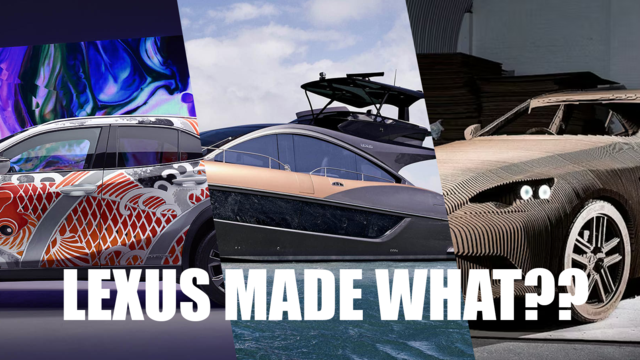
8 Weirdest Things Lexus Has Ever Built
Verdad Gallardo
10 Lexus Designs That Have Aged Like Fine Wine
Verdad Gallardo
Thread Starter
Lexus Fanatic
Joined: Oct 2003
Posts: 94,702
Likes: 290
From: Virginia/D.C. suburbs
Unless one is going to be a janitor on in a similar position at the plant, sweeping/mopping the floor at night, or emptying the trash, most auto-industry jobs are not semi-skilled or unskilled. It takes time to learn it correctly.


Lexus Fanatic
Joined: Nov 2011
Posts: 35,651
Likes: 426
From: ON/NY
I truly sense some underlying political themes and tones in specific wording and responses. Sort of like the debate forum. Seems like a total disregard to what is really happening out there. No respect for the facts.
I vote for closing this thread until and UAW/GM decision has been made. The reopening of it for concluding remarks when the deal has been made
I vote for closing this thread until and UAW/GM decision has been made. The reopening of it for concluding remarks when the deal has been made
Last edited by Toys4RJill; Oct 15, 2019 at 12:20 PM.
CL Community Team
Joined: Feb 2007
Posts: 9,432
Likes: 638
From: IL
(i)Unskilled:
An unskilled employee is one who does operations that involve the performance of simple duties, which require the experience of little of no independent judgment or previous experience although familiarity with the occupational environment is necessary. His work may thus require in addition to physical exertion familiarity with variety of articles or goods.
(ii)Semi-skilled:
A semiskilled worker is one who does work generally of defined routine nature wherein the major requirement is not so much of the judgment, skill and but for proper discharge of duties assigned to him or relatively narrow job and where important decisions made by others. His work is thus limited to the performance of routine operations of limited scope.
(iii)Skilled:
A skilled employee is one who is capable of working efficiently of exercising considerable independent judgement and of discharging his duties with responsibility. He must posses a thorough and comprehensive knowledge of the trade, craft or industry in which he is employed.
(iv)Highly Skilled:
A highly skilled worker is one who is capable of working efficiently and supervises efficiently the work of skilled employees.
An unskilled employee is one who does operations that involve the performance of simple duties, which require the experience of little of no independent judgment or previous experience although familiarity with the occupational environment is necessary. His work may thus require in addition to physical exertion familiarity with variety of articles or goods.
(ii)Semi-skilled:
A semiskilled worker is one who does work generally of defined routine nature wherein the major requirement is not so much of the judgment, skill and but for proper discharge of duties assigned to him or relatively narrow job and where important decisions made by others. His work is thus limited to the performance of routine operations of limited scope.
(iii)Skilled:
A skilled employee is one who is capable of working efficiently of exercising considerable independent judgement and of discharging his duties with responsibility. He must posses a thorough and comprehensive knowledge of the trade, craft or industry in which he is employed.
(iv)Highly Skilled:
A highly skilled worker is one who is capable of working efficiently and supervises efficiently the work of skilled employees.
"Automotive Technician" (Mechanic) is considered a semi-skilled position, and it requires significantly more experience and in-depth knowledge of how all of a car's systems function (and how they fail) than does repeatedly attaching the same part(s) on an assembly line. Other examples of semi-skilled jobs are carpenters and nurse's assistants.
If you're going to claim that assembly line work is a skilled profession requiring significant independent judgement, then we may as well stop now because we are not even speaking the same language.
O really. Due to uaw extortion thousands of auto workers were paid to do NOTHING but sit in rooms, for YEARS in the 2000s.
https://www.chicagotribune.com/news/...481-story.html
Guess that’s why millions of Americans buy cars made in germany, korea, japan, mexico, canada (oh right that doesn’t count), china, and on and on...
wasn’t your own Verano made in Germany, and your Lexus IS made in Japan? Heresy!
https://www.chicagotribune.com/news/...481-story.html
Second, the globalization of the American auto industry is what is in the greatest peril right now, not the UAW.....exporting of American auto jobs is no longer considered acceptable by not only the Union, but a growing majority of the public itself, and the representatives of the public in government. Third, the American auto companies are probably going to have a difficult time selling what is not produced here.....not only because of tariffs, but of the growing determination by the public to buy American.
wasn’t your own Verano made in Germany, and your Lexus IS made in Japan? Heresy!

Lexus Test Driver
Joined: Jan 2007
Posts: 7,460
Likes: 232
From: CA
O really. Due to uaw extortion thousands of auto workers were paid to do NOTHING but sit in rooms, for YEARS in the 2000s.
https://www.chicagotribune.com/news/...481-story.html
Guess that’s why millions of Americans buy cars made in germany, korea, japan, mexico, canada (oh right that doesn’t count), china, and on and on...
wasn’t your own Verano made in Germany, and your Lexus IS made in Japan? Heresy!
https://www.chicagotribune.com/news/...481-story.html
Guess that’s why millions of Americans buy cars made in germany, korea, japan, mexico, canada (oh right that doesn’t count), china, and on and on...
wasn’t your own Verano made in Germany, and your Lexus IS made in Japan? Heresy!
Lexus Champion
Joined: Apr 2007
Posts: 11,118
Likes: 123
From: Southeastern PA
It takes time to learn how to do any job. It takes time to learn how to make a latte; it takes time to learn how to work a cash register; it takes time to learn how to properly stock shelves; it takes time to learn how to work the floor waxer. You are using the term "unskilled" to mean that anyone can step into the job on day one and perform it as well as a 20 year veteran.