


A Tip For You While on Test-Drives


Thread Starter
Lexus Fanatic


Joined: Oct 2003
Posts: 94,207
Likes: 220
From: Virginia/D.C. suburbs
 A Tip For You While on Test-Drives
I know that, like me, there are a number of you here on this forum who are car enthusiasts or, for whatever reason, test-drive a number of different vehicles. I thought I'd share a little tip with you as to one thing to watch for, and be careful of, on the test-drive.
Automatic-transmission vehicles with console-mounted, stick-type shifters that offer a Sport/Manual-Shift mode often have a separate fore-aft shift-gate that is either to the left or the right (usually to the left in American-market, left-hand-drive vehicles). Some Chrysler-designed vehicles use a crosswise, left-right manual-shift gate instead of a fore-aft one. To shift up or down one gear, you usually bump or tap the shift lever forward or back to the (+) or (-) marking. The majority of newer cars have the markings with (+) ahead and (-) back to upshift or downshift. A few makes, though, including BMW, Mazda, and occasionally someone else, program the lever and markings in reverse......(-) ahead to downshift and (+) in back to upshift. To shift in the manual mode, this obviously requires that you look at the markings closely before you actually drive, as if you are used to doing it one way (as I tend to be with the forward (+) and back (-), even though I drive a lot of cars), it's easy sometimes to forget (or to forget and check beforehand), if you are in a reverse-programmed BMW or Mazda (although I already have enough trouble adapting to some of BMW's electronic console-shifters, even without that feature LOL).
If you do forget, of course (or forget to check beforehand), and accidentally bump the lever the wrong way, particularly at higher RPMs, the engine-transmission computer will probably not allow a shift to take place that would actually damage the engine by lugging it or over-redlining it. But, it still could, in some cases, cause a strong shock or jar to the drivetrain and motor-mounts if the vehicle doesn't have an automatic engine-rev-matching downshift feature (most automatics don't, but some do)...that's the automatic-equivalent to double-clutching or a heel-and-toe shift with a manual transmission.
One other thing that can sometimes happen, with this type of setup, to surprise you, is if the transmission is ready to (or just starting to) shift on its own, and then you suddenly switch it to the manual mode and give it an up or down-shift command. It will (sometimes) cause the engine to shift up or down two gears instead of one...and that, of course, can cause more of a shock to the drivetrain than you were expecting. That can also happen, in some cases, if you don't know what automatic gear you are actually in before you put it in the manual mode.
One thing I like about some Fiat automatics, particularly in the 500L (as I noted that when I did the 500L review) is that they have a display-mode with the gauges that always shows you what gear you are in at any given moment, even in full-automatic mode....most vehicles with automatics display the relevant gear only in the manual mode. With that feature on the Fiat automatics, it makes the guesswork and/or double-shifts I described less-lkely, as you know what gear you are in before you switch to manual. Unfortunately, I didn't think much of the rest of the 500L, but of course, that's another subject for another thread.
Of course, some vehicles have different patterns and hardware, like the new Chrysler 200/Land Rover/Jaguar shift-**** (or the older Jaguar J-pattern)...but what I have shown covers the majority of vehicles.
Typical (+/-) manual-pattern found on many vehicles
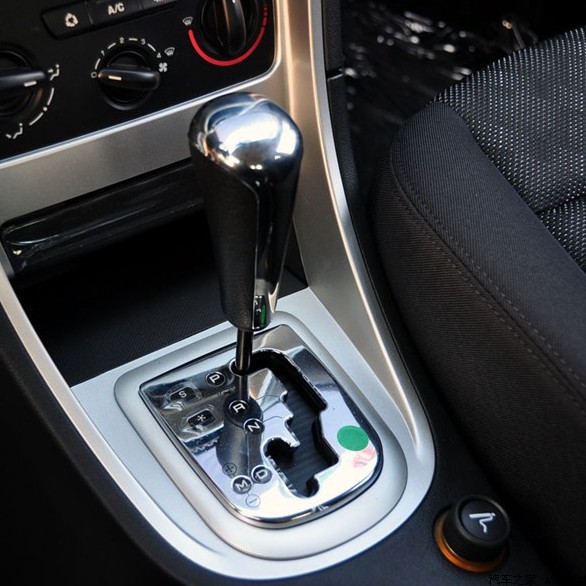
BMW-Type (-/+ ) electronic pattern

Mazda (-/+) manual-shift pattern

Chrysler (and older Mercedes) Sideways Auto-Stick pattern

Automatic-transmission vehicles with console-mounted, stick-type shifters that offer a Sport/Manual-Shift mode often have a separate fore-aft shift-gate that is either to the left or the right (usually to the left in American-market, left-hand-drive vehicles). Some Chrysler-designed vehicles use a crosswise, left-right manual-shift gate instead of a fore-aft one. To shift up or down one gear, you usually bump or tap the shift lever forward or back to the (+) or (-) marking. The majority of newer cars have the markings with (+) ahead and (-) back to upshift or downshift. A few makes, though, including BMW, Mazda, and occasionally someone else, program the lever and markings in reverse......(-) ahead to downshift and (+) in back to upshift. To shift in the manual mode, this obviously requires that you look at the markings closely before you actually drive, as if you are used to doing it one way (as I tend to be with the forward (+) and back (-), even though I drive a lot of cars), it's easy sometimes to forget (or to forget and check beforehand), if you are in a reverse-programmed BMW or Mazda (although I already have enough trouble adapting to some of BMW's electronic console-shifters, even without that feature LOL).
If you do forget, of course (or forget to check beforehand), and accidentally bump the lever the wrong way, particularly at higher RPMs, the engine-transmission computer will probably not allow a shift to take place that would actually damage the engine by lugging it or over-redlining it. But, it still could, in some cases, cause a strong shock or jar to the drivetrain and motor-mounts if the vehicle doesn't have an automatic engine-rev-matching downshift feature (most automatics don't, but some do)...that's the automatic-equivalent to double-clutching or a heel-and-toe shift with a manual transmission.
One other thing that can sometimes happen, with this type of setup, to surprise you, is if the transmission is ready to (or just starting to) shift on its own, and then you suddenly switch it to the manual mode and give it an up or down-shift command. It will (sometimes) cause the engine to shift up or down two gears instead of one...and that, of course, can cause more of a shock to the drivetrain than you were expecting. That can also happen, in some cases, if you don't know what automatic gear you are actually in before you put it in the manual mode.
One thing I like about some Fiat automatics, particularly in the 500L (as I noted that when I did the 500L review) is that they have a display-mode with the gauges that always shows you what gear you are in at any given moment, even in full-automatic mode....most vehicles with automatics display the relevant gear only in the manual mode. With that feature on the Fiat automatics, it makes the guesswork and/or double-shifts I described less-lkely, as you know what gear you are in before you switch to manual. Unfortunately, I didn't think much of the rest of the 500L, but of course, that's another subject for another thread.
Of course, some vehicles have different patterns and hardware, like the new Chrysler 200/Land Rover/Jaguar shift-**** (or the older Jaguar J-pattern)...but what I have shown covers the majority of vehicles.
Typical (+/-) manual-pattern found on many vehicles
BMW-Type (-/+ ) electronic pattern
Mazda (-/+) manual-shift pattern
Chrysler (and older Mercedes) Sideways Auto-Stick pattern
Last edited by mmarshall; Dec 8, 2015 at 05:27 PM.


Pit Crew


Joined: Dec 2015
Posts: 102
Likes: 79
From: CA
Thread Starter
Lexus Fanatic
Joined: Oct 2003
Posts: 94,207
Likes: 220
From: Virginia/D.C. suburbs
You're not the only one that feels that way. Some have argued that the Mazda/BMW pattern (-/+) is the natural one used in auto-shift racing. Most street drivers, though, who own and drive other brands are more used to the (+/-) pattern.
Thread Starter
Lexus Fanatic
Joined: Oct 2003
Posts: 94,207
Likes: 220
From: Virginia/D.C. suburbs

Porsche has described it best:
When you accelerate, you get pulled back. So, you pull the shifter back to upshift.
When you decelerate, you get pushed forward. So, you push the shifter forward to downshift.
For other automakers, the idea that (+) is up and (-) is down is just an idea of position (push up to upshift and pull down to downshift), not an ergonomic nor physical function.
When you accelerate, you get pulled back. So, you pull the shifter back to upshift.
When you decelerate, you get pushed forward. So, you push the shifter forward to downshift.
For other automakers, the idea that (+) is up and (-) is down is just an idea of position (push up to upshift and pull down to downshift), not an ergonomic nor physical function.


Trending Topics

Thread Starter
Lexus Fanatic
Joined: Oct 2003
Posts: 94,207
Likes: 220
From: Virginia/D.C. suburbs
 Are you seriously interested in a vehicle, actually have the money (or approved credit) for it, and they just are not interested in selling it to you, don't believe you can afford it, or, for whatever reason, just not allowing a test-drive?
Thread Starter
Lexus Fanatic
Joined: Oct 2003
Posts: 94,207
Likes: 220
From: Virginia/D.C. suburbs
In my Verano, for instance, although the engine makes some noise with increasing RPMs, the transmission is so smooth and quiet (most upshifts and some downshifts are almost undetectable by feel...after all, it is a Buick LOL), that, I often rely on the engine-tach and its characteristic needle-drop to detect and verify upshifts.
Last edited by mmarshall; Dec 9, 2015 at 06:15 PM.

Lead Lap


Joined: Apr 2002
Posts: 4,892
Likes: 14
From: Virginia
Perhaps so, but, for me, that feature is anything BUT a novelty. Steep hills, acceleration, slow stop-and-go-traffic, a heavily-loaded vehicle, etc....there are plenty of reasons for wanting to have manual control over even an automatic transmission. That's why automakers take the time, resources, and production costs to add this feature to their transmissions. As a driver, in most cases, you're going to constantly run into these conditions where you need (or want) the manual control....that, in my experience, is to something that changes with time.
In my Verano, for instance, although the engine makes some noise with increasing RPMs, the transmission is so smooth and quiet (most upshifts and some downshifts are almost undetectable by feel...after all, it is a Buick LOL), that, I often rely on the engine-tach and its characteristic needle-drop to detect and verify upshifts.
In my Verano, for instance, although the engine makes some noise with increasing RPMs, the transmission is so smooth and quiet (most upshifts and some downshifts are almost undetectable by feel...after all, it is a Buick LOL), that, I often rely on the engine-tach and its characteristic needle-drop to detect and verify upshifts.
Pit Crew
Joined: Dec 2015
Posts: 102
Likes: 79
From: CA
I'm in Sales, and the name of the game is to treat the customer right. So if they are being unwilling, then they don't deserve your business.
To make sure ANYBODY will take you seriously, have your financing ready. Meaning already pre approved, or you know your budget your possible payments and more or less the avg sales price of your model. This can all be done in less than 30 minutes.
This way you have the option to cut the sales speech to a cash over and a take it or leave it approach. A quick sale to move inventory and look good during the holiday rush is hard to pass up...
Hope this helps!

Thread
Thread Starter
Forum
Replies
Last Post
Blackraven
Car Chat
31
Jul 10, 2013 06:39 PM