


2015 Ford Mustang


Lexus Test Driver


Joined: Apr 2011
Posts: 8,386
Likes: 353
From: Las Vegas

You know, for the most part it seems like Ford has been really trying to wean consumers off of V8s by introducing Ecoboost options(note the V8 disappearing from the Explorer and now the Expedition).
It seems like a good way to do that here would have been to offer the 3.5.
Or perhaps they are trying to be true to the pony car heritage and not force the v8 out of the picture. In which case, I say HELL YEAH.
It seems like a good way to do that here would have been to offer the 3.5.
Or perhaps they are trying to be true to the pony car heritage and not force the v8 out of the picture. In which case, I say HELL YEAH.

Pricing information (BASE PRICING including $825 Destination & Delivery, Manual Transmission)
Also see: Order Guide (for detailed options/packages info)
Mustang V6 Fastback (050A) - $24,425
Mustang V6 Fastback (051A) - $25,420
Mustang ECOBOOST Fastback (100A) - $25,995
Mustang ECOBOOST Fastback (200A): $29,995
Mustang ECOBOOST Fastback (201A): $31,790
MUSTANG GT Fastback (300A) - $32,925
MUSTANG GT Premium Fastback (400A) - $36,925
MUSTANG GT Premium Fastback (401A) - $38,720
MUSTANG GT 50YR Limited Edition (500A) - $46,995
Options pricing:
Floor Mats - $85 retail
GT Performance PKG - $2,495 retail
Navigation - $795 retail
Recaros Leather - $1595 retail
Enhanced Security Package - $395
Enhanced Security Package $395
6-Speed Automatic Transmission $1195
3.55 Diff $395
Spare Wheel/Tire $195
Reverse Park Assist $295
Floor Mats $95
Recaros $1595
Wheel Stripe Package (Ecoboost) $895
18" Painted Aluminum Wheels (641) $155
ECOBOOST Performance Package (67E) $1995
Adaptive Cruise Control (52S) $1195
20" Machined Aluminum Wheels $1295
Premium Trim Package $295
Navigation $795
50th Anniversary Package $1595
19" Wheels $995 (GT)
GT Performance Package $2495
Dest and delivery - $825
Also see: Order Guide (for detailed options/packages info)
Mustang V6 Fastback (050A) - $24,425
Mustang V6 Fastback (051A) - $25,420
Mustang ECOBOOST Fastback (100A) - $25,995
Mustang ECOBOOST Fastback (200A): $29,995
Mustang ECOBOOST Fastback (201A): $31,790
MUSTANG GT Fastback (300A) - $32,925
MUSTANG GT Premium Fastback (400A) - $36,925
MUSTANG GT Premium Fastback (401A) - $38,720
MUSTANG GT 50YR Limited Edition (500A) - $46,995
Options pricing:
Floor Mats - $85 retail
GT Performance PKG - $2,495 retail
Navigation - $795 retail
Recaros Leather - $1595 retail
Enhanced Security Package - $395
Enhanced Security Package $395
6-Speed Automatic Transmission $1195
3.55 Diff $395
Spare Wheel/Tire $195
Reverse Park Assist $295
Floor Mats $95
Recaros $1595
Wheel Stripe Package (Ecoboost) $895
18" Painted Aluminum Wheels (641) $155
ECOBOOST Performance Package (67E) $1995
Adaptive Cruise Control (52S) $1195
20" Machined Aluminum Wheels $1295
Premium Trim Package $295
Navigation $795
50th Anniversary Package $1595
19" Wheels $995 (GT)
GT Performance Package $2495
Dest and delivery - $825

Lexus Champion
Joined: Apr 2011
Posts: 3,018
Likes: 0
From: CA™
Almost from the moment that Ford Mustang went on sale on April 17, 1964, it established its place in the automotive and cultural pantheon. With 22,000 sales and orders on the first day of availability and more than 9 million over the past 50 years Mustang has developed a worldwide following based on its visual presence, performance and accessibility.
Great sports cars are living, breathing machines that reflect both their drivers and their creators. Like a living organism, they must change and adapt or go extinct. As one of the few cars that has been in continuous production for 50 years, Mustang has adapted while retaining its essence.
Doyle Letson, chief designer interiors discusses the round gauges that have been part of Mustang DNA for 50 years.
Great sports cars are living, breathing machines that reflect both their drivers and their creators. Like a living organism, they must change and adapt or go extinct. As one of the few cars that has been in continuous production for 50 years, Mustang has adapted while retaining its essence.
Doyle Letson, chief designer interiors discusses the round gauges that have been part of Mustang DNA for 50 years.
Almost from the moment that Ford Mustang went on sale on April 17, 1964, it established its place in the automotive and cultural pantheon. With 22,000 sales and orders on the first day of availability and more than 9 million over the past 50 years Mustang has developed a worldwide following based on its visual presence, performance and accessibility.
Great sports cars are living, breathing machines that reflect both their drivers and their creators. Like a living organism, they must change and adapt or go extinct. As one of the few cars that has been in continuous production for 50 years, Mustang has adapted while retaining its essence.
Chris Svensson, design director, the Americas discusses the grille as the focal point of the face of Mustang.
Great sports cars are living, breathing machines that reflect both their drivers and their creators. Like a living organism, they must change and adapt or go extinct. As one of the few cars that has been in continuous production for 50 years, Mustang has adapted while retaining its essence.
Chris Svensson, design director, the Americas discusses the grille as the focal point of the face of Mustang.
Almost from the moment that Ford Mustang went on sale on April 17, 1964, it established its place in the automotive and cultural pantheon. With 22,000 sales and orders on the first day of availability and more than 9 million over the past 50 years Mustang has developed a worldwide following based on its visual presence, performance and accessibility.
Great sports cars are living, breathing machines that reflect both their drivers and their creators. Like a living organism, they must change and adapt or go extinct. As one of the few cars that has been in continuous production for 50 years, Mustang has adapted while retaining its essence.
Kemal Curic, exterior design manager discusses the forward-leaning shark-bite nose that has been characteristic of so many Mustangs over the past 50 years.
Great sports cars are living, breathing machines that reflect both their drivers and their creators. Like a living organism, they must change and adapt or go extinct. As one of the few cars that has been in continuous production for 50 years, Mustang has adapted while retaining its essence.
Kemal Curic, exterior design manager discusses the forward-leaning shark-bite nose that has been characteristic of so many Mustangs over the past 50 years.
Almost from the moment that Ford Mustang went on sale on April 17, 1964, it established its place in the automotive and cultural pantheon. With 22,000 sales and orders on the first day of availability and more than 9 million over the past 50 years Mustang has developed a worldwide following based on its visual presence, performance and accessibility.
Great sports cars are living, breathing machines that reflect both their drivers and their creators. Like a living organism, they must change and adapt or go extinct. As one of the few cars that has been in continuous production for 50 years, Mustang has adapted while retaining its essence.
Bill Mangan, interior design manager discusses the twin-brow instrument panel design that has been a staple element of many Mustangs over its 50 year history.
Great sports cars are living, breathing machines that reflect both their drivers and their creators. Like a living organism, they must change and adapt or go extinct. As one of the few cars that has been in continuous production for 50 years, Mustang has adapted while retaining its essence.
Bill Mangan, interior design manager discusses the twin-brow instrument panel design that has been a staple element of many Mustangs over its 50 year history.
Almost from the moment that Ford Mustang went on sale on April 17, 1964, it established its place in the automotive and cultural pantheon. With 22,000 sales and orders on the first day of availability and more than 9 million over the past 50 years Mustang has developed a worldwide following based on its visual presence, performance and accessibility.
Great sports cars are living, breathing machines that reflect both their drivers and their creators. Like a living organism, they must change and adapt or go extinct. As one of the few cars that has been in continuous production for 50 years, Mustang has adapted while retaining its essence.
Joel Piaskowski, design director, strategic design discusses the fastback roof profile of Mustang.
Great sports cars are living, breathing machines that reflect both their drivers and their creators. Like a living organism, they must change and adapt or go extinct. As one of the few cars that has been in continuous production for 50 years, Mustang has adapted while retaining its essence.
Joel Piaskowski, design director, strategic design discusses the fastback roof profile of Mustang.
Almost from the moment that Ford Mustang went on sale on April 17, 1964, it established its place in the automotive and cultural pantheon. With 22,000 sales and orders on the first day of availability and more than 9 million over the past 50 years Mustang has developed a worldwide following based on its visual presence, performance and accessibility.
Great sports cars are living, breathing machines that reflect both their drivers and their creators. Like a living organism, they must change and adapt or go extinct. As one of the few cars that has been in continuous production for 50 years, Mustang has adapted while retaining its essence.
Moray Callum, vice president, design, discusses the classic side scoop or "hockey stick" that has been a presence on many Mustangs of the past 50 years.
Great sports cars are living, breathing machines that reflect both their drivers and their creators. Like a living organism, they must change and adapt or go extinct. As one of the few cars that has been in continuous production for 50 years, Mustang has adapted while retaining its essence.
Moray Callum, vice president, design, discusses the classic side scoop or "hockey stick" that has been a presence on many Mustangs of the past 50 years.
Almost from the moment that Ford Mustang went on sale on April 17, 1964, it established its place in the automotive and cultural pantheon. With 22,000 sales and orders on the first day of availability and more than 9 million over the past 50 years Mustang has developed a worldwide following based on its visual presence, performance and accessibility.
Great sports cars are living, breathing machines that reflect both their drivers and their creators. Like a living organism, they must change and adapt or go extinct. As one of the few cars that has been in continuous production for 50 years, Mustang has adapted while retaining its essence.
Kemal Curic, exterior design manager, discusses one of the most distinctive visual characteristics of Mustang, the tri-bar taillamps.
Great sports cars are living, breathing machines that reflect both their drivers and their creators. Like a living organism, they must change and adapt or go extinct. As one of the few cars that has been in continuous production for 50 years, Mustang has adapted while retaining its essence.
Kemal Curic, exterior design manager, discusses one of the most distinctive visual characteristics of Mustang, the tri-bar taillamps.

 First 500 Ford Mustangs For Europe Sell Out In 30 Seconds

Ford recently opened up the order books for its 2015 Mustang in Europe, and within 30 seconds the first 500 cars destined for the old continent were snapped up. In an interesting move, Ford Motor Company [NYSE:F] opened up the order books during last weekend’s final for the UEFA Champions League, which saw Real Madrid CF beat Club Atlético de Madrid 4-1 after extra time. It proved successful, with more than 9,300 orders garnered from Mustang fans hopeful to be among the first 500 owners of the sixth-generation pony car in Europe.
The 500 new Mustangs were allocated across 20 countries. Ford will in the next few weeks contact the buyers from each of these countries who were quickest to place their reservation to let them know they have been successful. Each buyer will then be invited to complete their order at a dealership later this year but will have to wait until 2015 for delivery. Deliveries here are expected to start this fall.
Ford limited the first 500 examples to either Race Red for buyers interested in the coupe or Magnetic Silver for the convertible. The buyers also have to choose from either the Mustang EcoBoost model or Mustang GT. The base Mustang equipped with a V-6 won’t be offered in Europe.
All 500 examples will feature Ford’s latest SYNC system; navigation; heated and ventilated seats; Park Assist; black leather trim; chrome detailing; and 19-inch alloy wheels.
This is the first time in the Mustang's 50-year history that the car is being sold in Europe by Ford. Previous generations were typically sold in limited numbers by third party importers.
The 500 new Mustangs were allocated across 20 countries. Ford will in the next few weeks contact the buyers from each of these countries who were quickest to place their reservation to let them know they have been successful. Each buyer will then be invited to complete their order at a dealership later this year but will have to wait until 2015 for delivery. Deliveries here are expected to start this fall.
Ford limited the first 500 examples to either Race Red for buyers interested in the coupe or Magnetic Silver for the convertible. The buyers also have to choose from either the Mustang EcoBoost model or Mustang GT. The base Mustang equipped with a V-6 won’t be offered in Europe.
All 500 examples will feature Ford’s latest SYNC system; navigation; heated and ventilated seats; Park Assist; black leather trim; chrome detailing; and 19-inch alloy wheels.
This is the first time in the Mustang's 50-year history that the car is being sold in Europe by Ford. Previous generations were typically sold in limited numbers by third party importers.



Lexus Test Driver
Joined: Apr 2011
Posts: 8,386
Likes: 353
From: Las Vegas

Formerly Bad Co
Joined: Dec 2013
Posts: 1,041
Likes: 0
From: Chicago
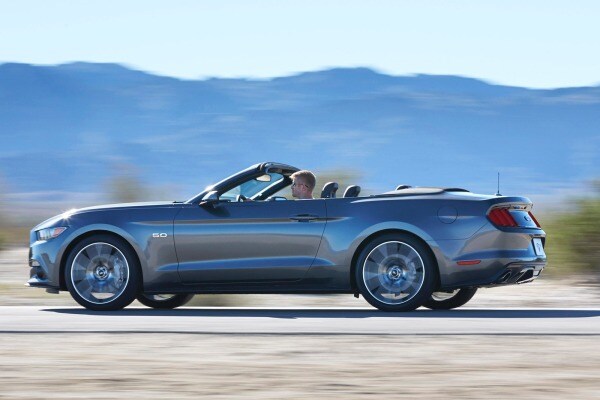
2015 Ford Mustang Convertible Is Rarity in Dwindling Drop Top Segment
Just the Facts:
SANTA MONICA, California — Despite such high-profile drop tops as the 2015 Ford Mustang Convertible and 2015 Chevrolet Corvette Stingray Convertible, American consumers are lukewarm about the segment, Edmunds has found.
Jeremy Acevedo, Edmunds supervisor of price and industry analysis, blames America's fascination with sport-utility vehicles for the fading interest in convertibles, as well as sticker shock.
"When you look at a lot of these vehicles, they are very expensive," Acevedo said.
Convertible interest is in a downward spiral.
Last year, domestic and imported convertibles combined accounted for a sliver less than 1 percent of all vehicle registrations, a mere 151,789 vehicles, slipping from 1.37 percent five years earlier, according to IHS Automotive/Polk vehicle registrations.
Market share slid further during the January through March period this year to 0.84 percent, compared to 0.91 percent for the same period in 2013.
Acevedo said: "Cost is definitely one reason" for the decline.
"With Mustang, for example, you are looking at a $5,000 premium to go from a (base) coupe to a convertible and $7,500 for the Camaro," he said.
The base 2014 Mustang coupe stickers for $23,335, compared to $28,335 for the convertible. Both prices include an $825 destination charge. The 2015 Ford Mustang coupe starts at $24,425, including an $825 destination charge, but Ford has not yet announced 2015 Mustang convertible pricing.
The base 2014 Chevrolet Camaro coupe is priced at $24,550 and $32,050 for the base convertible. Both prices include a $995 destination charge.
For Ford and Chevrolet, each convertible is far from being a big seller. Ford sold approximately 77,200 Mustangs last year, of which about 10,000 were convertibles. Chevrolet sold about 9,700 convertibles out of a total of 80,500 Camaros.
Convertibles also are marketed by Aston Martin, Audi, Bentley, BMW, Chrysler, Ferrari, Fiat, Infiniti, Jaguar, Lamborghini, Lexus, Maserati, Mazda, McLaren, Mercedes-Benz, Mini, Nissan, Porsche, Rolls-Royce, Smart and Volkswagen.
While market share has slipped in the past five years, so has the number of convertible offerings. There are 43 models for the 2014 model year, down from 51 in 2009.
Detroit's automakers barely have their toe in the water. Just four convertible models are offered, including the Corvette Stingray and the 2014 Chrysler 200, a far cry from the 1960s when nearly every brand marketed ragtops in as many as three dimensions: compact, intermediate and full size. The U.S model count is expected to slip to three for the 2015 model year, as Chrysler drops the 200 convertible.
Another reason for the decline in convertibles is the growing popularity of sport-utility vehicles, which offer all-wheel drive for inclement weather and highly flexible, functional interior space.
"People are buying things that are a little bit more pragmatic," Acevedo said. "Coupes are becoming less popular and so convertibles, which are even less practical in a lot of ways than a coupe, are certainly feeling that."
Although the convertible market is small, there is little to no chance convertibles will disappear from the U.S. market, said Tom Libby, manager of loyalty solutions and industry analysis at IHS Automotive.
"The high-end BMW, Mercedes models I think will always be there," Libby said. "There is a market and it is small but the buyer is very, very (wealthy) and willing to pay for it."
Edmunds says: With such poor sales, the likelihood of additional, mainstream convertible models is remote at best.
- Despite such high-profile drop tops as the 2015 Ford Mustang Convertible and 2015 Chevrolet Corvette Stingray Convertible, American consumers are lukewarm about the segment, Edmunds has found.
- Jeremy Acevedo, Edmunds supervisor of price and industry analysis, blames America's fascination with sport-utility vehicles for the fading interest in convertibles, as well as sticker shock.
- Last year, domestic and imported convertibles combined accounted for a sliver less than 1 percent of all vehicle registrations, a mere 151,789 vehicles, slipping from 1.37 percent five years earlier, according to IHS Automotive/Polk vehicle registrations.
SANTA MONICA, California — Despite such high-profile drop tops as the 2015 Ford Mustang Convertible and 2015 Chevrolet Corvette Stingray Convertible, American consumers are lukewarm about the segment, Edmunds has found.
Jeremy Acevedo, Edmunds supervisor of price and industry analysis, blames America's fascination with sport-utility vehicles for the fading interest in convertibles, as well as sticker shock.
"When you look at a lot of these vehicles, they are very expensive," Acevedo said.
Convertible interest is in a downward spiral.
Last year, domestic and imported convertibles combined accounted for a sliver less than 1 percent of all vehicle registrations, a mere 151,789 vehicles, slipping from 1.37 percent five years earlier, according to IHS Automotive/Polk vehicle registrations.
Market share slid further during the January through March period this year to 0.84 percent, compared to 0.91 percent for the same period in 2013.
Acevedo said: "Cost is definitely one reason" for the decline.
"With Mustang, for example, you are looking at a $5,000 premium to go from a (base) coupe to a convertible and $7,500 for the Camaro," he said.
The base 2014 Mustang coupe stickers for $23,335, compared to $28,335 for the convertible. Both prices include an $825 destination charge. The 2015 Ford Mustang coupe starts at $24,425, including an $825 destination charge, but Ford has not yet announced 2015 Mustang convertible pricing.
The base 2014 Chevrolet Camaro coupe is priced at $24,550 and $32,050 for the base convertible. Both prices include a $995 destination charge.
For Ford and Chevrolet, each convertible is far from being a big seller. Ford sold approximately 77,200 Mustangs last year, of which about 10,000 were convertibles. Chevrolet sold about 9,700 convertibles out of a total of 80,500 Camaros.
Convertibles also are marketed by Aston Martin, Audi, Bentley, BMW, Chrysler, Ferrari, Fiat, Infiniti, Jaguar, Lamborghini, Lexus, Maserati, Mazda, McLaren, Mercedes-Benz, Mini, Nissan, Porsche, Rolls-Royce, Smart and Volkswagen.
While market share has slipped in the past five years, so has the number of convertible offerings. There are 43 models for the 2014 model year, down from 51 in 2009.
Detroit's automakers barely have their toe in the water. Just four convertible models are offered, including the Corvette Stingray and the 2014 Chrysler 200, a far cry from the 1960s when nearly every brand marketed ragtops in as many as three dimensions: compact, intermediate and full size. The U.S model count is expected to slip to three for the 2015 model year, as Chrysler drops the 200 convertible.
Another reason for the decline in convertibles is the growing popularity of sport-utility vehicles, which offer all-wheel drive for inclement weather and highly flexible, functional interior space.
"People are buying things that are a little bit more pragmatic," Acevedo said. "Coupes are becoming less popular and so convertibles, which are even less practical in a lot of ways than a coupe, are certainly feeling that."
Although the convertible market is small, there is little to no chance convertibles will disappear from the U.S. market, said Tom Libby, manager of loyalty solutions and industry analysis at IHS Automotive.
"The high-end BMW, Mercedes models I think will always be there," Libby said. "There is a market and it is small but the buyer is very, very (wealthy) and willing to pay for it."
Edmunds says: With such poor sales, the likelihood of additional, mainstream convertible models is remote at best.
Ford Mustang pricing favors turbocharged engine

Ford's pricing for the new 2015 Mustang almost assures that the turbocharged engine -- possibly a hard-to-swallow option for pony car purists -- will be a hit.
While the base price for the Mustang with a V-6 engine is $24,425 plus delivery charges, the turbocharged EcoBoost version starts at only $1,570 more, according to a pricing sheet leaked by a dealer to a Mustang fan website. The report hasn't been denied, or confirmed, by Ford.
If the EcoBoost engine saves at least three or four miles per gallon over the conventional engine with little penalty in performance, it will be an easy choice for most buyers. Embracing a turbo would be a huge move for Mustang buyers, who are notoriously hidebound lot. But then again, so were pickup truck buyers, and they have moved in droves to Ford's turbocharged engine in the F-150.
At the high end of the market, Mustang will top out at $46,995 for the 50th anniversary limited edition. That's a big jump from the GT Premium fastback at $38,720. Some of the same elements of the 50th anniversary edition, too, are available in a special package for $1,595, according to the pricing sheet.
There are other interesting options as well. Ruby red paint tacks on $395 and "triple yellow" is $495.
While the base price for the Mustang with a V-6 engine is $24,425 plus delivery charges, the turbocharged EcoBoost version starts at only $1,570 more, according to a pricing sheet leaked by a dealer to a Mustang fan website. The report hasn't been denied, or confirmed, by Ford.
If the EcoBoost engine saves at least three or four miles per gallon over the conventional engine with little penalty in performance, it will be an easy choice for most buyers. Embracing a turbo would be a huge move for Mustang buyers, who are notoriously hidebound lot. But then again, so were pickup truck buyers, and they have moved in droves to Ford's turbocharged engine in the F-150.
At the high end of the market, Mustang will top out at $46,995 for the 50th anniversary limited edition. That's a big jump from the GT Premium fastback at $38,720. Some of the same elements of the 50th anniversary edition, too, are available in a special package for $1,595, according to the pricing sheet.
There are other interesting options as well. Ruby red paint tacks on $395 and "triple yellow" is $495.
 WardsAuto Says New Four-Cylinder Ford Mustang Feels Gutsy from the Passenger Side

We're not aware of any publication having (officially, because unofficially, you never know…) spent time behind the wheel of the most intriguing version of the 2015 Ford Mustang, the one with the 2.3-liter turbocharged inline-four, but WardsAuto had the chance to take a shotgun ride in the car during a recent Ford Performance event at the Charlotte Motor Speedway.
Their first impressions from the passenger seat where that "the all-new 2.3L EcoBoost sounds and feels convincing enough, propelling the car with gusto through three laps on a short handling track about the size of a football field in the Charlotte Motor Speedway parking lot".
Ford has said that the 2.3-liter EcoBoost unit that is derived from the 2.0-liter EcoBoost employed in a number of Blue Oval models including the Focus ST will deliver more than 305hp and 300 lb-ft of torque (406 Nm), placing it above the base 3.7-liter V6 that will produce “at least” 300hp and 270 lb-ft (366Nm).
Mustang Vehicle Engineering Manager Tom Barnes told the site that the first four-cylinder engine to be offered in Ford's pony car in 21 years "will not tarnish the car’s performance pedigree".
He said the engine is "really amped up" over the 2.0L turbo with the development team having paid special attention to its torque figures. "It’s flat across at 100%,” said Barnes. “We wanted to make the torque available early on, and we got that.”
The 2.3L unit will be available with tweaked versions of the 2.0L's automatic and manual gearboxes, while Ford has confirmed the use of a similar system to the electronically controlled “sound symposer” found in the Fiesta and Focus ST to augment throaty intake and deliver a better sound.
Barnes said that, while it won't be as satisfying to hear as the V8, it should please fans. “Sound is hugely important in the Mustang – there’s emotional response,” he says. “We are paying close attention to making sure the experience is right. We didn’t go for something that’s just, ‘Zing zing!’ We wanted it to be Mustang, so we actually have low-frequency sound. But it’s not like we are trying to fake it out. It’s not a V-8.”
As for WardsAuto's shotgun rider, he found the engine to sound "plenty aggressive and resonates more deeply than just about any other mainstream 4-cyl. engine on the road today".
Their first impressions from the passenger seat where that "the all-new 2.3L EcoBoost sounds and feels convincing enough, propelling the car with gusto through three laps on a short handling track about the size of a football field in the Charlotte Motor Speedway parking lot".
Ford has said that the 2.3-liter EcoBoost unit that is derived from the 2.0-liter EcoBoost employed in a number of Blue Oval models including the Focus ST will deliver more than 305hp and 300 lb-ft of torque (406 Nm), placing it above the base 3.7-liter V6 that will produce “at least” 300hp and 270 lb-ft (366Nm).
Mustang Vehicle Engineering Manager Tom Barnes told the site that the first four-cylinder engine to be offered in Ford's pony car in 21 years "will not tarnish the car’s performance pedigree".
He said the engine is "really amped up" over the 2.0L turbo with the development team having paid special attention to its torque figures. "It’s flat across at 100%,” said Barnes. “We wanted to make the torque available early on, and we got that.”
The 2.3L unit will be available with tweaked versions of the 2.0L's automatic and manual gearboxes, while Ford has confirmed the use of a similar system to the electronically controlled “sound symposer” found in the Fiesta and Focus ST to augment throaty intake and deliver a better sound.
Barnes said that, while it won't be as satisfying to hear as the V8, it should please fans. “Sound is hugely important in the Mustang – there’s emotional response,” he says. “We are paying close attention to making sure the experience is right. We didn’t go for something that’s just, ‘Zing zing!’ We wanted it to be Mustang, so we actually have low-frequency sound. But it’s not like we are trying to fake it out. It’s not a V-8.”
As for WardsAuto's shotgun rider, he found the engine to sound "plenty aggressive and resonates more deeply than just about any other mainstream 4-cyl. engine on the road today".
2015 Ford Mustang is 200-300 lbs heavier than predecessor - report

GT could weigh almost 4,000 lbs
According to a blog post from Steeda, the 2015 Ford Mustang has gained 200-300 lbs compared to the outgoing model.
Steeda is a company that produces and commercializes Mustang parts in the United States and in one of their recent blog posts they talked about development of the new pony car. They say weight is up by 200-300 lbs (91-136 kg) which is a worrying figure taking into account we are dealing with a sports car and we all know weight is the enemy.
Ford hasn't released final specifications for the 2015 Mustang even though the car was revealed back in December last year and it is set to go on sale this fall in United States and Europe. Some of that weight is justifiable by the new rear independent suspension but it will be a bit difficult to sell an almost 4,000 lbs Mustang GT. Maybe Ford's engineers worked their magic and managed somehow to offset the added weight.
As a reminder, the new Mustang will be available with a V6 3.7-liter developing at least 300 bhp (223 kW), a 4-cylinder 2.3-liter EcoBoost with more than 305 bhp (227 kW) and a larger V8 5.0-liter with at least 420 bhp (313 kW) in the GT derivative.
According to a blog post from Steeda, the 2015 Ford Mustang has gained 200-300 lbs compared to the outgoing model.
Steeda is a company that produces and commercializes Mustang parts in the United States and in one of their recent blog posts they talked about development of the new pony car. They say weight is up by 200-300 lbs (91-136 kg) which is a worrying figure taking into account we are dealing with a sports car and we all know weight is the enemy.
Ford hasn't released final specifications for the 2015 Mustang even though the car was revealed back in December last year and it is set to go on sale this fall in United States and Europe. Some of that weight is justifiable by the new rear independent suspension but it will be a bit difficult to sell an almost 4,000 lbs Mustang GT. Maybe Ford's engineers worked their magic and managed somehow to offset the added weight.
As a reminder, the new Mustang will be available with a V6 3.7-liter developing at least 300 bhp (223 kW), a 4-cylinder 2.3-liter EcoBoost with more than 305 bhp (227 kW) and a larger V8 5.0-liter with at least 420 bhp (313 kW) in the GT derivative.