



Self-Driving Vehicles

Tesla could pull the data and say this is what happened and when. For Toyota, it was in the news for longer because they didn't have this information and had to do a thorough investigation. Plus all the ongoing lawsuits like SW17LS mentioned

Driver School Candidate
Joined: Mar 2018
Posts: 4
Likes: 0
From: Texas
They are coming really fast in fact! I read that there even will be self driving homes instead of "normal" houses, information from this article. The reasons: they are much cheaper comparing to houses/apartments and many people like to travel freely, without being tight to one place. I would like to have such a self driving RV for travelling around, but to live...it's a bit extreme I think.
https://www.usatoday.com/story/tech/...ers/397123002/
SAN FRANCISCO — Uber has been sending self-driving trucks on delivery runs across Arizona since November, the first step in what promises to be a freight transportation revolution that could radically reshape the jobs of long-haul truckers.
After testing its technology earlier in 2017, Uber began contracting with trucking companies to use its own autonomous Volvo big rigs to take over loads as they traverse the state, it disclosed.
In Uber‘s current program, human truckers meet the self-driving truck at the Arizona border, which then takes their load across the state and hands it off to another human trucker. An Uber employee rides in the driver seat during the autonomous trip.
If one day both the technology and regulations play out in favor of self-driving trucks, two scenarios emerge.
The first would find self-driving trucks handling long-haul highway legs with no one at the wheel as they meet up with human truckers who then handle deliveries into city centers. The other possibility is Uber selling its technology to trucking owner-operators who then leverage it to sleep while the truck handles the bulk of long-distance driving.
Truckers make their money only when their rigs are on the road. They are also limited by law in terms of how much time they can spend behind the wheel, something a self-driving truck could impact positively.
"The big step for us recently is that we can plan to haul goods in both directions, using Uber Freight to coordinate load pickups and dropoffs with local truckers," said Alden Woodrow, who leads Uber's self- driving truck effort. "Keeping trucking local allows these drivers to make money while staying closer to home."
More: Why Uber and Lyft want to take you to the hospital
More: Uber, Lyft drivers actually earn less than minimum wage, MIT survey suggests
Uber Freight, which launched last May, is an app that matches shippers with loads using technology drawn from Uber's ride-hailing app. Typically such trucking logistics have been coordinated through phone calls and emails.
Uber isn't alone in its pursuit of self-driving truck technology, with startups such as Embark joining companies such as Tesla and its new Tesla Semi to carve out a slice of a $700 billion industry that moves 70% of all domestic freight, according to the American Trucking Association.
Despite the push, the technology behind self-driving trucks remains in its infancy, with hurdles that include government regulations and trucker buy-in.
Given that truckers only make money only when their rigs are on the road, the business model gives them incentive to drive as long as possible. A truck that makes the long hauls between exits, allowing a driver to sleep in the cab, could increase their profit. But they'd have to trust the technology, as well as fork over what promises to be a considerable investment to make their cabs autonomous.
Woodrow says Uber's trucking plans remain in development, but he does not see the company running a fleet of self-driving trucks — which would imply that its technology would be available for purchase from large established shipping companies.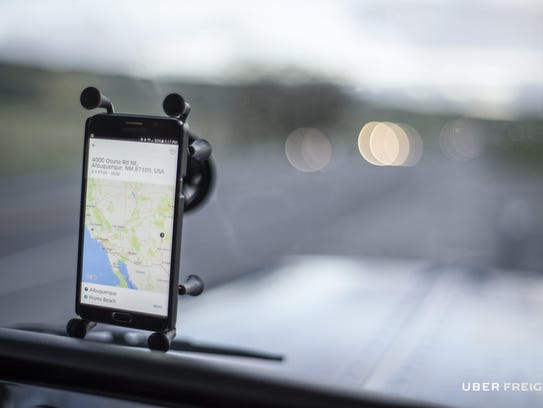 Uber Freight, an app that connects drivers with loads, is expanding nationally. (Photo: Uber Freight)
"Today we're operating our own trucks, but in the future it remains to be seen what happens," he says. "Trucking is a very large and sophisticated business with a lot of companies in the value chain who are good at what they do. So our desire is to partner."
Instead, Uber's Volvo trucks are given loads at border weigh stations. These trucks are equipped with hardware, software and an array of sensors developed by Uber's Advanced Technologies Group that help the truck make what amounts to a glorified cruise-control run across the state. Uber ATG also is behind ongoing self-driving car testing in Arizona, Pennsylvania and San Francisco.
Uber did not disclose what items it is transporting for which companies.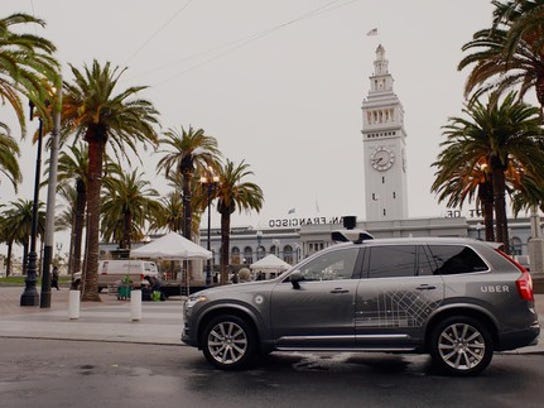 Uber deployed prototype self-driving Volvos in San Francisco in late 2016. (Photo: Volvo Cars)
Once the Uber trucks exit at the next highway hub near the Arizona border, they are met by a different set of truckers who hitch the trailer to own their cab to finish the delivery.
The idea is that truckers get to go home to their families instead of being on the road. In a video Uber created to tout the program, the company showcases a California trucker who, once at the Arizona border, hands his trailer over to an Uber self-driving truck for its trip east, while picking up a different load that needs to head back to California.
Autonomous vehicles are being pursued by dozens of companies ranging from large automakers to technology startups. Slowly, states are adapting their rules to try and be on the front lines of a potential transportation shift.
Michigan, California and Arizona, for example, have been constantly updating their autonomous car testing laws in order to court companies working on such tech. California recently joined Arizona in announcing that it would allow self-driving cars to be tested without a driver at the wheel.
Skeptics of the self-driving gold rush include the Consumer Watchdog Group's John Simpson, who in a recent letter to lawmakers said “any autonomous vehicle legislation should require a human driver behind a steering wheel capable of taking control."
Waymo's suit argued that Uber was building light detection and ranging sensors — roof-top lasers that help vehicles interpret their surroundings — based on trade secrets stolen by Anthony Levandowski, who left Waymo to start a self-driving truck company called Otto. Months after its creation in early 2016, Uber bought Otto for around $680 million. Uber's trucks only complete highway runs, meeting local truck drivers at hubs by exits in order to transfer their goods for local delivery. (Photo: Gregory Murphy)
Last year, Travis Kalanick, the Uber CEO who negotiated the deal with Levandowski, was ousted from the company he co-founded after a rash of bad publicity surrounding charges that Uber ran a sexist operation that often skirted the law. Levandowski was fired by Uber after he repeatedly declined to answer questions from Waymo's lawyers.
In settling the suit, Uber had to give Waymo $245 million in equity but it did not admit guilt. Uber has long maintained that its LiDAR was built with its own engineering know-how.
"Our trucks do not run on the same self-driving (technology) as Otto trucks did," says Woodrow. "It's Uber tech, and we're improving on it all the time."
Follow USA TODAY transportation tech writer Marco della Cava on Twitter.
Uber trucks start shuttling goods across Arizona — by themselves
SAN FRANCISCO — Uber has been sending self-driving trucks on delivery runs across Arizona since November, the first step in what promises to be a freight transportation revolution that could radically reshape the jobs of long-haul truckers.
After testing its technology earlier in 2017, Uber began contracting with trucking companies to use its own autonomous Volvo big rigs to take over loads as they traverse the state, it disclosed.
In Uber‘s current program, human truckers meet the self-driving truck at the Arizona border, which then takes their load across the state and hands it off to another human trucker. An Uber employee rides in the driver seat during the autonomous trip.
If one day both the technology and regulations play out in favor of self-driving trucks, two scenarios emerge.
The first would find self-driving trucks handling long-haul highway legs with no one at the wheel as they meet up with human truckers who then handle deliveries into city centers. The other possibility is Uber selling its technology to trucking owner-operators who then leverage it to sleep while the truck handles the bulk of long-distance driving.
Truckers make their money only when their rigs are on the road. They are also limited by law in terms of how much time they can spend behind the wheel, something a self-driving truck could impact positively.
"The big step for us recently is that we can plan to haul goods in both directions, using Uber Freight to coordinate load pickups and dropoffs with local truckers," said Alden Woodrow, who leads Uber's self- driving truck effort. "Keeping trucking local allows these drivers to make money while staying closer to home."
More: Why Uber and Lyft want to take you to the hospital
More: Uber, Lyft drivers actually earn less than minimum wage, MIT survey suggests
Uber Freight, which launched last May, is an app that matches shippers with loads using technology drawn from Uber's ride-hailing app. Typically such trucking logistics have been coordinated through phone calls and emails.
Uber isn't alone in its pursuit of self-driving truck technology, with startups such as Embark joining companies such as Tesla and its new Tesla Semi to carve out a slice of a $700 billion industry that moves 70% of all domestic freight, according to the American Trucking Association.
Despite the push, the technology behind self-driving trucks remains in its infancy, with hurdles that include government regulations and trucker buy-in.
Given that truckers only make money only when their rigs are on the road, the business model gives them incentive to drive as long as possible. A truck that makes the long hauls between exits, allowing a driver to sleep in the cab, could increase their profit. But they'd have to trust the technology, as well as fork over what promises to be a considerable investment to make their cabs autonomous.
Woodrow says Uber's trucking plans remain in development, but he does not see the company running a fleet of self-driving trucks — which would imply that its technology would be available for purchase from large established shipping companies.
Uber Freight, an app that connects drivers with loads, is expanding nationally. (Photo: Uber Freight)"Today we're operating our own trucks, but in the future it remains to be seen what happens," he says. "Trucking is a very large and sophisticated business with a lot of companies in the value chain who are good at what they do. So our desire is to partner."
Uber's trucks stick to the highway
Uber's current Arizona pilot program does not feature trucks making end-to-end runs from pick-up to delivery because it’s tough to make huge trucks navigate urban traffic on their own.Instead, Uber's Volvo trucks are given loads at border weigh stations. These trucks are equipped with hardware, software and an array of sensors developed by Uber's Advanced Technologies Group that help the truck make what amounts to a glorified cruise-control run across the state. Uber ATG also is behind ongoing self-driving car testing in Arizona, Pennsylvania and San Francisco.
Uber did not disclose what items it is transporting for which companies.
Uber deployed prototype self-driving Volvos in San Francisco in late 2016. (Photo: Volvo Cars)Once the Uber trucks exit at the next highway hub near the Arizona border, they are met by a different set of truckers who hitch the trailer to own their cab to finish the delivery.
The idea is that truckers get to go home to their families instead of being on the road. In a video Uber created to tout the program, the company showcases a California trucker who, once at the Arizona border, hands his trailer over to an Uber self-driving truck for its trip east, while picking up a different load that needs to head back to California.
Autonomous vehicles are being pursued by dozens of companies ranging from large automakers to technology startups. Slowly, states are adapting their rules to try and be on the front lines of a potential transportation shift.
Michigan, California and Arizona, for example, have been constantly updating their autonomous car testing laws in order to court companies working on such tech. California recently joined Arizona in announcing that it would allow self-driving cars to be tested without a driver at the wheel.
Skeptics of the self-driving gold rush include the Consumer Watchdog Group's John Simpson, who in a recent letter to lawmakers said “any autonomous vehicle legislation should require a human driver behind a steering wheel capable of taking control."
Uber refocuses after lawsuit
Uber's announcement aims to cast a positive light on the company's trucking efforts, and comes a few weeks after it settled a contentious year-old lawsuit brought by Waymo, the name of Google's self-driving car program.Waymo's suit argued that Uber was building light detection and ranging sensors — roof-top lasers that help vehicles interpret their surroundings — based on trade secrets stolen by Anthony Levandowski, who left Waymo to start a self-driving truck company called Otto. Months after its creation in early 2016, Uber bought Otto for around $680 million.
Uber's trucks only complete highway runs, meeting local truck drivers at hubs by exits in order to transfer their goods for local delivery. (Photo: Gregory Murphy)Last year, Travis Kalanick, the Uber CEO who negotiated the deal with Levandowski, was ousted from the company he co-founded after a rash of bad publicity surrounding charges that Uber ran a sexist operation that often skirted the law. Levandowski was fired by Uber after he repeatedly declined to answer questions from Waymo's lawyers.
In settling the suit, Uber had to give Waymo $245 million in equity but it did not admit guilt. Uber has long maintained that its LiDAR was built with its own engineering know-how.
"Our trucks do not run on the same self-driving (technology) as Otto trucks did," says Woodrow. "It's Uber tech, and we're improving on it all the time."
Follow USA TODAY transportation tech writer Marco della Cava on Twitter.
No wonder Uber is pushing those "self driving" trucks. I'm sure other companies will try to capitalize on this as well. They will push the government to allow for these "self driving" trucks to be "supervised" by people that won't require CDL and allow for these trucks to be driven 24/7 instead of current shift limits. The industry will get flooded by unqualified drivers willing to work for pennies.
(moderator - you should at least add the article topic even if it's in the url)..
Uber halts self-driving tests after pedestrian killed in Arizona
A woman was killed early Monday morning in Tempe
https://www.theverge.com/2018/3/19/1...-tempe-arizona
I wonder if the driver of the so called "self driving" car is going to be charged.
Uber halts self-driving tests after pedestrian killed in Arizona
A woman was killed early Monday morning in Tempe
https://www.theverge.com/2018/3/19/1...-tempe-arizona
I wonder if the driver of the so called "self driving" car is going to be charged.
Last edited by bitkahuna; Mar 19, 2018 at 11:13 AM.
To kind of answer my own question, it is unlikely that the lawyers are going to go after the driver, since there isn't much to gain from him. Most likely they are going to go after Uber, being that it is a multi billion dollar corporation.

Lexus Test Driver


Joined: Sep 2016
Posts: 8,574
Likes: 390
From: PA
Could be anything, but if they determine that it wasn't the pedestrians fault, are they going to charge the driver or he's off free because the car was "self driving"?
To kind of answer my own question, it is unlikely that the lawyers are going to go after the driver, since there isn't much to gain from him. Most likely they are going to go after Uber, being that it is a multi billion dollar corporation.
To kind of answer my own question, it is unlikely that the lawyers are going to go after the driver, since there isn't much to gain from him. Most likely they are going to go after Uber, being that it is a multi billion dollar corporation.
The way that they have said, "No human can shift that fast," when referring to a dual clutch auto, what if, self driving cars can do things such that other human drivers cannot know what they are doing? If the road has 56/100 of 1% autonomous vehicles, and the other 99.9944% are normal vehicles, then it's up to the minute minority to prove itself, not the other way around. It's up to what is today, the minority, to integrate to the road conditions, not the other way around. Otherwise, why not have drones darting in and out of slow moving traffic and then when there's a crash, say it's not the drone's fault...

Lexus Fanatic


Joined: Oct 2003
Posts: 94,328
Likes: 236
From: Virginia/D.C. suburbs
Could be anything, but if they determine that it wasn't the pedestrians fault, are they going to charge the driver or he's off free because the car was "self driving"?
To kind of answer my own question, it is unlikely that the lawyers are going to go after the driver, since there isn't much to gain from him. Most likely they are going to go after Uber, being that it is a multi billion dollar corporation.
To kind of answer my own question, it is unlikely that the lawyers are going to go after the driver, since there isn't much to gain from him. Most likely they are going to go after Uber, being that it is a multi billion dollar corporation.
From the article, it sounds like she was Jaywalking (or Jay-riding a bicycle) way outside of a marked crosswalk. I'm no defender of self-driving vehicles by any means, but it also needs to be pointed out that jaywalking laws exist for a reason....and a cop can ticket you for it.
ClubLexus Stories
Celebrating Lexus & Toyota from Around the Globe
8 Tips for Improving Your Hybrid or Plug-in Hybrid's Efficiency!
Michael S. Palmer
10 Best Lexus Models No One Remembers
Joe Kucinski
TRD Off-Road Premium: Best 2026 4Runner, Except This One Thing
Michael S. Palmer
Top 10 Lexus & Toyotas to Drive Before You Die!
Joe Kucinski
Top 10 Lexus/Toyotas With The LEAST 5-Year Depreciation
Joe Kucinski
Lexus LC500 Convertible Auction: A Preview of Rising Values?
Brett Foote
GX 550 vs TX 550: Best 3-Row Luxury Lexus Family Hauler
Michael S. Palmer
9 Best Lexus Models You Can Buy for Half Price (And 1 You Shouldn't!)
Joe Kucinski
2026 Lexus NX Buyer's Guide: Models, Features, Prices & More!
Brett Foote
Lexus Test Driver
Joined: Sep 2016
Posts: 8,574
Likes: 390
From: PA
From the article, it sounds like she was Jaywalking (or Jay-riding a bicycle) way outside of a marked crosswalk. I'm no defender of self-driving vehicles by any means, but it also needs to be pointed out that jaywalking laws exist for a reason....and a cop can ticket you for it.
Let's go to the other extreme--if you decide to walk my boy to preschool, even though there is a crosswalk, and signs stating that the state law is to yield to pedestrians, you simply do not cross if any motor vehicle is in sight. So to say a person was killed as a result of jaywalking, is outlandish. WTF was that human doing inside the car, observing the impact?
To tell you the truth, not a single person here is going to change anything, so, it's probably best to choose where you want to live. In my pedestrian examples, one is better off living in Toronto or NH for safety. But from a driver's perspective, very inconvenient. To punish jaywalkers is very Cali for Nye aay.

Lexus Fanatic

Joined: Jan 2005
Posts: 20,223
Likes: 265
Could be anything, but if they determine that it wasn't the pedestrians fault, are they going to charge the driver or he's off free because the car was "self driving"?
To kind of answer my own question, it is unlikely that the lawyers are going to go after the driver, since there isn't much to gain from him. Most likely they are going to go after Uber, being that it is a multi billion dollar corporation.
To kind of answer my own question, it is unlikely that the lawyers are going to go after the driver, since there isn't much to gain from him. Most likely they are going to go after Uber, being that it is a multi billion dollar corporation.
But yeah, in general, this is going to be huge liability issue, I thought that from the start.
Lexus Test Driver
Joined: Sep 2016
Posts: 8,574
Likes: 390
From: PA
edit ps just thought of that scene in French Connection where they almost ran over a baby carriage. A human thinks for a split second, baby, avoid accident at all costs (what kind of person would run over an infant?). An autonomous vehicle might say, jayalk, person with carriage. Jaywalking laws exist for a reason. Maintain velocity.
Last edited by Johnhav430; Mar 19, 2018 at 01:10 PM.

An autonomous vehicle might say, jayalk, person with carriage. Jaywalking laws exist for a reason. Maintain velocity.


Lexus Fanatic


Joined: May 2012
Posts: 68,466
Likes: 3,990
From: Maryland
My question would be, how many other pedestrians were hit or killed by driver driven vehicles on that same day? A google search showed me that number is about 6,000 per year, or 16 a day.
Those stories didn't make the news, this did because it was a self driving car. That makes my point about how certainly any fatality or accident involving a self driving vehicle is in the news lol
Those stories didn't make the news, this did because it was a self driving car. That makes my point about how certainly any fatality or accident involving a self driving vehicle is in the news lol

Lexus Champion
Joined: Jul 2013
Posts: 2,300
Likes: 4
From: RightHere
Just Google mapped the place where it happened and according to the police report she was walking west to east which means that she would have had to go across five lanes before she was struck in the curb lane. The pic of the Volvo shows right front damage so it appears this pedestrian almost made it to the sidewalk. The speed limit is 45 mph there. Curious, why was the safety driver onboard not able to intervene?
It was night time so neither the car or the driver may have seen this woman. Did she just randomly dash across all these traffic lanes and it was too late to react? Maybe Uber is going to have to look at its pedestrian detection tech, in or out of a crosswalk.
It was night time so neither the car or the driver may have seen this woman. Did she just randomly dash across all these traffic lanes and it was too late to react? Maybe Uber is going to have to look at its pedestrian detection tech, in or out of a crosswalk.
Idiotic road design that is typical for American suburbia is also to blame. Setting 45mph speed limit, which means realistically cars are going 55-60, in a place with unprotected sidewalks and crosswalks is just insane.