




Finished: Custom AEM EMS V2 Install IS300 - plug n play what?
 Finished: Custom AEM EMS V2 Install IS300 - plug n play what?
So, about a week or two ago, I set out to install an AEM EMS 30-6100 (Supra TT) in my 2001 Lexus IS300...
Needless to say, there is not a ton of info anywhere about this - little snippets here and there, a couple companies that make the plug n pray kits, but not willing to share their "classified" information...
Well, I'm here to tell you, about 3 days worth of work total, and mine is running beautifully. Still needs a full tune, but starts first time every time, runs, drives, etc. All is well!
I haven't finished what I consider even a decent base map, so I am not going to post that just yet (though if you want cam/crank sensor settings in the mean time, I can provide those), but I have finished a wiring diagram that shows everything that is done.
Keep in mind, I used a 30-6100 unit, but a 30-6050 would work as well, which is cheaper and is made for Honda's. I just happened to have easy access to a Supra box and wiring pigtails. The AEM's work the same way no matter which one you pick, as far as I can tell.
First things first - the cam and crank sensor resistors inside the box will need to be removed. On the V2, they are surface mount resistors and they come off very easily if you have ever used a soldering iron for PCB work. The scariest part is separating the two cards inside the AEM unit. R2 and R4 are the resistor numbers we care about here. Crank resistor is R4, cam is R2. Put the box back together and we are ready to go. (there is an option to remove resistors for intake air temp and coolant temp, but I didn't want to mess with that, so you will see my way around it shortly).
Now, I highly recommend mounting this guy underneath the driver seat - the seat comes out with 4 14mm bolts and once it is out, there is a ton of room to run wiring from the factory ECU under the hood. Use an existing grommet beneath the lower driver side corner of the windshield. Pull up the trim along the door sill, the carpet comes up easily and tuck your wiring in there. Make sure when reinstalling the seat not to pinch any wires. (it could also be mounted under the dash, in the glove compartment, etc. IMO, there is so much more room in the seat area to work...
The AEM becomes a piggy back, kinda. What we are doing is leaving the factory ECU with enough sensors and inputs to allow it to still shift the transmission, control drive by wire and the instrument cluster. We are taking control of the ignition and fuel away from the factory ECU and handing it over to the AEM EMS.
There are some obvious hookups we will need to make - +12v constant, +12v switched, Chassis ground, etc. After that, its sensors and outputs.
Cam Sensor: tap the cam sensor signal wire and run to AEM, leave it attached to factory ECU
Crank Sensor: tap the crank sensor signal wire and run to AEM, leave it attached to factory ECU
Coolant Sensor: I added my own external sensor - a two wire GM unit - one wire goes to ground, the other to the AEM
Intake Air Temp Sensor: Cut this wire, run the side that comes from the sensor to the AEM, attach a 2200 ohm 1/2 watt resistor to the other side and the opposite side of the resistor run to chassis ground - this gives the AEM an accurate intake temp, gives the factory ECU a constant 77 degrees intake air temp, this keeps the factory ecu happy and no spare sensors required.
Knock Sensor 1 & 2: tap these, run to AEM, leave attached to factory ECU
Throttle Position Sensor: Tap this run to AEM, leave attached to factory ECU
Ignition Coil 1-3: cut these, run to AEM, coil wires from factory ECU now go nowhere, put heat shrink to protect them from shorting out
Injector 1-6: cut these, run to AEM, injector wires from factory ECU now go nowhere, put heat shrink to protect them from shorting out
Mass Air Flow Signal: Tap this wire, install a 4.3 volt diode - line side goes towards MAF wire, ground opposite side - this works as an easy MAF clamp
MAP sensor: install a MAP sensor (I used a GM 3 bar because they are cheap) - all three wires go to the AEM - +5v, ground, signal
That's it really... some simple stuff really, keep in mind, you will want to install fuses on the +12v wiring as the AEM itself has no protection. If you can install a piggyback like an Emanage, you can install an EMS.
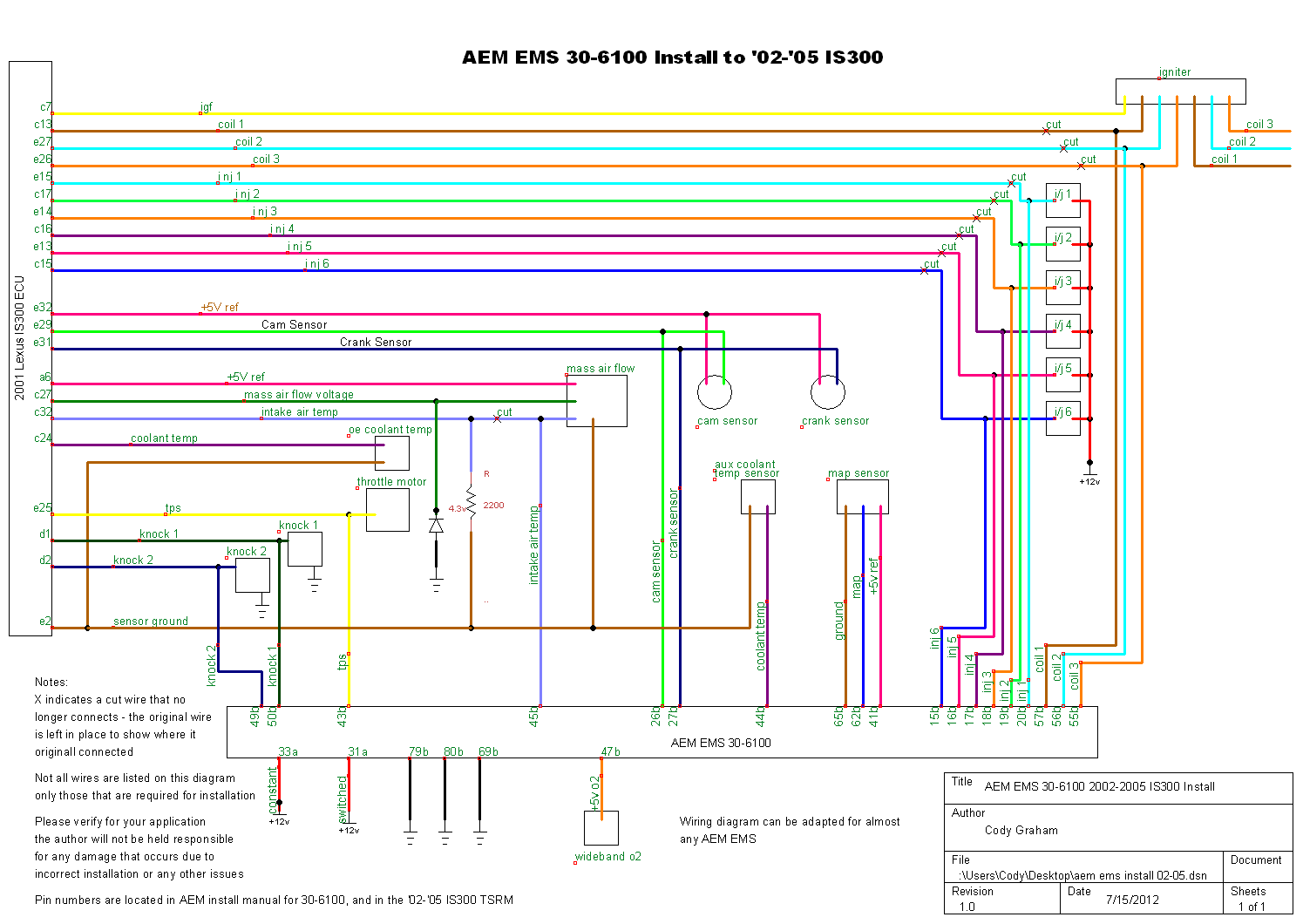
Here is a wiring schematic I drew up that should put a picture to the above list. You will also need the AEM manual for the EMS and pinouts for the IS300 ECU. This is for a 2001 IS300, I will try and get around to doing the same for 02-05, as it is just a matter of changing some pin numbers.
Needless to say, there is not a ton of info anywhere about this - little snippets here and there, a couple companies that make the plug n pray kits, but not willing to share their "classified" information...
Well, I'm here to tell you, about 3 days worth of work total, and mine is running beautifully. Still needs a full tune, but starts first time every time, runs, drives, etc. All is well!
I haven't finished what I consider even a decent base map, so I am not going to post that just yet (though if you want cam/crank sensor settings in the mean time, I can provide those), but I have finished a wiring diagram that shows everything that is done.
Keep in mind, I used a 30-6100 unit, but a 30-6050 would work as well, which is cheaper and is made for Honda's. I just happened to have easy access to a Supra box and wiring pigtails. The AEM's work the same way no matter which one you pick, as far as I can tell.
First things first - the cam and crank sensor resistors inside the box will need to be removed. On the V2, they are surface mount resistors and they come off very easily if you have ever used a soldering iron for PCB work. The scariest part is separating the two cards inside the AEM unit. R2 and R4 are the resistor numbers we care about here. Crank resistor is R4, cam is R2. Put the box back together and we are ready to go. (there is an option to remove resistors for intake air temp and coolant temp, but I didn't want to mess with that, so you will see my way around it shortly).
Now, I highly recommend mounting this guy underneath the driver seat - the seat comes out with 4 14mm bolts and once it is out, there is a ton of room to run wiring from the factory ECU under the hood. Use an existing grommet beneath the lower driver side corner of the windshield. Pull up the trim along the door sill, the carpet comes up easily and tuck your wiring in there. Make sure when reinstalling the seat not to pinch any wires. (it could also be mounted under the dash, in the glove compartment, etc. IMO, there is so much more room in the seat area to work...
The AEM becomes a piggy back, kinda. What we are doing is leaving the factory ECU with enough sensors and inputs to allow it to still shift the transmission, control drive by wire and the instrument cluster. We are taking control of the ignition and fuel away from the factory ECU and handing it over to the AEM EMS.
There are some obvious hookups we will need to make - +12v constant, +12v switched, Chassis ground, etc. After that, its sensors and outputs.
Cam Sensor: tap the cam sensor signal wire and run to AEM, leave it attached to factory ECU
Crank Sensor: tap the crank sensor signal wire and run to AEM, leave it attached to factory ECU
Coolant Sensor: I added my own external sensor - a two wire GM unit - one wire goes to ground, the other to the AEM
Intake Air Temp Sensor: Cut this wire, run the side that comes from the sensor to the AEM, attach a 2200 ohm 1/2 watt resistor to the other side and the opposite side of the resistor run to chassis ground - this gives the AEM an accurate intake temp, gives the factory ECU a constant 77 degrees intake air temp, this keeps the factory ecu happy and no spare sensors required.
Knock Sensor 1 & 2: tap these, run to AEM, leave attached to factory ECU
Throttle Position Sensor: Tap this run to AEM, leave attached to factory ECU
Ignition Coil 1-3: cut these, run to AEM, coil wires from factory ECU now go nowhere, put heat shrink to protect them from shorting out
Injector 1-6: cut these, run to AEM, injector wires from factory ECU now go nowhere, put heat shrink to protect them from shorting out
Mass Air Flow Signal: Tap this wire, install a 4.3 volt diode - line side goes towards MAF wire, ground opposite side - this works as an easy MAF clamp
MAP sensor: install a MAP sensor (I used a GM 3 bar because they are cheap) - all three wires go to the AEM - +5v, ground, signal
That's it really... some simple stuff really, keep in mind, you will want to install fuses on the +12v wiring as the AEM itself has no protection. If you can install a piggyback like an Emanage, you can install an EMS.
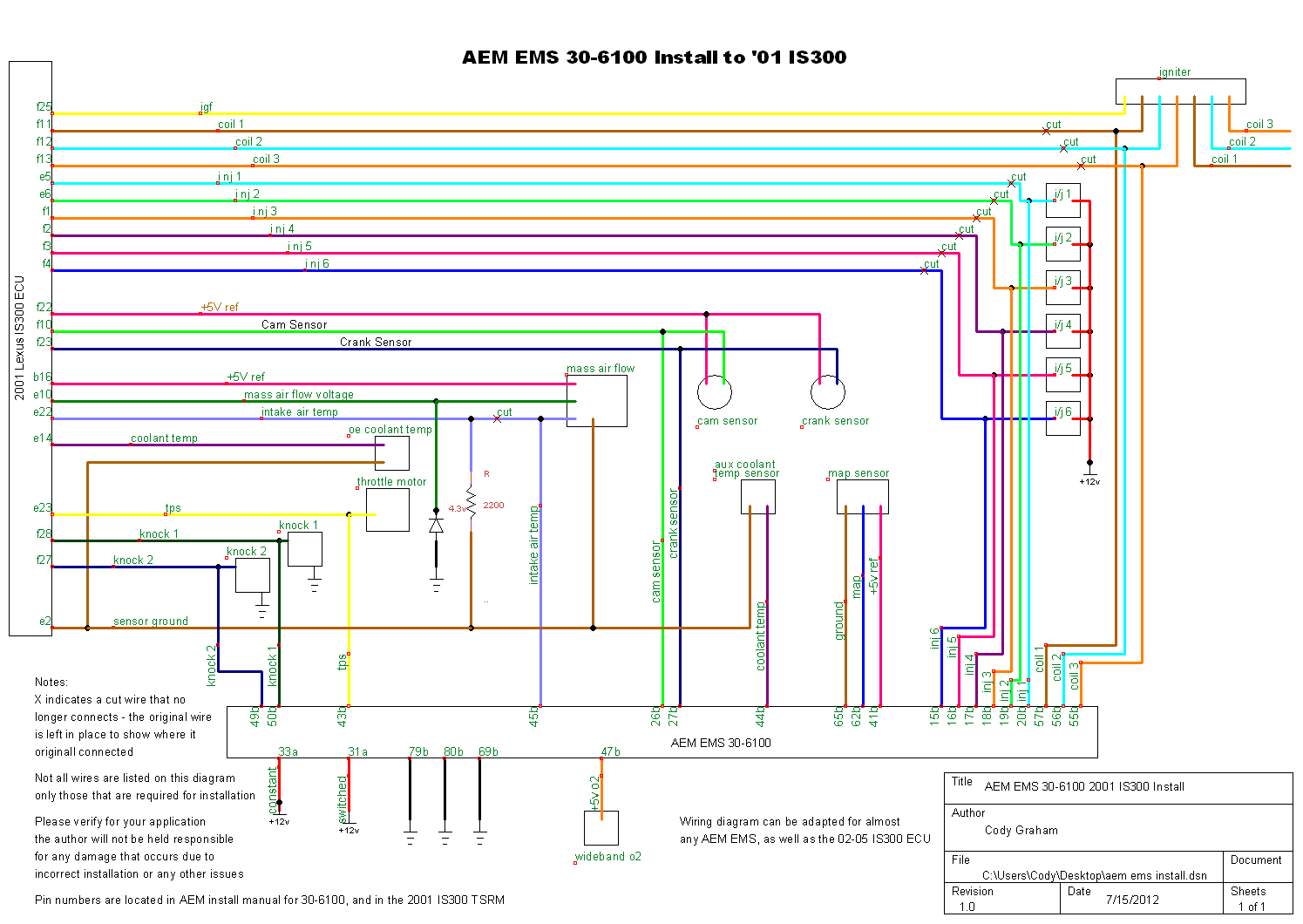
Here is a wiring schematic I drew up that should put a picture to the above list. You will also need the AEM manual for the EMS and pinouts for the IS300 ECU. This is for a 2001 IS300, I will try and get around to doing the same for 02-05, as it is just a matter of changing some pin numbers.
Any time... I am going to get a wiring diagram for the more popular Honda EMS 30-6050... functionality is the same, minus the obvious lack of auto transmission controls that we can't use anyways...
http://www.filefactory.com/file/2uqp...kmap_01V24_cal
Sorry for the free hosting link, if anyone has a more permanent host I can use, the thing is only like 15kb
There is my currently running, driving calibration file...
AEM EMS V2 30-6100 1.24
GE VVTI Cam / Crank sensors, 3 tooth cam, 36-2 crank
GM 3 bar MAP
Toyota IAT from MAF
GM Coolant temp
Drive by wire TPS
660 CC high impedance injectors, 55 psi base fuel, E85
AEM 30-4100 Wideband
OEM IS300 coil pack setup 1-6, 2-5, 3-4
This is definitely only a starting point for anyone, I highly recommend a good knowledgeable tuner have a look at it - I am still relearning the AEM, but, right now, my car drives amazing. It is not tuned in boost whatsoever - I've been working on the drivability part the past couple days...
Sorry for the free hosting link, if anyone has a more permanent host I can use, the thing is only like 15kb
There is my currently running, driving calibration file...
AEM EMS V2 30-6100 1.24
GE VVTI Cam / Crank sensors, 3 tooth cam, 36-2 crank
GM 3 bar MAP
Toyota IAT from MAF
GM Coolant temp
Drive by wire TPS
660 CC high impedance injectors, 55 psi base fuel, E85
AEM 30-4100 Wideband
OEM IS300 coil pack setup 1-6, 2-5, 3-4
This is definitely only a starting point for anyone, I highly recommend a good knowledgeable tuner have a look at it - I am still relearning the AEM, but, right now, my car drives amazing. It is not tuned in boost whatsoever - I've been working on the drivability part the past couple days...
Last edited by mitsuguy; Jul 22, 2012 at 08:02 AM.
Trending Topics
everything is working great... haven't had a lot of time to tune it, but its making some decent power now... it is pretty straightforward, just a matter of getting the time to do it...
ClubLexus Stories
Celebrating Lexus & Toyota from Around the Globe

10 Lexus Bargains That are Cheaper Than a New Toyota RAV4
Joe Kucinski
8 Weirdest Things Lexus Has Ever Built
Verdad Gallardo
10 Lexus Designs That Have Aged Like Fine Wine
Verdad Gallardo
8 Tips for Improving Your Hybrid or Plug-in Hybrid's Efficiency!
Michael S. Palmer
10 Best Lexus Models No One Remembers
Joe Kucinski
TRD Off-Road Premium: Best 2026 4Runner, Except This One Thing
Michael S. Palmer
Top 10 Lexus & Toyotas to Drive Before You Die!
Joe Kucinski
Top 10 Lexus/Toyotas With The LEAST 5-Year Depreciation
Joe Kucinski
Lexus LC500 Convertible Auction: A Preview of Rising Values?
Brett Foote

I did not use shielded wires... I had an emanage installed previously under the drivers seat and figured I'd at least try it with out any special wires to see if it would work... worked just fine, been driving it that way since...
fuel gauge sucks, it seems to work relatively good, but then throws you for a loop... for instance, this last tank of gas, slowly crept down to 3/4 of a tank, then fell to 1/2 tank... kept driving a little, it said 3/8 or a little more, put 10 gallons in, so, pretty close... don't trust it below 1/4 of a tank though... this happens not so much due to the AEM, but the injectors... if you up the injector size, you change the pulsewidth needed to run the car, since the factory ecu thinks it still has factory injectors *even though it isn't controlling them* it makes its fuel calculations based on those numbers...

Driver

Joined: Jan 2012
Posts: 149
Likes: 0
From: Ontario
fuel gauge sucks, it seems to work relatively good, but then throws you for a loop... for instance, this last tank of gas, slowly crept down to 3/4 of a tank, then fell to 1/2 tank... kept driving a little, it said 3/8 or a little more, put 10 gallons in, so, pretty close... don't trust it below 1/4 of a tank though... this happens not so much due to the AEM, but the injectors... if you up the injector size, you change the pulsewidth needed to run the car, since the factory ecu thinks it still has factory injectors *even though it isn't controlling them* it makes its fuel calculations based on those numbers...
Have you tampered with the wiring for the fuel gauge? The fuel gauge should work like stock... I have AEM and 850cc injectors as well and my fuel gauge is dead on. The tank level has nothing to do with your injector size. By changing the injectors that little "fuel economy" gauge in the cluster will be totally off tho. I have heard of many issues however with IS300's and fuel gauges reading strange when boosted / big power. However I believe this has more to do with the way in which the fuel system has been modified...
You have installed a return fuel system, correct? Did you maintain all of the stock return piping connections in the tank ... specifically where the return connects back inside the basket... It has a unique balancing system that tries to keep both sides of the tank in balance, but it relies directly on the returning fuel to be plumbed into the stock location and have the tube from the other side of the tank connected in properly. If the balancing system is not working correctly, it will lead to strange readings as many have described because there are two level sensors - one in each side of the tank and the ECU just takes an average. So you could potentially run into the situation where your gauge says like 1/3 full, but really the side that your pump is on is damn near empty and starving for fuel! Trust me, I've seen this happen before when the balancing isn't working correctly

I am very surprised yours is accurate. I assure you, my fuel assembly is correct, when the light comes on, I can fill it with about 13-14 gallons, which is about right... it is all hooked up the right way, and it is a return fuel system. The problem with these cars is that the fuel level is calculated by the ecu to make the needle not move around as much... there are only 4 or 5 levels the ecu cares about and when it gets to one of those levels is when the needle will move, sometimes dramatically. It calculates level between them based on MAF readings and how much fuel it thinks it is injecting, because my injectors are 2.5 times larger than stock, the needle moves about 2.5 times slower. Same calculation is what is used for the MPG needle, so I am even more surprised yours is accurate...
Driver
Joined: Jan 2012
Posts: 149
Likes: 0
From: Ontario
I am very surprised yours is accurate. I assure you, my fuel assembly is correct, when the light comes on, I can fill it with about 13-14 gallons, which is about right... it is all hooked up the right way, and it is a return fuel system. The problem with these cars is that the fuel level is calculated by the ecu to make the needle not move around as much... there are only 4 or 5 levels the ecu cares about and when it gets to one of those levels is when the needle will move, sometimes dramatically. It calculates level between them based on MAF readings and how much fuel it thinks it is injecting, because my injectors are 2.5 times larger than stock, the needle moves about 2.5 times slower. Same calculation is what is used for the MPG needle, so I am even more surprised yours is accurate...
However, I would maintain that the ECU uses the float level sensors (an average of the two of them) to read remaining fuel level. It of course uses an algorithm to stabilize the readings, or else every time the fuel sloshes going around any corner, braking, accelerating etc the fuel level needle would move around like crazy. But this is nothing new, pretty much any modern car has this kind of filtering/averaging.
And again I would say that the size of your injectors should have NOTHING to do with the fuel level remaining in the tank reading accurately. Why would the ECU care how much fuel you are injecting at the moment to tell you how much is left sitting in the tank? The remaining fuel is a directly measurable quantity (gallons or liters). It's like saying you had a half tank of gas, then you installed 1000cc injectors... Would you not agree that you should still have a half tank remaining as soon as u turn the key on without starting the engine?? It should not read anything lower or higher all of a sudden. Obviously your level should drop faster as you go and drive the car around making big power, because the fuel is being consumed faster.
I can't tell how your gauge is reacting because I'm not there to see it. It is possible that some part of the system is malfunctioning, whether it be one or both of the float level sensors, some wiring, the ECU itself, or something in the gauge cluster. Its hard to tell really why you are getting funny readings if you are 100% sure your balancing system is working.
If I were you I would drive around and run it down to see where the empty warning light comes on.... take a full jerry can in the trunk so that if you really do run out you wouldn't be stranded. Only way really to see where "empty" actually is for you now.
The floats don't put out the same type of signal as you might imagine. They only have 4 or 5 positions that they report. The ecu, believe it or not, calculates fuel level between these positions the exact same way it calculates fuel mileage. My gauge is accurate when at these positions. I have ran the car out of fuel and indeed had to add just over 17 gallons, it is definitely working correctly. This has nothing to do with making big power, it has everything to do with injector size. One reason I know this is that now, it behaves better with regular fuel in comparison to how it behaved with e85. It is more accurate now, but not perfect. The fuel level literally goes down nice and slow. It will drop significantly, say from 3/4 to 1/2 seemingly at random, but generally right around 120-140 miles on the odo. It is never when driving, at least I've never caught it do it while driving, only seems to happen when the car is started. I have tested outputs from both senders and they are functioning correctly. Over on my.is, there are guys working on a hack for this to be able tk replace the senders with a normal unit, however, the fuel level is multiplexed from the factory ecu, so you can't just wire in a new sender, it is a digital signal, not analog.