


Is this running too hot?


Thread Starter
Driver School Candidate
Joined: Feb 2012
Posts: 11
Likes: 0
 Is this running too hot?
The other day I saw my '98 LS400 run warmer than I have ever seen before.
After driving for about 3 hours at high speed, traffic came to a sudden crawl. After about 20 minutes, the temp guage creeped from it's normal position (just below half) to about 3/4 of the way up. Granted, it was the worst possible scenario for a cooling system. Hours of high speed driving, sudden stop and 95 degrees out in the blaring sun with the a/c on. Putting it in neutral and revving the engine a little bit brought the temps down a bit, and I definitely could hear the fan roaring, so I'm assuming the fan clutch is good. Coolant is clean and has been recently serviced at the dealer by the previous owner, so I doubt it's a clogged radiator issue.
What I did notice is that the radiator in these cars is tiny. I can't believe it's only a single-row radiator. I wouldn't be surprised if it ran hot under those conditions. I noticed when pricing out replacement radiators and fan clutches that there's an option for with and without towing package. Can I assume the towing package uses a dual-row radiator? Because if so I think an upgrade is in order.
Or maybe I'm just looking too much into it. Maybe it's okay for the guage to reach 3/4 up. If it were a GM vehicle I know that would be true and I wouldn't worry about it. Most of my experience with other cars has been that the gauge doesn't move from normal position, and if it does, it's damn near overheating. So does this look okay, or is this an issue that needs to be corrected?
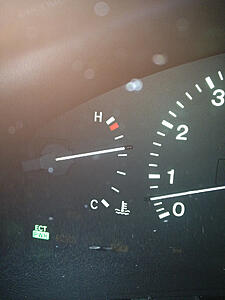
After driving for about 3 hours at high speed, traffic came to a sudden crawl. After about 20 minutes, the temp guage creeped from it's normal position (just below half) to about 3/4 of the way up. Granted, it was the worst possible scenario for a cooling system. Hours of high speed driving, sudden stop and 95 degrees out in the blaring sun with the a/c on. Putting it in neutral and revving the engine a little bit brought the temps down a bit, and I definitely could hear the fan roaring, so I'm assuming the fan clutch is good. Coolant is clean and has been recently serviced at the dealer by the previous owner, so I doubt it's a clogged radiator issue.
What I did notice is that the radiator in these cars is tiny. I can't believe it's only a single-row radiator. I wouldn't be surprised if it ran hot under those conditions. I noticed when pricing out replacement radiators and fan clutches that there's an option for with and without towing package. Can I assume the towing package uses a dual-row radiator? Because if so I think an upgrade is in order.
Or maybe I'm just looking too much into it. Maybe it's okay for the guage to reach 3/4 up. If it were a GM vehicle I know that would be true and I wouldn't worry about it. Most of my experience with other cars has been that the gauge doesn't move from normal position, and if it does, it's damn near overheating. So does this look okay, or is this an issue that needs to be corrected?


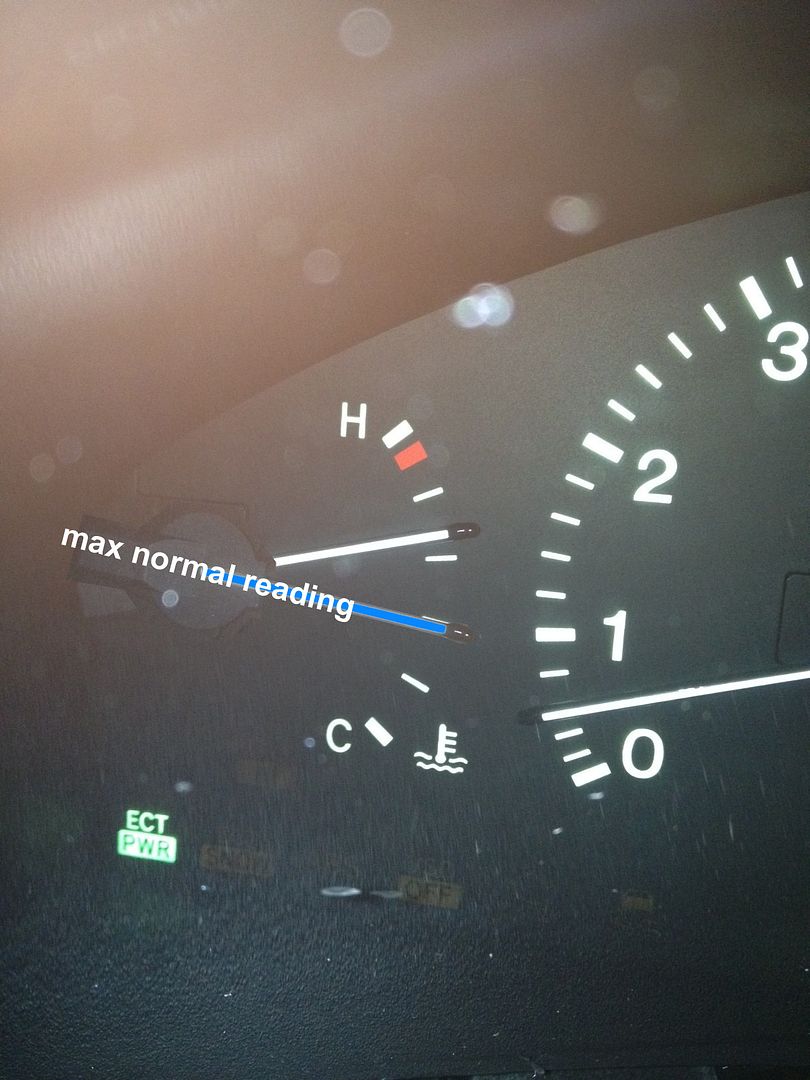

wow, an LS400 runs at 150, that is pretty coool (temperature wise.) i would expect a higher temp from such a big, heavy thing.
with that being said, you should still be fine running at the temperature youre running at now. a lot of cars run at around 180 no problem.
also, perhaps its time to invest in an aftermarket temperature gauge to give you a better reading, if youd like.
with that being said, you should still be fine running at the temperature youre running at now. a lot of cars run at around 180 no problem.
also, perhaps its time to invest in an aftermarket temperature gauge to give you a better reading, if youd like.


<Dooh> Can't read in my haste...burp it. 
Proper temp is where mar1 posted. As typical, if the cooling system has not been serviced in 30K miles, do the drill. Thermostat, coolant and reservoir cap, might even do the thermostat sensor since you are right there. While the coolant is spec'd to last longer, the thermostat is the dead man in this party since they tend to be on a 30K mile replacement interval. If the system has seen Toyota red and distilled water, I'd be pretty confident the radiator is in good shape barring any physical damage.
No need for a bigger radiator. Toyota among many other manufacturers do their heat box cooling system testing in Death Valley, CA, Africa and otehr hot locations. As designed they have a wide range of operational capabilities. Do the basic maintenance and you should be
Proper temp is where mar1 posted. As typical, if the cooling system has not been serviced in 30K miles, do the drill. Thermostat, coolant and reservoir cap, might even do the thermostat sensor since you are right there. While the coolant is spec'd to last longer, the thermostat is the dead man in this party since they tend to be on a 30K mile replacement interval. If the system has seen Toyota red and distilled water, I'd be pretty confident the radiator is in good shape barring any physical damage.
No need for a bigger radiator. Toyota among many other manufacturers do their heat box cooling system testing in Death Valley, CA, Africa and otehr hot locations. As designed they have a wide range of operational capabilities. Do the basic maintenance and you should be
Last edited by RA40; Aug 2, 2012 at 07:03 PM.


if it went down when you revved then you likely have an air bubble in the system, from either the last time service was done, or a pinhole leak.
bleed the system as mentioned numerous times on this forum and lexls.com and you should be fine.
bleed the system as mentioned numerous times on this forum and lexls.com and you should be fine.
Trending Topics
Thread Starter
Driver School Candidate
Joined: Feb 2012
Posts: 11
Likes: 0
The thermostats in these things are known for going bad after 30k miles? That's interesting to know.


Well I'm doubting there's an air bubble since the service was done well over a year ago. I'm pretty sure the temps went down since the fan was spinning at a higher speed. That was just verification that the fan clutch itself was working correctly.
The thermostats in these things are known for going bad after 30k miles? That's interesting to know.
The thermostats in these things are known for going bad after 30k miles? That's interesting to know.
I would look for a small leak and test the radiator cap... radiator caps are the #1 most overlooked cause of overheating - they allow coolant to push into the overflow and don't always allow it all to be drawn back into the radiator...
As Cody mentioned.
I've taken a conservative approach to the cooling system and the thermostat since the part is ~$22 and coolant is $25. Less than an hour for the drill and this gives me peace of mind. YMMV. +1 on checking the radiator cap.
I've taken a conservative approach to the cooling system and the thermostat since the part is ~$22 and coolant is $25. Less than an hour for the drill and this gives me peace of mind. YMMV. +1 on checking the radiator cap.

Thread
Thread Starter
Forum
Replies
Last Post
cnstarz
ES - 1st to 6th Gen (1990-2018)
10
Jul 19, 2011 06:38 AM
