When you click on links to various merchants on this site and make a purchase, this can result in this site earning a commission. Affiliate programs and affiliations include, but are not limited to, the eBay Partner Network.
2022 Honda Civic Sedan vs. 2021 Toyota Corolla Comparison Test: Not Even Close
Together, they dominate the compact-car market, but one of these small sedans dominates the other.
Honda Civic versus Toyota Corolla is one of the most entrenched rivalries in the automotive marketplace. The two small cars are vitally important not only to their makers but also to millions of Americans who depend on them for straightforward, reliable transportation. An all-new redesign of either is rightly expected to upend the compact car segment, which is still strong despite the popularity of SUVs, and neither company wants to get its car wrong. Bringing them together for a comparison test ought to presage a knock-down, drag-out fight, but the 2022 Honda Civic Touring is so much better than the 2021 Toyota Corolla XSE it isn't even funny.
Now, this isn't how we're supposed to do things. We're supposed to write these things in a way that keeps you glued to your screen, balancing the successes and failures of each vehicle and keeping you in suspense until the big conclusion. Sometimes, though, that kind of presentation is disingenuous. This is one of those times. This isn't a close comparison. One car is clearly better than the other, and the only thing to do is tell it to you straight.
What Makes The Civic So Much Better?
Here's a line from the notes turned in by our judges in this comparison: "Other than some elevated interior noise, I am struggling to think of anything the Civic does wrong. It's an incredibly solid effort."
Truthfully, both cars could use some work in the interior noise department. The Civic, as has long been the case with Hondas, gets loud inside on bad pavement and when the engine is working hard. The Corolla, meanwhile, has an even more raucous engine and develops a lot of wind noise around the door mirrors at higher city speeds that only gets worse as you go faster. It is quieter over bad pavement than the Honda, though.
What About The Rest Of The Interior?
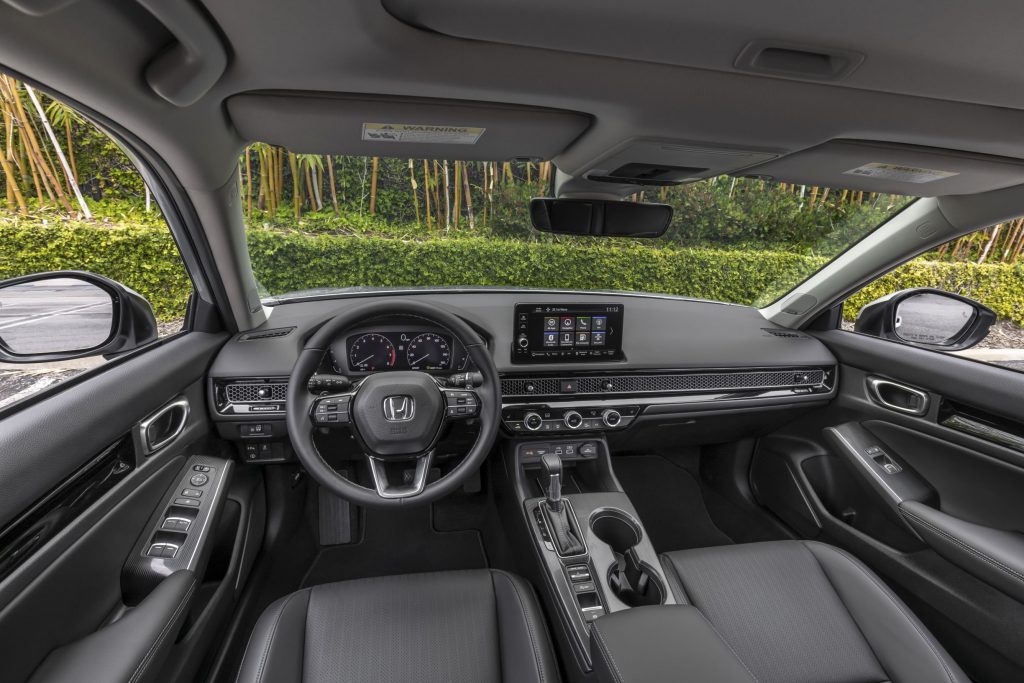
Which interior you prefer depends a lot on who you're trying to make happy. If it's just the driver, the Corolla puts up a good fight. If it's everyone in the vehicle, Honda wins going away. The Toyota gets points here for its very comfortable front seats, but that's about the only outright win. The Civic's interior is more spacious, has vastly better ergonomics, and looks and feels premium.
"It's here, in competition with its primary rival, that you start to feel the Corolla's drawbacks," MotorTrend en Español editor Miguel Cortina said. "Although it's only 3 years old, it feels even older—especially when the Civic is brand new, not to mention the almost equally fresh Hyundai Elantra and Nissan Sentra."
The most obvious differentiator is in how things feel and the impression they give. The Corolla's exterior door handles feel flimsy, and the door sounds hollow when you close it. The turn signal stalk feels and sounds like it's going to snap off in your hand when you use it. The materials are fine for a car at this price point, but Honda didn't settle for fine. Everything you touch, pull, push, or twist in the Civic feels like it was borrowed from a more expensive car.
Then there's the space. The Corolla is cozy at best. The front passenger's inboard knee is always resting against the center console, which is narrower than the Civic's but somehow still in the way. The rear seats of the two cars have roughly the same amount of space according to the tape measure, but the Corolla feels tighter, as you sit so high it feels like you have to duck to look out the side windows like you would on a plane. The Civic feels spacious and airy, with excellent sight lines and plenty of room to spread out, no matter which seat you occupy, despite being within an inch or two of the Corolla in every dimension inside and out.
Then there's the matter of how the interior is designed to serve those aboard. Honda pulls out another clean victory here with controls, cupholders, chargers, and everything else conveniently located and easy to manipulate. The wider center console allows the cupholders to be placed next to the shifter rather than behind, as in the Corolla, where they're under your elbow. The wireless phone charging pad is larger than it needs to be, making it easy to reach into, whereas Toyota crammed its pad up under the dashboard. Two USB ports are right above the Honda's charging pad, whereas Toyota stuck a single port up under the dash next to the glove box, almost as if they forgot to include one until the last minute. The Civic also has a pair of easily accessible USB ports for the rear seats, which Toyota does not, though there's one in the center armrest you'll never use. Does Toyota not know people like charging lots of devices at once, and from every seat?
Anything Else?
The Civic's trunk is bigger, and it's easier to fold the rear seats for more space thanks to release handles located in the cargo area. Toyota put the release handles on the seats, which would be fine except for some odd reason they placed them near the center of the car rather than out by the doors where you could reach them without climbing into the back seat.
The Honda's blind-spot warning system could also stand to chill out. It fires its alarm unless there's an enormous gap available, and that just isn't always realistic in heavy traffic.
Let's Wrap It Up, Then
As we said, the Civic ran away with this comparison. It outclasses the Corolla in almost every way we can think of. "The Civic feels closer to an Accord than the Corolla does to a Camry," Cortina said. "The Honda feels like a more mature car—quieter overall, more comfortable, more modern, more everything. It projects a strong premium vibe in the compact sedan segment. The previous Civic was the best among its peers, and this 11th-generation car goes a step further. The competition is nowhere close."
Of the cars in this particular test, the Civic's sticker was $210 more than the Corolla's. If it were $2,100 more, it would still be worth choosing the Honda.
2nd Place: 2021 Toyota Corolla XSE Sedan
Pros: Solid handling, comfy front seats, strong brakes. Cons: Goofy ergonomic decisions, interior feels tight, feels older than it is. Verdict: The Corolla is a good car, but it just can't touch the greatness of the new Civic.
1st Place: 2022 Honda Civic Touring Sedan
Pros: Chassis punches above its weight, stellar interior packaging and materials, elevated refinement. Cons: Overeager lane departure warning, road noise can be an issue. Verdict: It's hard not to think of the all-new 2022 Civic as the best small car for sale in America today
From all accounts, it seems Honda has the old magic formula back. I'll say much of that has to do with appearance. Back to giving people a proper sedan that mimics more expensive sedans. That had worked for decades, but was lost with the last toyish generation. Nice to see the change here and there is no doubt the new Civic will be a massive sales success for the brand. Now one can hope the next Accord follows down the same path.
Civic dominated this comparison. Not even close...
Considering it's 4 years newer than the Corolla, I'd be surprised if it didn't. The comparison I want to see is with the new Elantra. Even better if it's the Type R vs. N.
i see lots of comments like this, but when i look at them i don't see it.
Mazda has been killing it with interiors lately. I think seeing them in video helps. I just watched this last night out of curiosity and was reminded how nice the interior bits are.
Over a decade ago, my parents actually looked at Honda, Toyota, Hyundai and even Mazda. We previously had a 1984 Honda Accord. They wound up over the past decade going with 1 civic 1 accord and then an accord hybrid. Had they got an SUV, they really liked Toyota and even Lexus offerings, but luxury cars were out of the question as when you park on the street in DC, assume people will nick both bumpers. The few days I had my RX300 in DC before I moved to Mexico, sure enough, both bumpers nicked.
However, my parents were sold on a nice interior and were able to get some movement on pricing they could not get with the other brands.
I'd say that they're pretty close, which is great for the Civic. Main differences I see are the honeycomb vent design vs the stitched dash, the infotainment screens, and shifter panel. I like the "widescreen" look of the infotainment screen on the Mazda3, as well as the placement of the control **** for the infotainment and the volume control. The Mazda3 design appears to be more subdued than the Civic's design, especially in the center console/shift panel area.
The difference is more apparent to me when you compare the 2-tone interior options. When I compare the white leather or greige leatherette on the Mazda3 to the gray leather on the Civic, I prefer Mazda's execution. There appear to be more stitched surfaces on the Mazda3 at first glance, and as far as looks go, I'm not a fan of the patterned design on some of the trim pieces in the Civic.
I'd say that they're pretty close, which is great for the Civic. Main differences I see are the honeycomb vent design vs the stitched dash, the infotainment screens, and shifter panel. I like the "widescreen" look of the infotainment screen on the Mazda3, as well as the placement of the control **** for the infotainment and the volume control. The Mazda3 design appears to be more subdued than the Civic's design, especially in the center console/shift panel area.
The difference is more apparent to me when you compare the 2-tone interior options. When I compare the white leather or greige leatherette on the Mazda3 to the gray leather on the Civic, I prefer Mazda's execution. There appear to be more stitched surfaces on the Mazda3 at first glance, and as far as looks go, I'm not a fan of the patterned design on some of the trim pieces in the Civic.
The new Civic interior is definitely a step up. I test drove then new 2017 Corolla vs. Civic. vs. Mazda 3 and found that the Corolla wasn't as good as the Civic or Mazda 3. If I wanted the most boring driving experience to discourage my teenager from driving fast, then I would have bought the Corolla. I ended up with the Mazda 3 instead as it was just a much better experience vs the Corolla and had a better interior than the Civic. This new Civic looks like its on par with the Mazda 3.






 2022 Honda Civic Sedan vs. 2021 Toyota Corolla Comparison Test: Not Even Close


