


Rotors which ones?


I don't understand how you could think that I'm inflating my opinion of myself at all. I'm quoting an auther of an article originally posted by lobuxracer. Does that bring me any glory? I just don't understand why you insist on ignoring the facts. I wouldn't call an article written in Grass Roots Motorsports by an actual recer and ABS systems engineer for Bosch "hear-say".

Rookie
Joined: Nov 2007
Posts: 60
Likes: 0
From: illinois
I quoted that same article actually and you ignored my response, what facts? no studies no numbers, not even a bibligraphy for the article written. I actually don't think cross drilled rotors are good for track use, but that doesn't mean that they are not better for other purposes like keeping unsprung weight down and for better stopping power. most people on this forum do not track their cars, but everybody on here has gone 60-0 to avoid accidents so that is why that study would be interesting. maybe we should just agree to disagree?

Lead Lap
Joined: Aug 2007
Posts: 462
Likes: 0
From: OH
I just felt like everyone was getting a little too heated, and I dont like it when we don't get along, so I thought I would give everyone some pretty pictures to look at.
 Caparo t1 brakes

 Ferraris F1 brakes
 Renault f1
 Nascar brakes
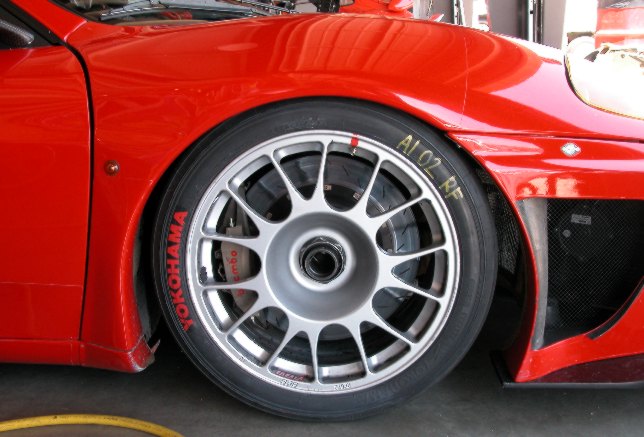 360 challenge
 Indy car brakes
Caparo t1 brakes Ferraris F1 brakesRenault f1 Nascar brakes 360 challenge Indy car brakes

Lead Lap
Joined: Jul 2006
Posts: 430
Likes: 0
From: TX
The two open wheel cars are a perfect exemple of the other/next argument. Should the holes or slots face forward or backward? I'm not really asking, I have my own opinion but the first two cars are a perfect example of both being used on a true race car.
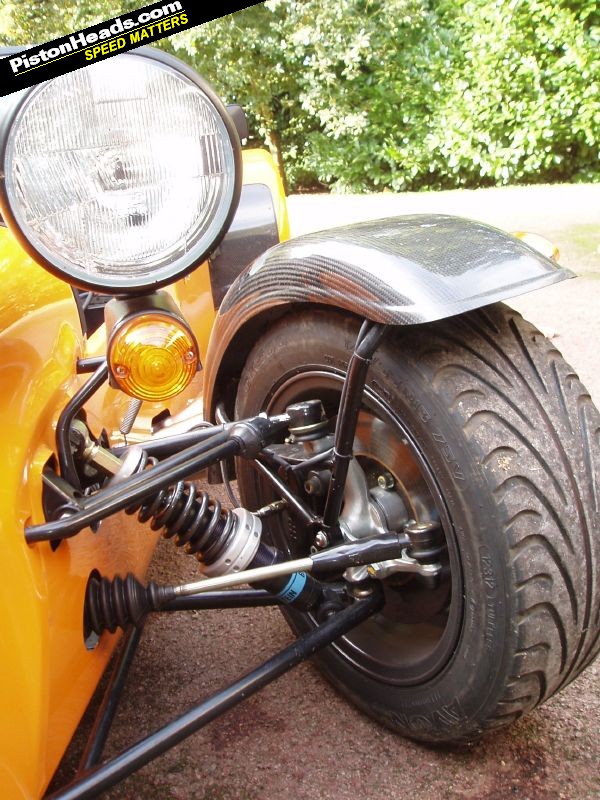


Okay. I'll agree that you won't read the article that I linked with a bibliography that has plenty of numbers and calculations. If you think I ignored the part of the article that you requoted to me, then you must not have read post #46 either. If you think shaving a few ounces of weight off your rotors will improve performance in some noticeable way, go for it.
Rookie
Joined: Nov 2007
Posts: 60
Likes: 0
From: illinois
obviously your guy thinks its important to keep rotor weight down when he wrote
That's a lot of steel hanging on the wheel that needs to accelerate each time the gas pedal is pushed. So the motto of this story is bigger is better until your temperatures are under control. After that point, you are doing more harm than good, unless you really like the look. (And hey, some of us do.)
from the mouth of your own source. plus none of this matters unless your tracking your car and the 2IS is not a true track car. the only one listed on his bibligography is him, how can you cite yourself? plus there just calculations not studies evaluating differences.
thats a sweet alcon brake kit , though. like the slots. is that a carbon fiber dust shield?
That's a lot of steel hanging on the wheel that needs to accelerate each time the gas pedal is pushed. So the motto of this story is bigger is better until your temperatures are under control. After that point, you are doing more harm than good, unless you really like the look. (And hey, some of us do.)
from the mouth of your own source. plus none of this matters unless your tracking your car and the 2IS is not a true track car. the only one listed on his bibligography is him, how can you cite yourself? plus there just calculations not studies evaluating differences.
thats a sweet alcon brake kit , though. like the slots. is that a carbon fiber dust shield?
Last edited by Rehab_Pain; Jan 14, 2008 at 08:54 PM.

Yes, that source is saying that non-drilled rotors mean your acceleration is hurt a bit by the extra rotating mass.
Your braking remains better than with crappy drilled rotors though because of the better heat capacity.
Once heat is under control then drilling -still- doesn't make you brake any better, it just reduces rotating mass for acceleration at the cost of your rotors cracking and warping more often- which is fine for some circumstances but kinda dumb for a street car that isn't running the insanely oversized rotors he's talking about.
It helps to understand the -entire- sentence you're using as evidence.
Your braking remains better than with crappy drilled rotors though because of the better heat capacity.
Once heat is under control then drilling -still- doesn't make you brake any better, it just reduces rotating mass for acceleration at the cost of your rotors cracking and warping more often- which is fine for some circumstances but kinda dumb for a street car that isn't running the insanely oversized rotors he's talking about.
It helps to understand the -entire- sentence you're using as evidence.
Rookie
Joined: Nov 2007
Posts: 60
Likes: 0
From: illinois
ok i found a good article that expresses gernby's point well, has studies and even an annotated bibliography. This is actually what i was looking for. drilled discs bad for track due to uneven rate if expansion causing cracks, but good for street cars to keep down unsprung weight for quicker acceleration.
http://www.answers.com/topic/disc-brake
Cracking is limited mostly to drilled discs, which get small cracks around outside edges of the drilled holes near the edge of the disc due to the disc's uneven rate of expansion in severe duty environments. In the main small hairline cracks will appear in all cross drilled discs, this is normal. Manufacturers that use drilled discs as OEM are doing so for two reasons: looks, if they determine that the average owner of the vehicle model will not overly stress them; or as a function of reducing the unsprung weight of the brake assembly, with the engineering assumed that enough brake disc mass remains to absorb racing temperatures and stresses. A brake disc is a heat sink, so removing mass increases the heat stress it will have to contend with. Generally an OEM application that is drilled will crack somewhat and could fail catastrophically if used over and above the original equipment design. Once cracked, these discs cannot be repaired.
i'm officially done with this thread.
http://www.answers.com/topic/disc-brake
Cracking is limited mostly to drilled discs, which get small cracks around outside edges of the drilled holes near the edge of the disc due to the disc's uneven rate of expansion in severe duty environments. In the main small hairline cracks will appear in all cross drilled discs, this is normal. Manufacturers that use drilled discs as OEM are doing so for two reasons: looks, if they determine that the average owner of the vehicle model will not overly stress them; or as a function of reducing the unsprung weight of the brake assembly, with the engineering assumed that enough brake disc mass remains to absorb racing temperatures and stresses. A brake disc is a heat sink, so removing mass increases the heat stress it will have to contend with. Generally an OEM application that is drilled will crack somewhat and could fail catastrophically if used over and above the original equipment design. Once cracked, these discs cannot be repaired.
i'm officially done with this thread.


James Walker is currently the Vehicle Performance Development Manager for brake control systems at Delphi Energy & Chassis. His prior professional experience includes brake control system development, design, and application engineering at Kelsey-Hayes (now TRW), Saturn Corporation, General Motors, Bosch Braking Systems, and Ford Motor Company. He obtained his B.S.M.E. from GMI Engineering & Management Institute.
Mr. Walker created scR motorsports consulting during eight years of SCCA Club Racing in the SSC and ITA classes. Through scR motorsports, he has been actively serving as an industry advisor to Kettering University in the fields of brake system design and brake control systems since 1996. He also serves as a brake control system consultant for StopTech, a manufacturer of high-performance racing brake systems. In addition, Mr. Walker contributes regularly to several automotive publications focusing on brake system design and modification for racing applications.
Mr. Walker created scR motorsports consulting during eight years of SCCA Club Racing in the SSC and ITA classes. Through scR motorsports, he has been actively serving as an industry advisor to Kettering University in the fields of brake system design and brake control systems since 1996. He also serves as a brake control system consultant for StopTech, a manufacturer of high-performance racing brake systems. In addition, Mr. Walker contributes regularly to several automotive publications focusing on brake system design and modification for racing applications.
For the drilled / slotted rotors available for our cars, you are probably reducing weight by way less than 1 lbs per rotor. Even if it were as much as 1 lbs each, I wouldn't consider that significant on a steet car. I think it's overwhelmingly obvious that the only legitimate reason for a cross drilled rotor on a car is aesthetics.

Pole Position
Joined: Jan 2008
Posts: 315
Likes: 2
From: California
OK...dudes...I had a 99 Carrera and spent LOTS of time at tracks and with Porsche owners who TRACKED their cars hard....The ONLY Porsche WITHOUT drilled rotors are the bottom of the line BASE Boxster and Caymans....Even their 10,000 Carbon Ceramics are drilled. I have NEVER seen a Porsche cracked rotor. These are people braking from 160+ MPH on tracks....In fact a Carrera 4S can stop from 177 mph in less than the length of a football field. IN THEORY drilled rotors are weaker...but in the real world...drilled rotors by reputable companies used by the average driver will be the same as non drilled....To say that Porsche uses them for "bling" purposes is WRONG. They do NOT engineer and design for bling...they do it PURELY from a performance stand point. To say that a $200K GT2 has an INFERIOR braking system because people who spend $200k want the bling of drilled rotors is ridiculous. If Porsche had a system that worked better, they would use it. Period. The use of drilling reduces weight without compromising strength....The drilling also aids in heat dissipation. Like I said...GOOD QUALITY drilled rotors are NOT going to crack on you any more than a set of non drilled rotors. Ask Brembo....
OK...dudes...I had a 99 Carrera and spent LOTS of time at tracks and with Porsche owners who TRACKED their cars hard....The ONLY Porsche WITHOUT drilled rotors are the bottom of the line BASE Boxster and Caymans....Even their 10,000 Carbon Ceramics are drilled. I have NEVER seen a Porsche cracked rotor. These are people braking from 160+ MPH on tracks....In fact a Carrera 4S can stop from 177 mph in less than the length of a football field. IN THEORY drilled rotors are weaker...but in the real world...drilled rotors by reputable companies used by the average driver will be the same as non drilled....To say that Porsche uses them for "bling" purposes is WRONG. They do NOT engineer and design for bling...they do it PURELY from a performance stand point. To say that a $200K GT2 has an INFERIOR braking system because people who spend $200k want the bling of drilled rotors is ridiculous. If Porsche had a system that worked better, they would use it. Period. The use of drilling reduces weight without compromising strength....The drilling also aids in heat dissipation. Like I said...GOOD QUALITY drilled rotors are NOT going to crack on you any more than a set of non drilled rotors. Ask Brembo....
Porsche does not do everything because engineering says it should be a certain way. They do many things because their buyers expect them. Just like every other car company.
I've seen lots of "good" quality drilled rotors crack, and they crack sooner than solid blanks. Ask any brake engineer. Asking Brembo's marketing department is a total waste of time.