


Rotors which ones?


Racer

Joined: Aug 2006
Posts: 1,635
Likes: 3
From: Las Vegas

I have never had any problems with drilled rotors on any of mine or my families very aggressively driven street cars (ie. SL55, S55, Gallardo, M3, and C320). I imagine it is a question of quality whether or not it is going to have problems. Such as a chevy malibu will have more problems than an IS after
50,000 miles. That doesnt mean all cars are crap after 50,000 just certain kinds.
50,000 miles. That doesnt mean all cars are crap after 50,000 just certain kinds.



Never seen anything like this?

I have. Lots of times.
I'm not saying this doesn't happen:
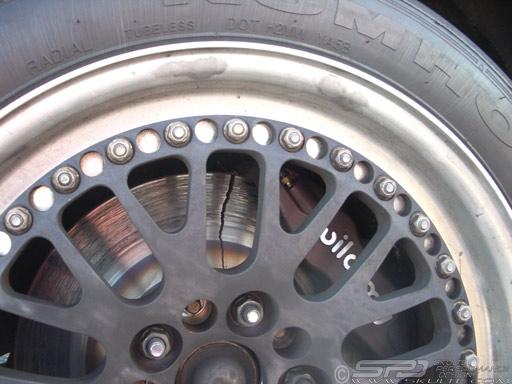
Just that I've seen it a lot more with drilled rotors.
I have. Lots of times.
I'm not saying this doesn't happen:
Just that I've seen it a lot more with drilled rotors.
Last edited by lobuxracer; Jan 14, 2008 at 04:40 PM.


LOL ... no there aren't. That's the point. Cross drilled rotors don't belong on a track at all. They belong on show cars. My first set of "performance rotors" were cross drilled, and they felt very impressive. Of course I didn't realize at the time that the improvement was entirely from the other upgrades that I did at the same time (Motul fluid and Porterfield R4 pads). Unfortunately, after my 2nd 30 minute track session, the rotors were destroyed. They didn't crack like the ones lobuxracer posted, but they were blistered. I never had that problem with blanks.


Rookie
Joined: Nov 2007
Posts: 60
Likes: 0
From: illinois
almost a waste of space this thread is, just the same old argument over and over, with neither side having any proven studies to support their claim. moderator should just shut this thead down, like beating a dead horse.
Proven studes? Would it not suffice to hear from a well renouned brake system engineer?
From the author of Pulp Friction, James Walker Jr.
From the author of Pulp Friction, James Walker Jr.
Those Poor Rotors Let's look ot some common rotor "modification" and "performance" upgrades that you may have been exposed to. We'll try to separate the marketing from the engineering: Bigger rotors will make your friends think you are cool, bigger rotors look sexy, but bigger rotors do not stop the car. What a bigger rotor will do is lower the overall operating temperature of the brakes--which is a GREAT idea IF your temperatures are causing problems with other ports of the braking system.
Take, for exomple, a Formula 500 racer, a small 800-pound, single-seat formula car. While the brakes are certainly much smaller than those found on a 3000-pound GT1 Camaro, that does not necessarily mean that they need to be made larger. In fact, installing o GT1 brake package onto our formula car would probably do more harm than good. That's a lot of steel hanging on the wheel that needs to accelerate each time the gas pedal is pushed. So the motto of this story is bigger is better until your temperatures are under control. After that point, you are doing more harm than good, unless you really like the look. (And hey, some of us do.)
Crossdrilling your rotors might look neat, but what is it really doing for you? Well, unless your car is using brake pads from the '40s and 50s, not a whole lot. Rotors were first drilled because early brake pad materials gave off gasses when heated to racing temperatures, a process known as "gassing out." These gasses then formed a thin layer between the brake pad face and the rotor, acting as a lubricant and effectively lowering the coefficient of friction. The holes were implemented to give the gasses somewhere to go. It was an effective solution, but today's friction materials do not exhibit the some gassing out phenomenon as the early pads.
For this reason, the holes have carried over more as a design feature than a performance feature. Contrary to popular belief, they don't lower temperatures. (In fact, by removing weight from the rotor, they can actually cause temperatures to increase a little.) These holes create stress risers that allow the rotor to crack sooner, and make a mess of brake pads--sort of like a cheese grater rubbing against them at every stop. Want more evidence? Look at NASCAR or F1. You would think that if drilling holes in the rotor was the hot ticket, these teams would be doing it.
The one glaring exception here is in the rare situation where the rotors are so oversized that they need to be drilled like Swiss cheese. (Look at any performance motorcycle or lighter formula car, for an example.) While the issues of stress risers and brake pad wear are still present, drilling is used to reduce the mass of the parts in spite of these concerns. Remember that nothing comes for free. If these teams switched to non-drilled rotors, they would see lower operating temperatures and longer brake pad life, at the expense of higher weight. It's all about tradeoffs.
Slotting rotors, on the other hand, might be a consideration if your sanctioning body allows for it. Cutting thin slots across the face of the rotor can actually help to clean the face of the brake pads over time, helping to reduce the glazing often found during high-speed use which can lower the coefficient of friction. While there may still be a small concern over creating stress risers in the face of the rotor, if the slots are shallow and cut properly, the trade-off appears to be worth the risk. (Have you looked at a NASCAR rotor lately?)
Take, for exomple, a Formula 500 racer, a small 800-pound, single-seat formula car. While the brakes are certainly much smaller than those found on a 3000-pound GT1 Camaro, that does not necessarily mean that they need to be made larger. In fact, installing o GT1 brake package onto our formula car would probably do more harm than good. That's a lot of steel hanging on the wheel that needs to accelerate each time the gas pedal is pushed. So the motto of this story is bigger is better until your temperatures are under control. After that point, you are doing more harm than good, unless you really like the look. (And hey, some of us do.)
Crossdrilling your rotors might look neat, but what is it really doing for you? Well, unless your car is using brake pads from the '40s and 50s, not a whole lot. Rotors were first drilled because early brake pad materials gave off gasses when heated to racing temperatures, a process known as "gassing out." These gasses then formed a thin layer between the brake pad face and the rotor, acting as a lubricant and effectively lowering the coefficient of friction. The holes were implemented to give the gasses somewhere to go. It was an effective solution, but today's friction materials do not exhibit the some gassing out phenomenon as the early pads.
For this reason, the holes have carried over more as a design feature than a performance feature. Contrary to popular belief, they don't lower temperatures. (In fact, by removing weight from the rotor, they can actually cause temperatures to increase a little.) These holes create stress risers that allow the rotor to crack sooner, and make a mess of brake pads--sort of like a cheese grater rubbing against them at every stop. Want more evidence? Look at NASCAR or F1. You would think that if drilling holes in the rotor was the hot ticket, these teams would be doing it.
The one glaring exception here is in the rare situation where the rotors are so oversized that they need to be drilled like Swiss cheese. (Look at any performance motorcycle or lighter formula car, for an example.) While the issues of stress risers and brake pad wear are still present, drilling is used to reduce the mass of the parts in spite of these concerns. Remember that nothing comes for free. If these teams switched to non-drilled rotors, they would see lower operating temperatures and longer brake pad life, at the expense of higher weight. It's all about tradeoffs.
Slotting rotors, on the other hand, might be a consideration if your sanctioning body allows for it. Cutting thin slots across the face of the rotor can actually help to clean the face of the brake pads over time, helping to reduce the glazing often found during high-speed use which can lower the coefficient of friction. While there may still be a small concern over creating stress risers in the face of the rotor, if the slots are shallow and cut properly, the trade-off appears to be worth the risk. (Have you looked at a NASCAR rotor lately?)
Rookie
Joined: Nov 2007
Posts: 60
Likes: 0
From: illinois
again this is just one man's opinion not supported by any studies, but even he says.
The one glaring exception here is in the rare situation where the rotors are so oversized that they need to be drilled like Swiss cheese. (Look at any performance motorcycle or lighter formula car, for an example.) While the issues of stress risers and brake pad wear are still present, drilling is used to reduce the mass of the parts in spite of these concerns. Remember that nothing comes for free. If these teams switched to non-drilled rotors, they would see lower operating temperatures and longer brake pad life, at the expense of higher weight. It's all about tradeoffs.
maybe you should have highlighted this portion as well instead of only the portion that helps your cause. less weight in oversized rotors for better stopping power. as your own source said its all about the trade offs. I would like to see a study of 100-0 then 60-0 with blanks and same size cross drilled rotors that would be interesting.
The one glaring exception here is in the rare situation where the rotors are so oversized that they need to be drilled like Swiss cheese. (Look at any performance motorcycle or lighter formula car, for an example.) While the issues of stress risers and brake pad wear are still present, drilling is used to reduce the mass of the parts in spite of these concerns. Remember that nothing comes for free. If these teams switched to non-drilled rotors, they would see lower operating temperatures and longer brake pad life, at the expense of higher weight. It's all about tradeoffs.
maybe you should have highlighted this portion as well instead of only the portion that helps your cause. less weight in oversized rotors for better stopping power. as your own source said its all about the trade offs. I would like to see a study of 100-0 then 60-0 with blanks and same size cross drilled rotors that would be interesting.
If you think a study of stopping distances between blanks and cross drilled rotors would be interesting, then you obviously haven't read the Pulp Friction article. The science is simple if you would bother to read it instead of spew ignorance.
Regarding the part of the quote that I posted without highlighting ... it doesn't apply to street cars at all. "The one glaring exception here is in the rare situation where the rotors are so oversized that they need to be drilled like Swiss cheese. (Look at any performance motorcycle or lighter formula car, for an example.)" Does this sound like a 2IS to you?
Regarding the part of the quote that I posted without highlighting ... it doesn't apply to street cars at all. "The one glaring exception here is in the rare situation where the rotors are so oversized that they need to be drilled like Swiss cheese. (Look at any performance motorcycle or lighter formula car, for an example.)" Does this sound like a 2IS to you?