


Firestone dealer cheeper than....


Thread Starter
Driver
Joined: Nov 2007
Posts: 190
Likes: 0
From: Montana
 Firestone dealer cheeper than....
Went to the local Firestone dealer and priced out the Bridgestone Alenza's. Their price was $158.99 per and $716.32 total. That includes free mounting, life time balancing and rotation every 5K miles.
Anyone find anything better?
Anyone find anything better?

Advanced
Joined: Mar 2008
Posts: 506
Likes: 113
From: Arkansas
That beats Tire Rack as they want $162 a tire, plus you would still have to pay shipping, approx $35 plus have them mounted and balanced approx $90 but you would not have to pay sales tax. This route would cost approx $775. The Firestone deal sounds pretty good. This would be for the 18 " tire. The 17" runs $134 a tire.Total cost would around $660 Which one you got ?
This would be for the 18 " tire. The 17" runs $134 a tire.Total cost would around $660 Which one you got ?
Last edited by catdaddylo; Jul 7, 2008 at 07:22 PM.


Lead Lap
Joined: May 2006
Posts: 3,999
Likes: 37
From: FL
Old news...only some Firestone tires and not Bridgestones (to my knowledge)...tires were barely adequate for the vehicles they were put on...drivers also had under inflated tire pressures...overloaded vehicle in many cases...on hot roads..highway speeds...and so forth. All added up to cause these premature tire failures.
I have put hundreds of thousands of miles on Bridgestone tires and have never had any premature failures. Cars, SUVs, sports cars...makes no difference.
Using the above, I could make pretty much ANY normal tire put on ANY SUV fail.
Trending Topics

Pole Position
Joined: Feb 2006
Posts: 240
Likes: 0
From: MA
Firestone just took the fall for Ford - it was a crap box vehicle that caused the issue, pretty much everything that flipped over was an Explorer, even if the tire was defective, the explorer was more defective!

Out of Warranty


Joined: Aug 2001
Posts: 14,925
Likes: 13
From: Houston, Republic of Texas
That's about what I paid last year for a set of Alenza's at Firestone. If you can wait a month or two, they usually put on a sale approaching Labor Day. I got a $75 Amex gift card as a rebate on that purchase. A few years earlier I put a set of CrossTerrains on my RX300 at a Labor Day sale and got a pair of FRS radios that have been really handy a time or two. It pays to follow the sales! 
Out of Warranty
Joined: Aug 2001
Posts: 14,925
Likes: 13
From: Houston, Republic of Texas
Old news...only some Firestone tires and not Bridgestones (to my knowledge)...tires were barely adequate for the vehicles they were put on...drivers also had under inflated tire pressures...overloaded vehicle in many cases...on hot roads..highway speeds...and so forth. All added up to cause these premature tire failures.
My RX300 came with a set of GY Integrity's that were absolute junk. I replaced them with Michelin CT's that were outstanding tires that showed little wear after nearly 40K. My RX330 was delivered with a set of Michelin MX4's that were OK, but wore out completely in 22K, the Alenza's I replaced them with are running with no signs of wear after another 12K.
The failure of those Firestones on the Ford Explorer was usually the result of a cheaply manufactured tire that had a stiff sidewall, leading many owners (and dealers) to run them under-inflated to soften up the ride. At these low pressures, particularly if the vehicle was moderately loaded, the steel belts began to squirm and eventually separated the tire plies, leading to catastrophic failures.
The Explorer was a spin-off from the Ford Ranger pickup, but as an SUV, it carried its CG a good bit higher while carrying forward a rather narrow track and a wonky suspension designed for a considerably different set of driving dynamics.
Like most accidents, it had no one single cause, but was triggered by a cascade of failures - a cheaply-made tire, underinflated to smooth the ride, that allowed the belts to deform at speed particularly in hot weather, blow out the tire, and a vehicle that was top-heavy and rather ill-handling that made recovery from a blowout at speed almost impossible. The resulting rollover usually collapsed the flimsy roof, killing many of the occupants.
Both the Explorer and the Firestone tire have long since been redesigned and now offer perfectly acceptable handling and reliability within the market segment. They are today emblems of what can go wrong when the right set of circumstances collide.

Driver
Joined: Nov 2005
Posts: 132
Likes: 0
From: North Dakota
Lil4X is absolutely right about the Explorer and Firestone tires. Also just throw in the fact that too many people simply do not realize that a SUV, no matter what factory badge is on it, does not drive and handle like a car. Anyway, in Feb. of 2001 I bought a Ford Sportrac which came with the Firestone Wilderness tires that were recalled about a month or so after my purchase. There were about 6 different tires that Ford was replacing them with but every time the Ford dealer called me he had the Goodyear Wrangler RT which really wasn't that great of tire as far as I was concerned, I wanted the Michelins that Ford said they would replace them with. Anyway did end up with the GY on the Sportrac. In the summer of 2001 I rented the large U-Haul trailer to move my one daughter from ND to ID and had no problems with the Firestones on it. Jump ahead to 2006 and another U-Haul rental and they would not rent me a trailer to pull behind the Sportrac. U-Haul policy is no trailer rentals to any year of Explorer or Sportrac. I ended up pulling the trailer with my RX330 which was totally acceptable to U-Haul. By the way my Sportrac now has Goodyear Fortera's (installed about 1 1/2 years ago) and I really like them.
On a note about the Firestone dealer on the Alenza tires. Last October I put the Alenza's on my RX 330. I got them at Tires Plus. I called the local Firestone dealer which I had bought 3 different sets of tires from over the past 5 years or so (two different sets of Blizzacks and a set of Firestones for my daughters car). The best deal he could give me was $177. a tire (235-55-18) plus valve stem, tire disposal, and sales tax. It put it at about $780. total. Tires Plus (website) put the V rated at $779 and the H rated at $697 total out the door. I called the Tires Plus over in Fargo and talked to them about just putting on the H rated. They offered me the V rated for $749. out the door plus the website had a $25. off coupon I could use to give me a out the door price of $724. Called Firestone back and they really wouldn't budge from the quoted price. So went with the Tires Plus offer.
2005 RX 330 Thundercloud, Thundercloud Mist, Gray/Black interior with Black Birdseye Maple, NAV, ML, HID with AFS, Rain Sensing Wipers, Headlight Washers, Tow Package with OEM Hitch, 18 inch Thundercloud rims with Bridgestone Dueler H/L Alenzas.
1998 GS 300 Previous and first Lexus.
On a note about the Firestone dealer on the Alenza tires. Last October I put the Alenza's on my RX 330. I got them at Tires Plus. I called the local Firestone dealer which I had bought 3 different sets of tires from over the past 5 years or so (two different sets of Blizzacks and a set of Firestones for my daughters car). The best deal he could give me was $177. a tire (235-55-18) plus valve stem, tire disposal, and sales tax. It put it at about $780. total. Tires Plus (website) put the V rated at $779 and the H rated at $697 total out the door. I called the Tires Plus over in Fargo and talked to them about just putting on the H rated. They offered me the V rated for $749. out the door plus the website had a $25. off coupon I could use to give me a out the door price of $724. Called Firestone back and they really wouldn't budge from the quoted price. So went with the Tires Plus offer.
2005 RX 330 Thundercloud, Thundercloud Mist, Gray/Black interior with Black Birdseye Maple, NAV, ML, HID with AFS, Rain Sensing Wipers, Headlight Washers, Tow Package with OEM Hitch, 18 inch Thundercloud rims with Bridgestone Dueler H/L Alenzas.
1998 GS 300 Previous and first Lexus.

Lead Lap
Joined: May 2003
Posts: 442
Likes: 0
From: California
I put 213,000 miles on my '94 Explorer. I replaced the crappy OEM Firestones at around 12,000 miles. I used BFG's All-Terrains, Bridgestone Duellers, and Yokohama's for the next 200,000 miles.
As an FYI to Lil4X, the weaker roofs were introduced in the 2nd Gen, '95 Explorers. 1990-1994 had stronger roofs. And amen to the crappy Good Year Integritys. We have the Alenza's on our RX300 and love them.

The problem was Ford's door sticker low pressure number for a more comfortable ride.
The door sticker stated 26 lbs of tire pressure instead of the now required 32 and above..
Considering most vehicles on the road have low tire pressure which probably had Explorers at much less than 26lbs.
The door sticker stated 26 lbs of tire pressure instead of the now required 32 and above..
Considering most vehicles on the road have low tire pressure which probably had Explorers at much less than 26lbs.
Advanced
Joined: Mar 2008
Posts: 506
Likes: 113
From: Arkansas
Here is a pic of my 1992 Explorer that I kept until Feb of this year when I sold it when I bought my 2008 Lexus RX350 AWD
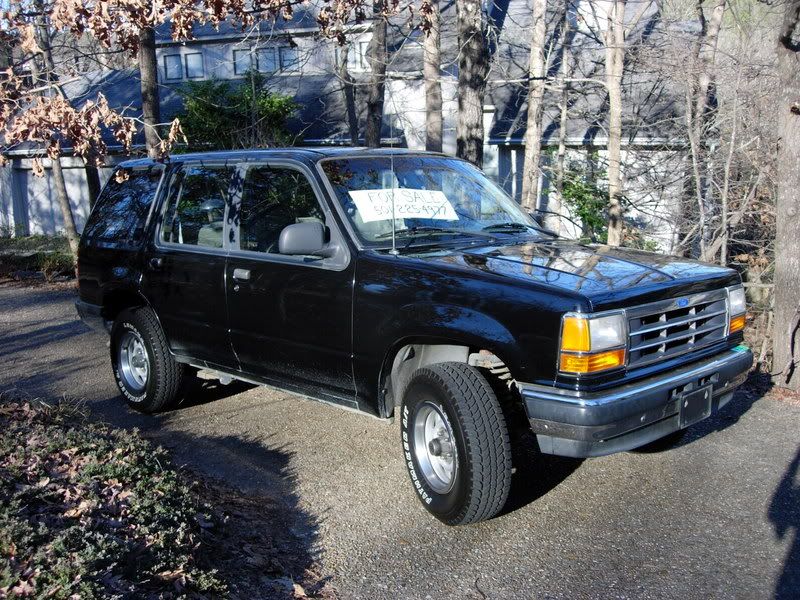
I had the Firestone "death tires" and was on my second set of them when the recall was made. Firestone replaced mine with some Dunlop AT tires (5) at no cost. I ran my tires at around 30-32 PSI. The Dunlops started dropping belts and when I sold my Ford it had brand new Firestones on it. FYI Ford sent a door decal to all Explorer owners to place over the OEM sticker to run tires at 30 PSI. The biggest weakness of the earlier Explorers was the automatic transmission. It was originally designed for the Maverick and was just not heavy duty enough for the Explorer. I had to replace mine at 70K miles and then again at 115K My Explorer worked well in heavy snow in Colorado and the occasional snows here in Arkansas. I hope my RX does as well.
I had the Firestone "death tires" and was on my second set of them when the recall was made. Firestone replaced mine with some Dunlop AT tires (5) at no cost. I ran my tires at around 30-32 PSI. The Dunlops started dropping belts and when I sold my Ford it had brand new Firestones on it. FYI Ford sent a door decal to all Explorer owners to place over the OEM sticker to run tires at 30 PSI. The biggest weakness of the earlier Explorers was the automatic transmission. It was originally designed for the Maverick and was just not heavy duty enough for the Explorer. I had to replace mine at 70K miles and then again at 115K
My Explorer worked well in heavy snow in Colorado and the occasional snows here in Arkansas. I hope my RX does as well.

Instructor
Joined: Dec 2006
Posts: 769
Likes: 55
From: ma
I am sorry, I am missing the point of this thread. Are you advocating that Firestone tires are now good enough to put on an RX? Or are you saying that a Firestone dealership might be a cheap place to get quality Bridgestones?
Firestone has had a lot of bad press in the past, and much of it deservedly so! They chose to make cheaply engineered tires, and the statistics eventualy reflected that engineering decision. It is POSSIBLE that they got better, but I would need to see some independent testing data before I started putting firestones on anything other than my lawn mower. Being slightly cheaper than someone else is of no importance to me--I want to know cornering capability, wet road traction, tread separation data, warranty period, etc.
Firestone has had a lot of bad press in the past, and much of it deservedly so! They chose to make cheaply engineered tires, and the statistics eventualy reflected that engineering decision. It is POSSIBLE that they got better, but I would need to see some independent testing data before I started putting firestones on anything other than my lawn mower. Being slightly cheaper than someone else is of no importance to me--I want to know cornering capability, wet road traction, tread separation data, warranty period, etc.