


2012+ OEM rims tire options


Driver
Joined: Jun 2020
Posts: 127
Likes: 29
From: Vic

You did this for appearance, not performance. It's very rare when you can drop ride height by more than 10mm and maintain decent camber curves. Typically roll center drops below ground at the kind of drop you're running and the roll couple is so long that you can't put stiff enough springs in the car.
I actually raised the heights 10mm that was set by HKS out of the box.



Suffice it to say, it's very likely your measured performance is far worse than stock at the drop you are running. The only way to know for sure is to test it, but doing the homework first will at least get you in the ballpark.

Driver
Joined: Jun 2020
Posts: 127
Likes: 29
From: Vic
Nothing of the sort. There's a balance and science to suspension, and lower /= better. This book would be worth a read. Dennis Grant has a bit more of a clue than most, including me by a far sight. https://www.amazon.com/dp/1521406987/
Suffice it to say, it's very likely your measured performance is far worse than stock at the drop you are running. The only way to know for sure is to test it, but doing the homework first will at least get you in the ballpark.
Suffice it to say, it's very likely your measured performance is far worse than stock at the drop you are running. The only way to know for sure is to test it, but doing the homework first will at least get you in the ballpark.
I think you've now convinced me to raise it maybe 10mm all around, I'll have to get it all re-aligned.
EDIT; Whats good alignment specs to maximize handling? I currently have toe at front neg -0.5mm and rear positive +0.9mm.
EDIT; Worked out my lower than OEM tire heights contribute to an extra 9mm lower, so in actual fact my coilovers are lower than OEM heights of 17mm front and 12mm rear, so maybe might increase 7mm all around.
tires are 265/30/19 & 235/35/19, 50% worn but l'm going to purchase 275/30 & either 255/35 or 245/35.
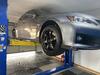
Here's what it looks like, there's plenty of fender clearances


Last edited by Slowlane; Jul 24, 2021 at 08:16 PM.
Moderator


Joined: Apr 2017
Posts: 3,069
Likes: 978
From: Indiana
Nothing of the sort. There's a balance and science to suspension, and lower /= better. This book would be worth a read. Dennis Grant has a bit more of a clue than most, including me by a far sight. https://www.amazon.com/dp/1521406987/
Suffice it to say, it's very likely your measured performance is far worse than stock at the drop you are running. The only way to know for sure is to test it, but doing the homework first will at least get you in the ballpark.
Suffice it to say, it's very likely your measured performance is far worse than stock at the drop you are running. The only way to know for sure is to test it, but doing the homework first will at least get you in the ballpark.
I understand what your saying, but also wonder why all time attack and race cars seem to be lowered? Was the CCSR lowered or stock height? I’m guessing all time attack cars have fully adjustable suspension arms that allow them to alter their geometry? I say this not at all to debate, just as a confused bystander. The fastest ISFs that I follow are all very low.
Last but not least, the most important part in any car is the nut behind the wheel. A really determined driver can overcome lots of setup problems with sheer tenacity.
But, in general, arbitrarily lowering a car without understanding what happens to the camber curves is a recipe for going slower, and often much slower than the correct ride height.
Here's an even easier read than David Grant's book from Mike Kojima: https://motoiq.com/how-to-make-crappy-cars-handle-well/
Mike is also one of those guys who has forgot more than I'll ever know about setting up suspensions.
Driver
Joined: Jun 2020
Posts: 127
Likes: 29
From: Vic
I've ordered PS4S 275/30 & and 255/35, as Lance recommended I'm going to adjust my HKS coilovers to 10mm lower than OEM.
With this set up Can someone recommend good alignment specs for decent handling without too much wear on tire edges. I've read with wider tires its best not to have too much toe.Whats better toe out or in front and rear and by how much?
With this set up Can someone recommend good alignment specs for decent handling without too much wear on tire edges. I've read with wider tires its best not to have too much toe.Whats better toe out or in front and rear and by how much?
When tire wear is your first consideration, the front with OEM bushings needs toe-in because it toes out dramatically on braking and kills the inside edges of the front tires. There's a long thread here about Reconsidering the Factory Alignment that goes into detail on this. If you put polyurethane rear LCA bushings on the front end like Figs or RR Racing sell, you can go to zero toe and get excellent wear. If you're like me and prefer the car turns in better, you can go toe-out 1/16" - 1/8" but you will have faster inside edge wear for sure.
In the rear, run the factory spec - 3mm toe-in. It shouldn't present any tire wear issues and the toe-in helps the car turn. If you have replaced rear links with polyurethane or solid bushings, you can experiment with other settings, but the factory settings work well for tire life and turn in both with the OEM bushings.
In the rear, run the factory spec - 3mm toe-in. It shouldn't present any tire wear issues and the toe-in helps the car turn. If you have replaced rear links with polyurethane or solid bushings, you can experiment with other settings, but the factory settings work well for tire life and turn in both with the OEM bushings.
Driver
Joined: Jun 2020
Posts: 127
Likes: 29
From: Vic
When tire wear is your first consideration, the front with OEM bushings needs toe-in because it toes out dramatically on braking and kills the inside edges of the front tires. There's a long thread here about Reconsidering the Factory Alignment that goes into detail on this. If you put polyurethane rear LCA bushings on the front end like Figs or RR Racing sell, you can go to zero toe and get excellent wear. If you're like me and prefer the car turns in better, you can go toe-out 1/16" - 1/8" but you will have faster inside edge wear for sure.
In the rear, run the factory spec - 3mm toe-in. It shouldn't present any tire wear issues and the toe-in helps the car turn. If you have replaced rear links with polyurethane or solid bushings, you can experiment with other settings, but the factory settings work well for tire life and turn in both with the OEM bushings.
In the rear, run the factory spec - 3mm toe-in. It shouldn't present any tire wear issues and the toe-in helps the car turn. If you have replaced rear links with polyurethane or solid bushings, you can experiment with other settings, but the factory settings work well for tire life and turn in both with the OEM bushings.
I do have front superpro bushings which l believe are the same as figs.
1/8" is around 3mm
I'll do front 3.0mm toe out and back 3.0mm toe in.
What are good cold tire pressures with hard spirited driving, 36 to 38 front, 32 to 34 rear. I have removed everything in the trunk including spare wheel, so it's a bit lighter in the back.
I might even raise the height to OEM.Thanks again.
Cheers Jim

Pit Crew

Joined: Mar 2019
Posts: 188
Likes: 127
From: Vancouver, BC
Any reason you'd want to go 4 psi lower at the rear? I'd say stick with 35-36psi cold all around and you'll be close to optimum for most street use scenarios. I understand that you're looking to maximize handling for spirited driving but IMO this is difficult to optimize as optimum pressures for handling will vary depending on model of tire, ambient temperature swing from where you park overnight to on the road, humidity, whether you use air or nitrogen in your tires, type of road, speeds, etc. A lot of these variables are constantly changing. You could try the chalk on sidewall method or take tire temps across the tread width to try and optimize for different conditions if you have the patience for it.
Driver
Joined: Jun 2020
Posts: 127
Likes: 29
From: Vic
Any reason you'd want to go 4 psi lower at the rear? I'd say stick with 35-36psi cold all around and you'll be close to optimum for most street use scenarios. I understand that you're looking to maximize handling for spirited driving but IMO this is difficult to optimize as optimum pressures for handling will vary depending on model of tire, ambient temperature swing from where you park overnight to on the road, humidity, whether you use air or nitrogen in your tires, type of road, speeds, etc. A lot of these variables are constantly changing. You could try the chalk on sidewall method or take tire temps across the tread width to try and optimize for different conditions if you have the patience for it.
Driver
Joined: Jun 2020
Posts: 127
Likes: 29
From: Vic
When tire wear is your first consideration, the front with OEM bushings needs toe-in because it toes out dramatically on braking and kills the inside edges of the front tires. There's a long thread here about Reconsidering the Factory Alignment that goes into detail on this. If you put polyurethane rear LCA bushings on the front end like Figs or RR Racing sell, you can go to zero toe and get excellent wear. If you're like me and prefer the car turns in better, you can go toe-out 1/16" - 1/8" but you will have faster inside edge wear for sure.
In the rear, run the factory spec - 3mm toe-in. It shouldn't present any tire wear issues and the toe-in helps the car turn. If you have replaced rear links with polyurethane or solid bushings, you can experiment with other settings, but the factory settings work well for tire life and turn in both with the OEM bushings.
In the rear, run the factory spec - 3mm toe-in. It shouldn't present any tire wear issues and the toe-in helps the car turn. If you have replaced rear links with polyurethane or solid bushings, you can experiment with other settings, but the factory settings work well for tire life and turn in both with the OEM bushings.
I raised the suspension 10mm front & rear, had MPS4S tires fitted today 255/35/19 Front & 275/30/19 rear. Heights are now just 4mm lower than OEM.
They maxed out the Toe, 1.9mm toe-out front and 3.1mm toe-in rear, no more toe adjustment. They said I'll be lucky to see 10,000km wear in the inside edges and recommended more neutral toe but I said I'd rather have happy 10k's than frustrating 30ks. So I went with your recommendations.
Car seems to handle much better, much more grip and no stability control lights flickering, happy days.
Many thanks Lance


Thread
Thread Starter
Forum
Replies
Last Post
ndk83
IS - 2nd Gen (2006-2013)
4
Jan 30, 2010 07:20 AM