


Suspension Flex Tests


Thread Starter

Joined: Oct 2008
Posts: 42,476
Likes: 321
From: California
 Suspension Flex Tests
There’s no need to explain the Toyota Land Cruiser, one of Toyota’s earliest successful products. The 2020 Toyota Land Cruiser Heritage Edition celebrates some 60 years of popularity of a vehicle that has survived the segment’s “mall wagon” phase and the rise of crossovers. Its already-sterling reputation has received an additional recent push from the rise of overlanding — an outdoor pastime that has always existed but only recently got a press agent.
By comparison, the Lexus LX is a more recent development. Debuting in 1996, the LX 470 was little more than an 80-series Land Cruiser with cladding, a Lexus badge and a higher price. The amount of styling differentiation and luxury specialization has increased over the years to the point that the newest LX 570 actually seems like a completely different vehicle.
In truth, the 2020 Lexus LX 570 and the 2020 Toyota Land Cruiser are both 200-series Land Cruisers under the skin. They share the same thirsty 5.7-liter V8 engine and the same frame that features a double-wishbone suspension at the front, a five-link coil spring suspension at the rear and a 112.2-inch wheelbase in the middle. The styling is strikingly different, of course, but so are the hidden details of their suspensions.
The Land Cruiser employs a simple set of coil springs and shock absorbers, but with an interconnected pair of automatically disconnecting stabilizer bars called KDSS (Kinetic Dynamic Suspension System). The Lexus, on the other hand, has fixed stabilizer bars and coil springs, but its “shocks” are really hydraulic cylinders that perform height adjustments and transmit suspension movements via piping to remote electronically-adjustable damper valves mounted along the frame rails.
All of the above begs a question: Which of them will go farther up my RTI ramp and, by extension, offer better suspension articulation in an authentic off-road situation?
By comparison, the Lexus LX is a more recent development. Debuting in 1996, the LX 470 was little more than an 80-series Land Cruiser with cladding, a Lexus badge and a higher price. The amount of styling differentiation and luxury specialization has increased over the years to the point that the newest LX 570 actually seems like a completely different vehicle.
In truth, the 2020 Lexus LX 570 and the 2020 Toyota Land Cruiser are both 200-series Land Cruisers under the skin. They share the same thirsty 5.7-liter V8 engine and the same frame that features a double-wishbone suspension at the front, a five-link coil spring suspension at the rear and a 112.2-inch wheelbase in the middle. The styling is strikingly different, of course, but so are the hidden details of their suspensions.
The Land Cruiser employs a simple set of coil springs and shock absorbers, but with an interconnected pair of automatically disconnecting stabilizer bars called KDSS (Kinetic Dynamic Suspension System). The Lexus, on the other hand, has fixed stabilizer bars and coil springs, but its “shocks” are really hydraulic cylinders that perform height adjustments and transmit suspension movements via piping to remote electronically-adjustable damper valves mounted along the frame rails.
All of the above begs a question: Which of them will go farther up my RTI ramp and, by extension, offer better suspension articulation in an authentic off-road situation?

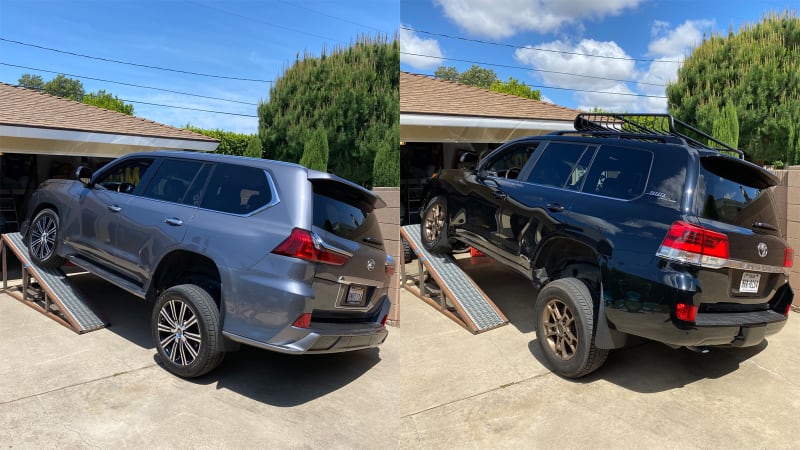
Right away, the very approach to the ramp demonstrates a huge difference and a serious issue for the LX. Its normal cruising height (there is a lower height, but this isn’t that) doesn’t provide enough approach clearance to attempt the ramp. The front spoiler contacts the nasty grating before the tire does. It’s a close-run thing, but from this point on, clearance gets SMALLER as the left front suspension compresses on the way up. If it's touching now, it’s only going to get worse if I go forward.
It must be noted that this LX570 test sample is fitted with the optional “Sport Package” that consists of, among other things, an even more aggressively-styled front fascia with built in “spoilers” that do a fantastic job of living up to the primary definition of the word by ruining approach clearance directly in front of the tires. Things surely would have been different if this LX 570 lacked this $2,510 appearance package.
But our LX 570 isn’t out of this fight yet. Its four-wheel height control system includes a switch that raises the front 2 inches and the rear 2.4 inches. That’s more than enough to give it the clearance it needs to drive up the ramp. But I discovered a problem when I pressed the switch to put it in high mode: The system raises the rear axle first, which has the effect of driving the barely-touching nose firmly into the ramp. The front doesn’t begin to rise until after the rear is fully raised. This seems backwards. You approach obstacles at the front, so the front should lift first.
Meanwhile, the Land Cruiser, which only has one fixed height, has no trouble motoring right on up the ramp.
It must be noted that this LX570 test sample is fitted with the optional “Sport Package” that consists of, among other things, an even more aggressively-styled front fascia with built in “spoilers” that do a fantastic job of living up to the primary definition of the word by ruining approach clearance directly in front of the tires. Things surely would have been different if this LX 570 lacked this $2,510 appearance package.
But our LX 570 isn’t out of this fight yet. Its four-wheel height control system includes a switch that raises the front 2 inches and the rear 2.4 inches. That’s more than enough to give it the clearance it needs to drive up the ramp. But I discovered a problem when I pressed the switch to put it in high mode: The system raises the rear axle first, which has the effect of driving the barely-touching nose firmly into the ramp. The front doesn’t begin to rise until after the rear is fully raised. This seems backwards. You approach obstacles at the front, so the front should lift first.
Meanwhile, the Land Cruiser, which only has one fixed height, has no trouble motoring right on up the ramp.

The Land Cruiser’s advantage is clear. It is able to drive about 8 inches farther up the ramp than the LX before the left-rear tires of both vehicles lose contact with my driveway and start spinning.
Such a visual comparison isn’t always meaningful when different makes and models compete for honors on the ramp, but it works here because they have precisely the same wheelbase.
Such a visual comparison isn’t always meaningful when different makes and models compete for honors on the ramp, but it works here because they have precisely the same wheelbase.

Even when set to high mode, the LX is still in worse shape at the top of the ramp than the Land Cruiser. I can barely swipe my index finger through the gap, and only if flat; it won’t fit sideways. This reaffirms my decision to award zero points to the LX in normal mode because the vehicle would drop 2 inches and crush its front bodywork if I were to engage it now.
Meanwhile, the Land Cruiser’s front fascia stands high enough that I can fit my whole hand in there with room to spare. I’m not worried about the flap in the background because it is flexible enough to move out of the way. It’s also a hidden unpainted piece that sits farther back.
This comparison illustrates that the LX's spoiler isn’t just harming the approach angle because it’s lower, it’s also causing difficulty because it juts farther forward. The spoiler is about the same distance from the camera even though the LX’s tire (and its general bulk) are some 8 inches farther away down the ramp.
Meanwhile, the Land Cruiser’s front fascia stands high enough that I can fit my whole hand in there with room to spare. I’m not worried about the flap in the background because it is flexible enough to move out of the way. It’s also a hidden unpainted piece that sits farther back.
This comparison illustrates that the LX's spoiler isn’t just harming the approach angle because it’s lower, it’s also causing difficulty because it juts farther forward. The spoiler is about the same distance from the camera even though the LX’s tire (and its general bulk) are some 8 inches farther away down the ramp.

The opposite corner — passenger side rear — is at full compression, with both suspensions resting on their bump stops. There doesn’t seem to be much of a difference in flex back here.
That said, a small difference is apparent if I put my fingers in above the tire. I can fit three in the LX, but I have to bend one back to do the same in the Land Cruiser. Call it 2 1/2 or 2 3/4. Both tires are said to have the same overall rolling diameter, but the Land Cruiser’s sidewalls are 1.5 inches taller. They’ll compress more at the bottom, so I suppose they could likewise distort upward at the top a small amount.
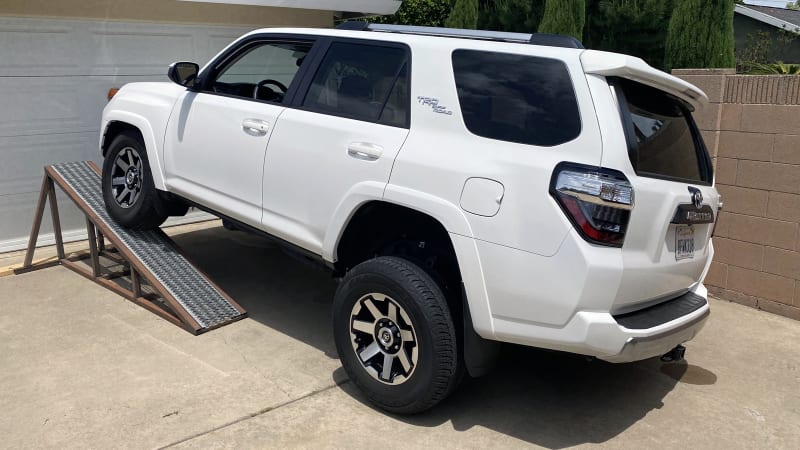
Lower down, the seam in my driveway and the warp in the mudflaps further illustrates how much farther the Land Cruiser was able to climb and pitch its nose up.
That said, a small difference is apparent if I put my fingers in above the tire. I can fit three in the LX, but I have to bend one back to do the same in the Land Cruiser. Call it 2 1/2 or 2 3/4. Both tires are said to have the same overall rolling diameter, but the Land Cruiser’s sidewalls are 1.5 inches taller. They’ll compress more at the bottom, so I suppose they could likewise distort upward at the top a small amount.
Lower down, the seam in my driveway and the warp in the mudflaps further illustrates how much farther the Land Cruiser was able to climb and pitch its nose up.

The amount of flex looks to be quite similar from this side, too. But the tires really stand out here. The LX 570 comes standard with 20-inch wheels and tires, but this one has the optional 21-inch upgrade. The term upgrade is debatable on a whole host of fronts, but it's a clear negative when it comes to off-highway performance. The Land Cruiser, on the other hand, rides on 18-inch wheels and tires that make much more sense off road. The Heritage Edition comes with special BBS forged wheels that are lighter than the standard Land Cruiser 18-inch fitment.

The difference in suspension flexibility is most apparent up front, where the Land Cruiser’s front tire tucks much farther up into the wheel well. This extra flex is why it can drive farther up the ramp, as evidenced by my two pieces of blue tape. The Land Cruiser’s disconnectable KDSS stabilizer bars may deserve credit here, but I’m not able to confirm that because I couldn’t drive the LX 570 up the ramp in its normal height mode to make a direct comparison.
Why does this Hi mode matter to this measurement? Height-adjustable suspensions typically articulate more in normal height mode than they do in any raised mode. The mechanism that makes the vehicle rise does so by making the suspension stiffer, which lessens the amount of suspension compression for a given level of force. The LX’s front tire would almost certainly compress farther up into the fender in normal mode and climb higher up the ramp, but there isn’t enough approach clearance to attempt that measurement.
Why does this Hi mode matter to this measurement? Height-adjustable suspensions typically articulate more in normal height mode than they do in any raised mode. The mechanism that makes the vehicle rise does so by making the suspension stiffer, which lessens the amount of suspension compression for a given level of force. The LX’s front tire would almost certainly compress farther up into the fender in normal mode and climb higher up the ramp, but there isn’t enough approach clearance to attempt that measurement.

Here’s what all of this boils down to in terms of Ramp Travel Index, which is the distance a vehicle climbs up the ramp divided by its wheelbase — multiplied by 1,000 to remove any pesky decimals and make things more interesting.
Here are the results:
LX 570, normal mode: 0 inches of climb ÷ 112.2 x 1,000 = 0 points
LX 570, high mode: 66 inches of climb ÷ 112.2 x 1,000 = 588 points
Land Cruiser: 74.2 inches of climb ÷ 112.2 x 1,000 = 661 points
Conclusions:
First, the Land Cruiser is very capable right out of the box; 661 points is no joke. That’s more than a Gladiator Rubicon can manage with its stabilizer bar disconnected. Also, the LX 570’s high mode score of 588 points is still impressive in its own right. A TRD Tacoma can’t manage 500 points, if you need a reference point.
But the LX’s so-called Sport Package absolutely ruins the approach angle in normal mode, and it’s barely passable even in high mode. Do not get the Sport Package if you’re eyeing the LX 570 for any sort of off-pavement touring.
It’s hard to know what the lack of the Sport Package would mean to the LX. The extra chin clearance would certainly allow it to make a ramp attempt in normal mode, and it would certainly score higher. Would it be enough to match the Land Cruiser? It’s hard to say, but 661 points is only 8.2 inches away. It is the same chassis, so it might manage it if the fixed stabilizer bars don’t get in the way.
I’d love to conduct that test, but I can already tell I wouldn’t bother with the LX 570 if I had overlanding in mind. Its adaptive variable suspension and street-focused wheel and tire package are there to please pavement cruisers, and the sheer complexity of the system makes it impossible to install a spring and shock upgrade without ripping it all out and dealing with the blinking warning lights that would inevitably mark its absence.
The answer is right there in the name: if you want to get out there and cruise on some land, get the Toyota Land Cruiser.
Here are the results:
LX 570, normal mode: 0 inches of climb ÷ 112.2 x 1,000 = 0 points
LX 570, high mode: 66 inches of climb ÷ 112.2 x 1,000 = 588 points
Land Cruiser: 74.2 inches of climb ÷ 112.2 x 1,000 = 661 points
Conclusions:
First, the Land Cruiser is very capable right out of the box; 661 points is no joke. That’s more than a Gladiator Rubicon can manage with its stabilizer bar disconnected. Also, the LX 570’s high mode score of 588 points is still impressive in its own right. A TRD Tacoma can’t manage 500 points, if you need a reference point.
But the LX’s so-called Sport Package absolutely ruins the approach angle in normal mode, and it’s barely passable even in high mode. Do not get the Sport Package if you’re eyeing the LX 570 for any sort of off-pavement touring.
It’s hard to know what the lack of the Sport Package would mean to the LX. The extra chin clearance would certainly allow it to make a ramp attempt in normal mode, and it would certainly score higher. Would it be enough to match the Land Cruiser? It’s hard to say, but 661 points is only 8.2 inches away. It is the same chassis, so it might manage it if the fixed stabilizer bars don’t get in the way.
I’d love to conduct that test, but I can already tell I wouldn’t bother with the LX 570 if I had overlanding in mind. Its adaptive variable suspension and street-focused wheel and tire package are there to please pavement cruisers, and the sheer complexity of the system makes it impossible to install a spring and shock upgrade without ripping it all out and dealing with the blinking warning lights that would inevitably mark its absence.
The answer is right there in the name: if you want to get out there and cruise on some land, get the Toyota Land Cruiser.

cool comparo, but as always the primary buyers of these vehicles are unlikely to explore the extents of their capabilities shown here.
i still find it super crazy how they price the land cruisers! perhaps i just don't get why it's so good, and worth the asking price of over $80k...
i still find it super crazy how they price the land cruisers! perhaps i just don't get why it's so good, and worth the asking price of over $80k...
Thread Starter
Joined: Oct 2008
Posts: 42,476
Likes: 321
From: California
You’ve seen this particular Toyota 4Runner before because it was the subject of the first Suspension Deep Dive I wrote for Autoblog. It’s still hanging around my driveway and available to make the occasional repeat appearance because, well, it’s mine. I chose the TRD Off-Road for a couple of reasons, some of which will come into play on my Flex Index ramp.
First, it’s the only model other than the TRD Pro that comes with a push-button locking rear differential, electronic crawl control and multi-terrain select. Second, it can cost as much as $10,000 less than a TRD Pro, particularly if you’re content with cloth seating and no sunroof, as I am. I used some of the money I saved to buy the third item: an option called KDSS, the Kinetic Dynamic Suspension System. Importantly, this clever option can only be fitted to a TRD Off-Road; it’s not even available on the TRD Pro.
I absolutely wanted KDSS because that incomprehensible acronym stands for a very useful feature: automatically disconnecting front and rear stabilizer bars. This capability is a boon to off-roading because it does wonders for articulation. But KDSS isn’t just for hardcore off-roaders. It also improves everyday stability because the ability to disconnect the stabilizer bars allowed Toyota the freedom to specify much fatter stabilizer bars than you’d find on a 4Runner that lacks KDSS. This means my KDSS-equipped 4Runner will handle better on the way to the trailhead and be more stable if I load gear on the roof or buy a roof-top tent.
I didn’t have my Flex Index ramp when I put together the Suspension Deep Dive of the 4Runner, but the ramp is the perfect way to show what KDSS can do. It also allows me to safely crawl underneath and show how the system works its magic in a frame-twist situation that simulates a common off-road scenario.
First, it’s the only model other than the TRD Pro that comes with a push-button locking rear differential, electronic crawl control and multi-terrain select. Second, it can cost as much as $10,000 less than a TRD Pro, particularly if you’re content with cloth seating and no sunroof, as I am. I used some of the money I saved to buy the third item: an option called KDSS, the Kinetic Dynamic Suspension System. Importantly, this clever option can only be fitted to a TRD Off-Road; it’s not even available on the TRD Pro.
I absolutely wanted KDSS because that incomprehensible acronym stands for a very useful feature: automatically disconnecting front and rear stabilizer bars. This capability is a boon to off-roading because it does wonders for articulation. But KDSS isn’t just for hardcore off-roaders. It also improves everyday stability because the ability to disconnect the stabilizer bars allowed Toyota the freedom to specify much fatter stabilizer bars than you’d find on a 4Runner that lacks KDSS. This means my KDSS-equipped 4Runner will handle better on the way to the trailhead and be more stable if I load gear on the roof or buy a roof-top tent.
I didn’t have my Flex Index ramp when I put together the Suspension Deep Dive of the 4Runner, but the ramp is the perfect way to show what KDSS can do. It also allows me to safely crawl underneath and show how the system works its magic in a frame-twist situation that simulates a common off-road scenario.


There was plenty of clearance when I nosed up to the ramp, but I knew that beforehand. That’s because this is a 20-degree ramp, and my Toyota 4Runner TRD Off-Road 4x4 has a full 33 degrees of approach clearance. But it's even better than that as far as ramp clearance is concerned.
The approach angle is typically measured under the chin of the front bumper or the leading edge of the skidplate — whatever is lowest. Sometimes a low-hanging tow hook will define the number. But the zone that arguably matters more is this area directly in front of the tires because off-road drivers tackle most obstacles by putting a wheel on a convenient ledge or rock instead of straddling it. The front fascia of the 4Runner (and the Tacoma) is cut up and back at the corners so there is extra approach clearance in this critical area.
The approach angle is typically measured under the chin of the front bumper or the leading edge of the skidplate — whatever is lowest. Sometimes a low-hanging tow hook will define the number. But the zone that arguably matters more is this area directly in front of the tires because off-road drivers tackle most obstacles by putting a wheel on a convenient ledge or rock instead of straddling it. The front fascia of the 4Runner (and the Tacoma) is cut up and back at the corners so there is extra approach clearance in this critical area.
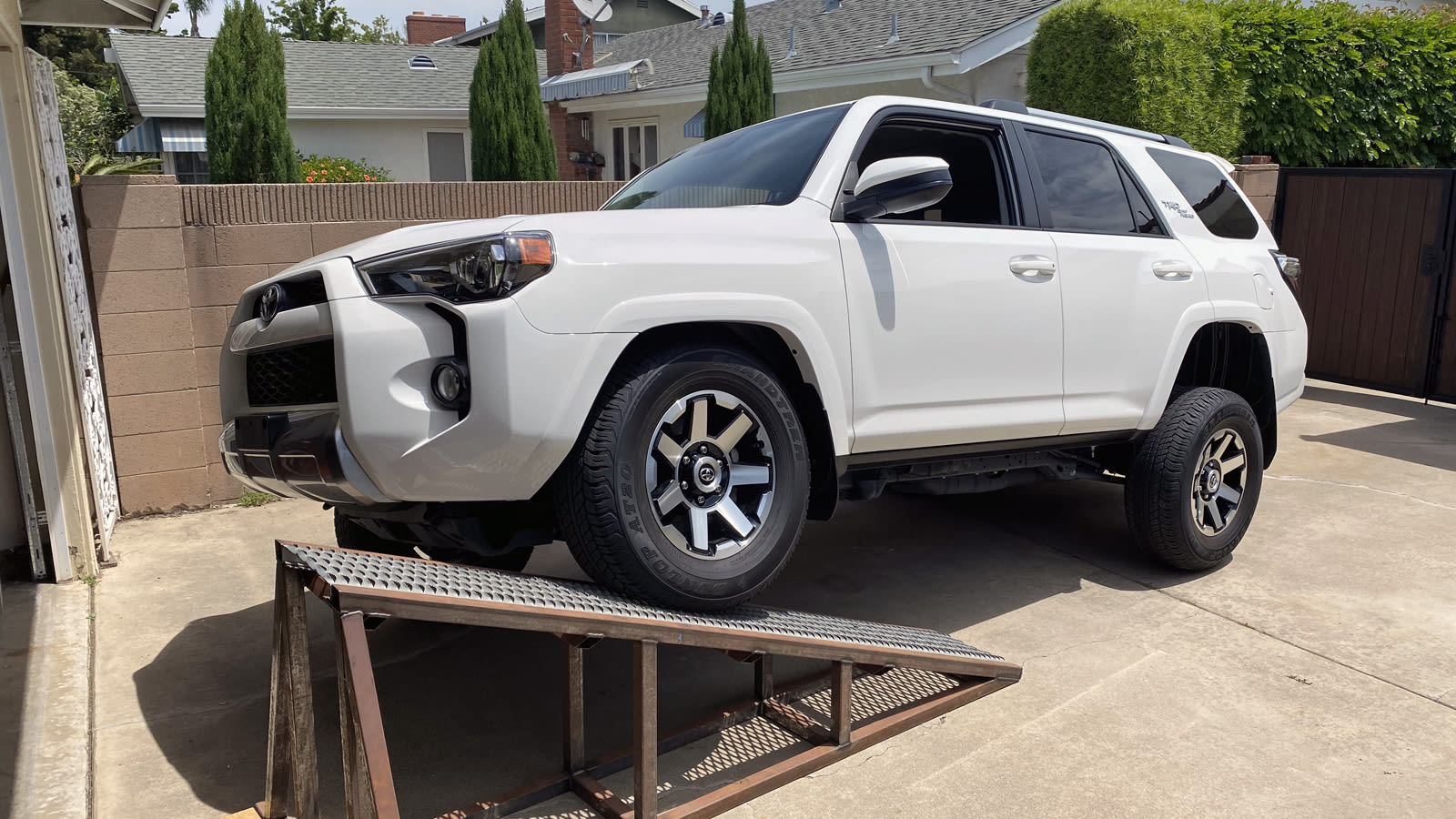
My 4Runner traveled a good ways up the ramp before a sliver of daylight appeared under its left-rear tire. I chose to engage my rear differential lock to climb slightly past the tipping point, however, because I know that 4Runners tend to roll back slightly after you set the foot-operated parking brake. It’s a function of how drum parking brakes take up the slack and self-energize on a slope.
It took a couple of tries to get it parked at the precise point where the tire just barely touched the ground after my weight was subtracted from the vehicle (ie: I climbed out) but could be easily lifted clear of the concrete with a finger or two. So positioned, it was time to make my measurements.
Warning! Math Content Ahead
The wheel lift height measured = 20.83 inches.
Divide that by the sine of 20 degrees (the ramp’s angle) to get the ramp climb distance.
Ramp climb distance = 60.9 inches.
The wheelbase of the 4Runner is 109.8 inches.
Divide ramp climb by wheelbase and multiply the result by 1,000 to get the Flex Index.
4Runner TRD Off-Road w/KDSS Flex Index score = 555 points
That’s a healthy score for an affordable mid-size SUV right out of the box. KDSS is clearly making a difference. Let’s see what it’s doing.
It took a couple of tries to get it parked at the precise point where the tire just barely touched the ground after my weight was subtracted from the vehicle (ie: I climbed out) but could be easily lifted clear of the concrete with a finger or two. So positioned, it was time to make my measurements.
Warning! Math Content Ahead
The wheel lift height measured = 20.83 inches.
Divide that by the sine of 20 degrees (the ramp’s angle) to get the ramp climb distance.
Ramp climb distance = 60.9 inches.
The wheelbase of the 4Runner is 109.8 inches.
Divide ramp climb by wheelbase and multiply the result by 1,000 to get the Flex Index.
4Runner TRD Off-Road w/KDSS Flex Index score = 555 points
That’s a healthy score for an affordable mid-size SUV right out of the box. KDSS is clearly making a difference. Let’s see what it’s doing.

The bumper-to-ramp clearance diminishes during the climb, but there’s still quite a bit left at the top. The nearest point is still 6 inches away even with the front tire buried in the wheel well.
But there’s something else to notice here. The front stabilizer bar was previously located down low near the skidplate, but it has moved up considerably now that I’ve driven up the ramp.
But there’s something else to notice here. The front stabilizer bar was previously located down low near the skidplate, but it has moved up considerably now that I’ve driven up the ramp.
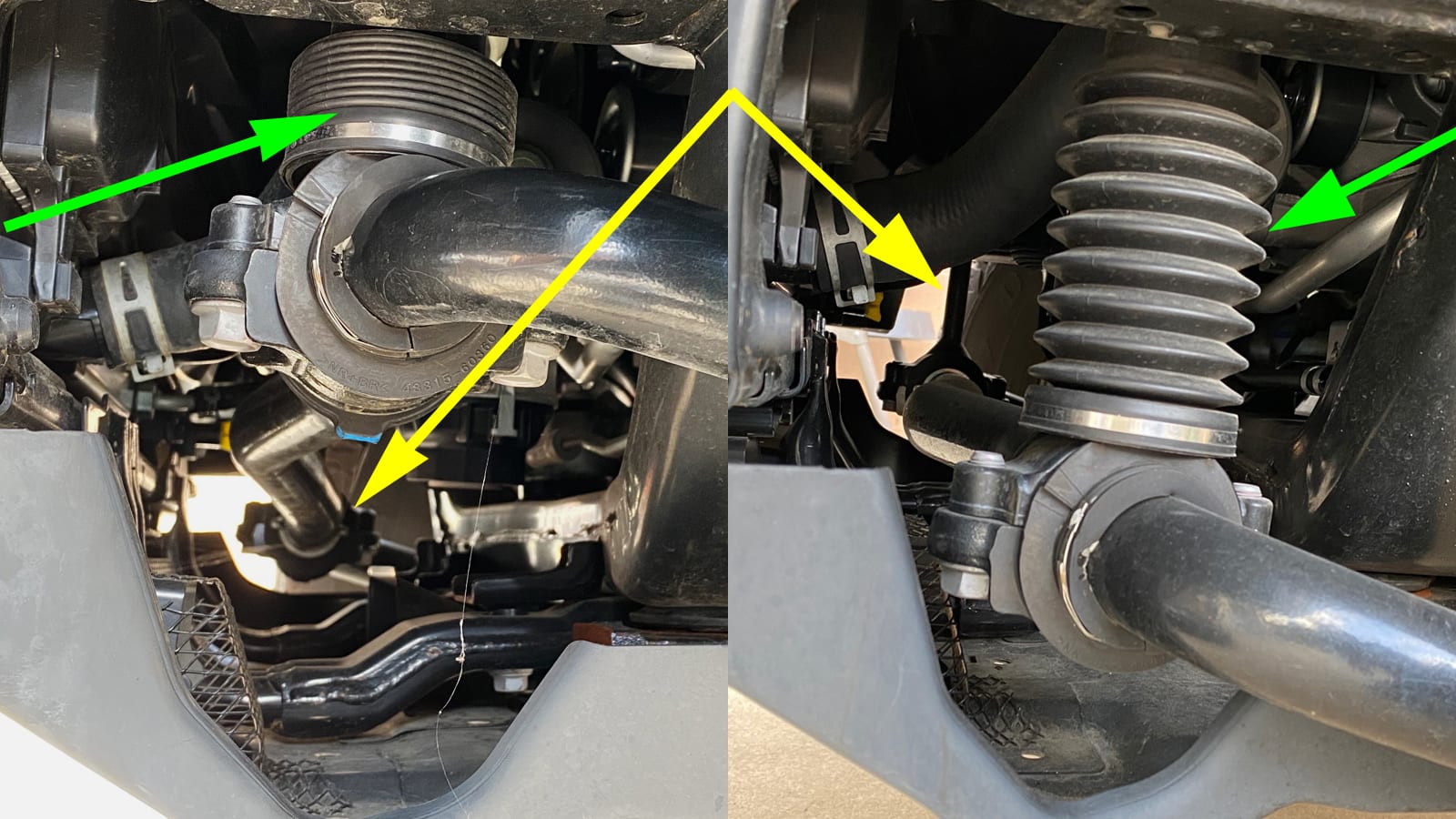
This side-by-side image shows the difference. On the right we have the fixed neutral position that KDSS maintains when driving on the street. The KDSS hydraulic strut (green arrow) is rigid and unmoving in normal driving. Its partner on the passenger side (yellow) is a solid fixed-length rod. Together they hold the pivot point firmly in space so the stabilizer bar can twist and develop roll resistance that suppresses body roll.
The left image shows what happens when the system encounters a mogul or some other kind of off-road frame-twist situation, the exact scenario that is simulated by my ramp. This change happened automatically as I drove up. I didn’t push any buttons.
The once-rigid strut (green) has gone limp. But its partner on the other side is in the same place as before because it’s a fixed-length rod. This difference allows the stabilizer bar to wobble in place instead of twisting. No roll resistance can be developed; its anti-roll function has been neutralized. From the vehicle’s point of view, it’s like the stabilizer bar isn’t even there.
The left image shows what happens when the system encounters a mogul or some other kind of off-road frame-twist situation, the exact scenario that is simulated by my ramp. This change happened automatically as I drove up. I didn’t push any buttons.
The once-rigid strut (green) has gone limp. But its partner on the other side is in the same place as before because it’s a fixed-length rod. This difference allows the stabilizer bar to wobble in place instead of twisting. No roll resistance can be developed; its anti-roll function has been neutralized. From the vehicle’s point of view, it’s like the stabilizer bar isn’t even there.

And that’s why the suspension flexes enough to shove the left-front tire up into the fender wheel on the way to scoring 555 Flex Index points. One thing I can’t help noticing is there's still enough room for larger-diameter tires. Yes, a ramp like this is a good way to perform clearance checks.

Here I’ve drawn a line to show how the stabilizer bar is oriented up behind the skid plate. It’s pretty much parallel with a line between the tire contact patches instead of the body, as it would be if this 4Runner didn’t have KDSS. By flopping loose it stays parallel to the footprint between the front tires. Since it doesn’t twist, it can’t generate any roll resistance. What we get instead is unrestricted wheel articulation.

This side-by-side image shows what’s happening at the rear. As before, the right-hand side is what the KDSS strut looks like when the vehicle is being driven on pavement. The strut stays rigid and unmoving, so the stabilizer bar twists in corners to develop torque that limits the amount of body roll. That’s why stabilizer bars are also called anti-roll bars or anti-sway bars.
On the left, my short trip up the ramp has caused the KDSS strut to grow instead of shrink. That’s consistent with a mogul or frame-twist situation (also why we call something like this a frame-twist situation), and indeed the fact the front and rear are doing the opposite thing is precisely why KDSS not only works, but does so automatically.
I lack a cutaway to explain the plumbing, but suffice it to say the front and rear struts are connected. When both are trying to compress in a corner, the fluid from each cylinder buts heads and reaches a stalemate where they meet in the middle of the vehicle. The result: no fluid flow, locked cylinders and functioning stabilizer bars. But each is moving the opposite from each other in a frame twist situation. The fluid flow is complimentary, so it circulates from front to back freely, which allows free strut movement and wobbling, ineffective stabilizer bars.
On the left, my short trip up the ramp has caused the KDSS strut to grow instead of shrink. That’s consistent with a mogul or frame-twist situation (also why we call something like this a frame-twist situation), and indeed the fact the front and rear are doing the opposite thing is precisely why KDSS not only works, but does so automatically.
I lack a cutaway to explain the plumbing, but suffice it to say the front and rear struts are connected. When both are trying to compress in a corner, the fluid from each cylinder buts heads and reaches a stalemate where they meet in the middle of the vehicle. The result: no fluid flow, locked cylinders and functioning stabilizer bars. But each is moving the opposite from each other in a frame twist situation. The fluid flow is complimentary, so it circulates from front to back freely, which allows free strut movement and wobbling, ineffective stabilizer bars.

It’s easier to see how the rear axle and the rear stabilizer bar have remained parallel. There’s no twist in that stabilizer bar because the strut has lengthened relative to its fixed partner on the other side. The only reason neither is parallel to the ground is because of what’s happening to the tires themselves.

Here’s what I mean. The right rear is compressed much more than usual. And as we’ve seen a couple of images back the left rear tire is essentially unloaded (and round) all the way ‘round.

My Suspension Deep Dive revealed that the 4Runner can be said to have two bump stops that work in stages. The first stage is a large rubber overload spring/bumper (yellow) that gives extra support when the vehicle is loaded. In this frame twist scenario we can see that the supplemental overload spring/bumper has grounded out. The main bump stop hasn’t touched down yet. There’s a little bit of margin that might come into play if this was a more dynamic situation. But it’s also a reminder that spring stiffness can also define the limit of off-road articulation.[/QUOTE][QUOTE]
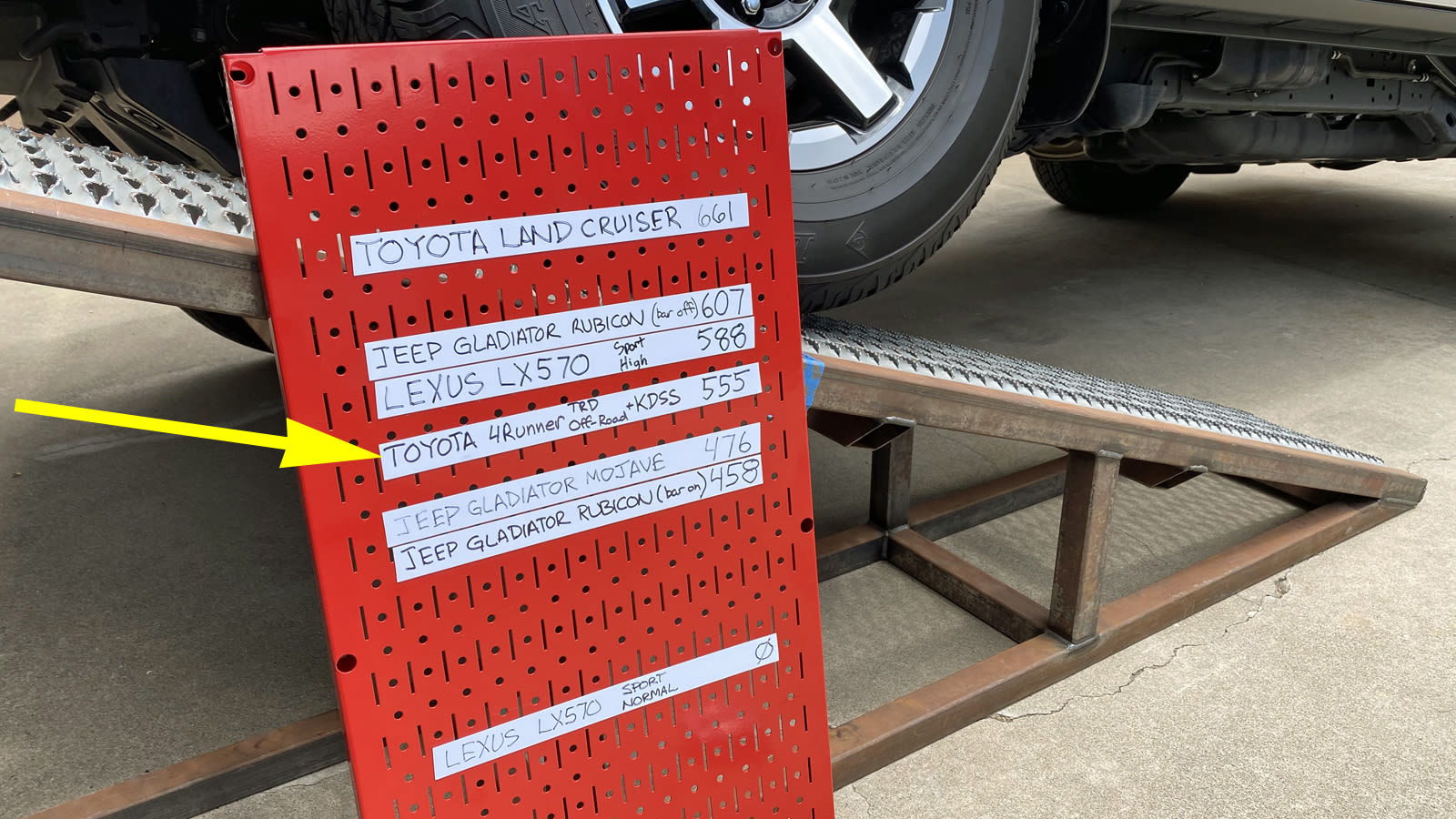
Here’s how the 4Runner measures up to other vehicles I have measured recently. It’s in good company. It clearly bests the Gladiator Mojave, but the Land Cruiser — which also has KDSS — eats it for lunch. That’s intentional on Toyota’s part. I used to be an insider there, and the Land Cruiser was always engineered to be the top dog. The 4Runner would never be allowed to out-perform it. It’s a bit like Porsche’s approach to the 911 and the Cayman.
For my money, quite literally, the 4Runner still wins. It’s a lot cheaper than a Land Cruiser, and its narrower dimensions allow it to fit through tighter squeezes and be less susceptible to the plant-caused paint ruination that we in the west call Desert Stripe. More than anything, the 4Runner’s articulation can be quite strong if you buy the TRD Off-Road with the clever and transparent KDSS option.
For my money, quite literally, the 4Runner still wins. It’s a lot cheaper than a Land Cruiser, and its narrower dimensions allow it to fit through tighter squeezes and be less susceptible to the plant-caused paint ruination that we in the west call Desert Stripe. More than anything, the 4Runner’s articulation can be quite strong if you buy the TRD Off-Road with the clever and transparent KDSS option.

Lexus Champion


Joined: Jan 2012
Posts: 17,087
Likes: 514
From: Knoxville, TN
Awesome posts, thank you. From someone in the market for an LX.
I wonder how the pre-2016 model would work out. (My desired year)
It has beefier tires and 20 inch rims, and better approach and departure angles.
Current LX with those rims and tires is way too much rim and too little sidewall. That said, those 21" rims may be the most gorgeous rims I've ever seen from Lexus.
I wonder how the pre-2016 model would work out. (My desired year)
It has beefier tires and 20 inch rims, and better approach and departure angles.
Current LX with those rims and tires is way too much rim and too little sidewall. That said, those 21" rims may be the most gorgeous rims I've ever seen from Lexus.
Thread Starter
Joined: Oct 2008
Posts: 42,476
Likes: 321
From: California
The Ultimate Toyota Off-Road SUV Suspension Flex Test
Toyota RAV4 TRD Off-Road vs 4Runner TRD Off-Road vs Land Cruiser Heritage Edition
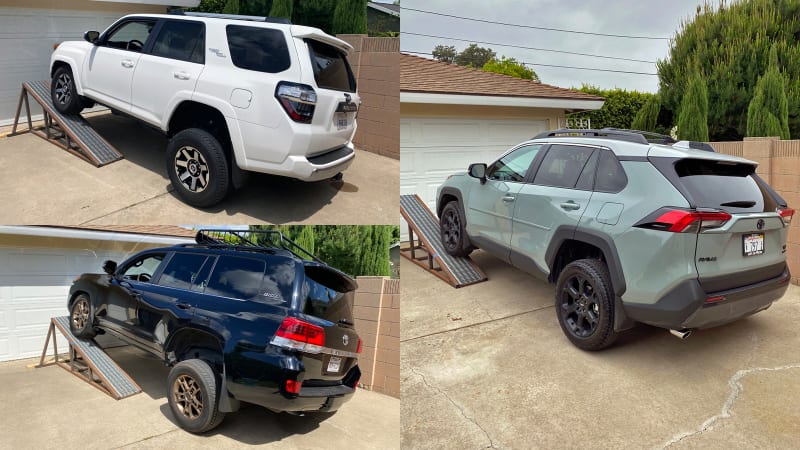
As I sit down to write this, it’s dawning on me that I have owned all three of these vehicles at one point or another. The Toyota 4Runner TRD Off-Road is the one that currently shades my driveway. You’ve seen it before. Twice.
But I actually brought my wife and newborn daughter home from the hospital in a 1996 Toyota RAV4, a four-door model with a manual transmission, lockable center differential and a Torsen rear differential. It may have looked like a hiking boot, but it handled like a rally car on my dirt road commute, which was so utterly deserted I could fully exploit the route’s numerous corners and float over its perfectly-shaped jump.
My 1993 Toyota Land Cruiser was an 80-series with solid axles that made it an obstinate pig on that same washboarded road. But it redeemed itself by being an absolute go-anywhere beast on the rocky trails in the nearby mountains. After some 100,000 miles, I swapped it for a minivan after we moved back to California with two kids in tow, which is not even close to the dumbest automotive decision I’ve made — even if it reads like it in print.
I never had the chance to put those two on a Flex Index ramp, but I can certainly do that with their modern successors. The 2020 Toyota RAV4 TRD Off-Road, Toyota 4Runner TRD Off-Road and Toyota Land Cruiser Heritage Edition occupy the same market slots as their predecessors, so I’m interested to see how the three of them measure up on the ramp.
But I actually brought my wife and newborn daughter home from the hospital in a 1996 Toyota RAV4, a four-door model with a manual transmission, lockable center differential and a Torsen rear differential. It may have looked like a hiking boot, but it handled like a rally car on my dirt road commute, which was so utterly deserted I could fully exploit the route’s numerous corners and float over its perfectly-shaped jump.
My 1993 Toyota Land Cruiser was an 80-series with solid axles that made it an obstinate pig on that same washboarded road. But it redeemed itself by being an absolute go-anywhere beast on the rocky trails in the nearby mountains. After some 100,000 miles, I swapped it for a minivan after we moved back to California with two kids in tow, which is not even close to the dumbest automotive decision I’ve made — even if it reads like it in print.
I never had the chance to put those two on a Flex Index ramp, but I can certainly do that with their modern successors. The 2020 Toyota RAV4 TRD Off-Road, Toyota 4Runner TRD Off-Road and Toyota Land Cruiser Heritage Edition occupy the same market slots as their predecessors, so I’m interested to see how the three of them measure up on the ramp.
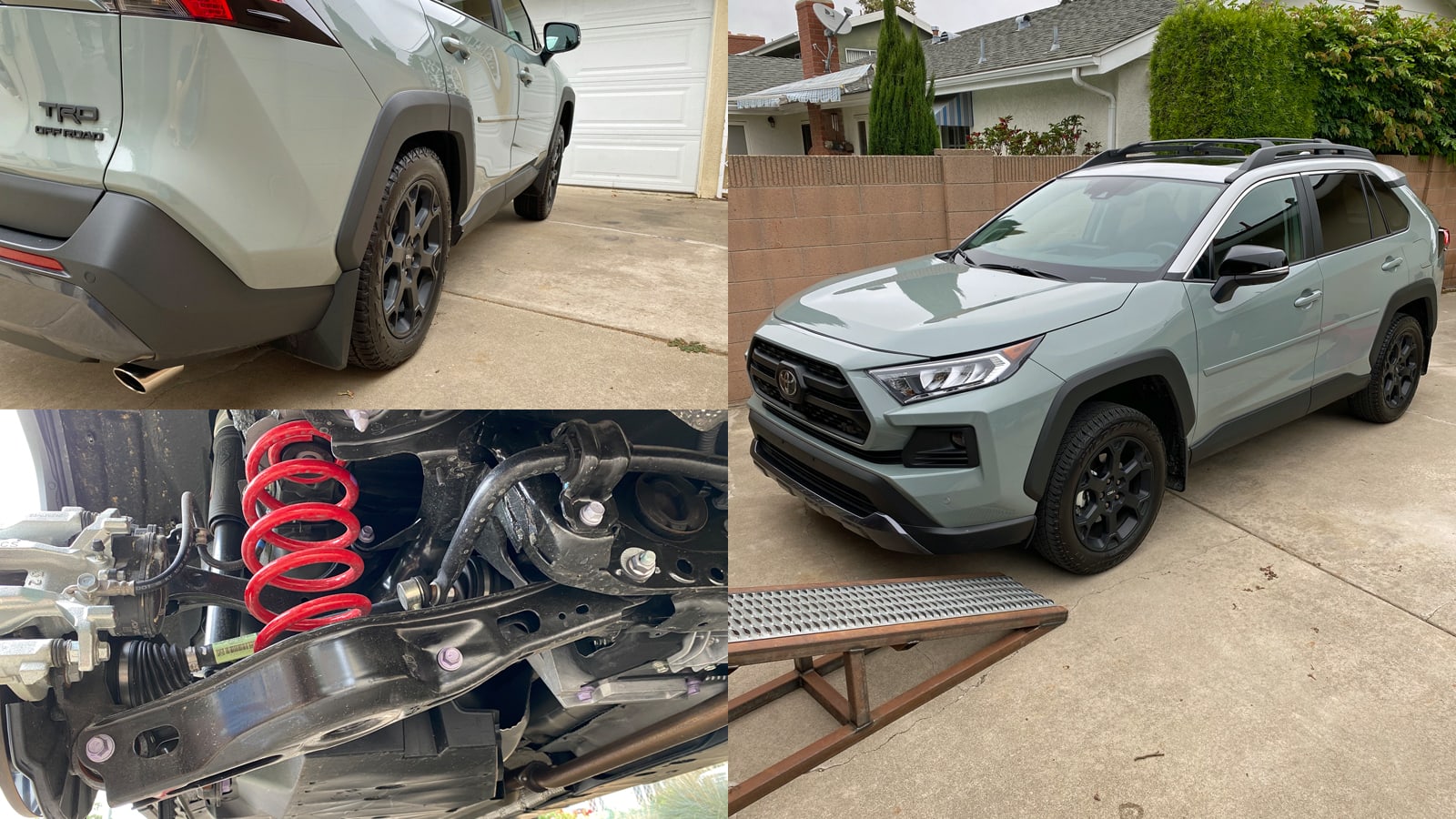
The RAV4 TRD Off-Road is a new trim level for 2020. Besides being garnished with TRD badging and special interior trim, it is fitted with TRD-calibrated springs, shocks and bump stops, taller fender flares, blacked-out 18-inch wheels and Falken Wildpeak AT Trail tires. The raised sidewall lettering on the tires looks far knobbier than the tread itself, but they do all right.
All RAV4s share an approach angle of 19 degrees, which doesn’t seem like enough to tackle a 20-degree ramp. But that’s measured at the lowest point in the middle of the bumper’s span, and the RAV4’s fascia kicks up out toward the tires. In this case it was just enough to clear the ramp.
All RAV4s share an approach angle of 19 degrees, which doesn’t seem like enough to tackle a 20-degree ramp. But that’s measured at the lowest point in the middle of the bumper’s span, and the RAV4’s fascia kicks up out toward the tires. In this case it was just enough to clear the ramp.

The RAV4 TRD Off-Road comes with a forward-facing camera, but the ramp/bumper interface is back behind the lens where it can’t see. I had to stop and get out to make sure that I knew it would clear back under there.
Through it all, the front proximity sensors didn’t know what to make of the looming ramp. But they were easy enough to mute using the OK button on the left-hand steering-wheel spoke once I saw the helpful on-screen message. I normally refer to such a feature as the Taco Bell button because I find them to be an absolute necessity when I’m lined up at a drive-thru.
The RAV4 didn’t climb up terribly far, but it was able to drive right on past the point of tire lift-off without any of the usual tire-squealing drama. That’s because the TRD Off-Road is one of three RAV4 trims, along with the Adventure and AWD-equipped Limited, that has a torque-vectoring rear differential. I had the luxury of backing down to carefully place the vehicle at the exact point of liftoff.
Through it all, the front proximity sensors didn’t know what to make of the looming ramp. But they were easy enough to mute using the OK button on the left-hand steering-wheel spoke once I saw the helpful on-screen message. I normally refer to such a feature as the Taco Bell button because I find them to be an absolute necessity when I’m lined up at a drive-thru.
The RAV4 didn’t climb up terribly far, but it was able to drive right on past the point of tire lift-off without any of the usual tire-squealing drama. That’s because the TRD Off-Road is one of three RAV4 trims, along with the Adventure and AWD-equipped Limited, that has a torque-vectoring rear differential. I had the luxury of backing down to carefully place the vehicle at the exact point of liftoff.

My old RAV4’s Torsen wouldn’t have been able to pull this off because a Torsen needs the lightly-loaded tire to at least offer SOME resistance to transfer torque to the loaded side. In a case like this it’d have spun like an open differential.
In the end, the RAV4 TRD Off-Road generated 11.17 inches of lift, which translates to 32.7 inches of climb. Divide that by its 105.9-inch wheelbase and you get a score of:
308 Flex Index points
The low 300s is indeed the realm of most crossovers I have measured in the past, but this still seems like it’s on the low end. Maybe the TRD Off-Road name led me to expect more. But then I thought about it some and came up with a couple of possible explanations.
For one, the TRD Off-Road and the Adventure are unique in the RAV4 lineup in that they can both tow 3,500 pounds — some 2,000 pounds more than other RAV4 models. The extra tongue weight that comes with that surely requires firmer rear springs, and springs like that would theoretically limit rear flex.
But that’s not the only thing about the TRD Off-Road that’s different. The TRD-tuned suspension also includes unique front and rear bump stops. These are hidden up in the damper boots where I couldn’t get a look at them, but based on past experience, I’m betting they’re longer and more progressive ones that are meant to make contact early to soften rougher dirt-road impacts.
The RAV4 was never going to be a rock crawler, so in the TRD Off-Road, suspension flex wasn’t going to be as critical as the ability to glide over pockmarked and washboarded dirt roads and wannabe rally stages — just like my 1996 RAV4.
In the end, the RAV4 TRD Off-Road generated 11.17 inches of lift, which translates to 32.7 inches of climb. Divide that by its 105.9-inch wheelbase and you get a score of:
308 Flex Index points
The low 300s is indeed the realm of most crossovers I have measured in the past, but this still seems like it’s on the low end. Maybe the TRD Off-Road name led me to expect more. But then I thought about it some and came up with a couple of possible explanations.
For one, the TRD Off-Road and the Adventure are unique in the RAV4 lineup in that they can both tow 3,500 pounds — some 2,000 pounds more than other RAV4 models. The extra tongue weight that comes with that surely requires firmer rear springs, and springs like that would theoretically limit rear flex.
But that’s not the only thing about the TRD Off-Road that’s different. The TRD-tuned suspension also includes unique front and rear bump stops. These are hidden up in the damper boots where I couldn’t get a look at them, but based on past experience, I’m betting they’re longer and more progressive ones that are meant to make contact early to soften rougher dirt-road impacts.
The RAV4 was never going to be a rock crawler, so in the TRD Off-Road, suspension flex wasn’t going to be as critical as the ability to glide over pockmarked and washboarded dirt roads and wannabe rally stages — just like my 1996 RAV4.


Those who want an SUV that can tackle rougher terrain have at least two more choices. The 4Runner is a body-on-frame machine that shares a front suspension with the Tacoma. But its wheelbase is shorter than that pickup, and it has a five-link coil spring rear suspension instead of leaf springs. Its front fascia is severely sculpted not just for looks, but for clearance. The only one I’d avoid is the Limited, which, among other things, has a prominent chin.
As I proved by spending my own cold, hard cash, the 4Runner represents a lot of off-roader for the money — especially if you buy the TRD Off-Road for its locking rear differential, crawl control and multi-terrain select system. KDSS (Kinetic Dynamic Suspension System) is an option you can only get on this version of the 4Runner, and by now you’ve heard me pontificate about how it’s the killer app in the 4Runner lineup that you absolutely must have.
It certainly makes a difference here on my ramp. My 4Runner hiked its front wheel 20.83 inches in the air, which translates to 60.9 inches of climb up the ramp. Compare that to its 109.8-inch wheelbase and you get a score of:
555 Flex Index points
As I proved by spending my own cold, hard cash, the 4Runner represents a lot of off-roader for the money — especially if you buy the TRD Off-Road for its locking rear differential, crawl control and multi-terrain select system. KDSS (Kinetic Dynamic Suspension System) is an option you can only get on this version of the 4Runner, and by now you’ve heard me pontificate about how it’s the killer app in the 4Runner lineup that you absolutely must have.
It certainly makes a difference here on my ramp. My 4Runner hiked its front wheel 20.83 inches in the air, which translates to 60.9 inches of climb up the ramp. Compare that to its 109.8-inch wheelbase and you get a score of:
555 Flex Index points

Toyota knows that much of its history rests on the shoulders of the Land Cruiser, so there’s no way they’re going to let a 4Runner eat it for lunch. The Land Cruiser is a big machine next to a 4Runner, but it’s not as much as a behemoth if you park one next to the full size SUVs from Ford and Chevy. It’s still reasonably tidy when it comes to trail dimensions.
The Land Cruiser is built with off-roading in mind, and the design brief insists that it be able to tackle rougher terrain than the 4Runner can. The basic suspension layout is the same as the 4Runner if you merely read the words: five-link coil spring rear suspension, double wishbone front suspension with a high-mount upper arm. But it is a decidedly bigger vehicle, the geometry provides more suspension flex and the pieces are more robust. In reality, they share nothing.
In North America, at least, an upsized Land Cruiser version of the KDSS system comes standard. And now we have the Heritage Edition that adds forged alloy wheels and does away with some chrome trim, the third-row seats and a center-console cooler box that no one much liked. It’s better suited to carrying off-road gear, and it really looks the part.
It also lives up to its position in the Toyota hierarchy on my ramp. The Land Cruiser effortlessly motored to a point where its left front tire was hiked 25.38 inches off the ground, which amounts to 74.2 inches of ramp climb. Divide that by its wheelbase of 112.2 inches and you get a score of:
661 Flex Index points
The Land Cruiser is built with off-roading in mind, and the design brief insists that it be able to tackle rougher terrain than the 4Runner can. The basic suspension layout is the same as the 4Runner if you merely read the words: five-link coil spring rear suspension, double wishbone front suspension with a high-mount upper arm. But it is a decidedly bigger vehicle, the geometry provides more suspension flex and the pieces are more robust. In reality, they share nothing.
In North America, at least, an upsized Land Cruiser version of the KDSS system comes standard. And now we have the Heritage Edition that adds forged alloy wheels and does away with some chrome trim, the third-row seats and a center-console cooler box that no one much liked. It’s better suited to carrying off-road gear, and it really looks the part.
It also lives up to its position in the Toyota hierarchy on my ramp. The Land Cruiser effortlessly motored to a point where its left front tire was hiked 25.38 inches off the ground, which amounts to 74.2 inches of ramp climb. Divide that by its wheelbase of 112.2 inches and you get a score of:
661 Flex Index points

That the Land Cruiser is significantly more flexible than a RAV4 is no surprise. But this test does demonstrate one thing clearly: If you want to flex and make for the rocks, get a truck-based body-on-frame SUV. The Land Cruiser is the king of this particular artificial hill but, if you’re like me, you might conclude that the 4Runner TRD Off-Road with KDSS is the better off-road value.
But the opposite is true even if this ramp test isn’t the best way to prove it: Crossovers like the 2020 Toyota RAV4 TRD Off-Road and my own dear-departed 1996 RAV4 might actually have an edge if flex isn’t important to you. Their independent suspensions have low unsprung mass, and that’s sure to make them smoother and more tossable if the only dirt roads you’ll ever drive are graded once in a while.
But the opposite is true even if this ramp test isn’t the best way to prove it: Crossovers like the 2020 Toyota RAV4 TRD Off-Road and my own dear-departed 1996 RAV4 might actually have an edge if flex isn’t important to you. Their independent suspensions have low unsprung mass, and that’s sure to make them smoother and more tossable if the only dirt roads you’ll ever drive are graded once in a while.

Lexus Fanatic
Joined: Nov 2011
Posts: 35,446
Likes: 373
From: ON/NY
It is quite astonishing that the Land Cruiser does so incredibility well. I would have expected the 4Runner Pro to land higher on the list. Hopefully they test the Jeep Wrangler to see how it does. A GX would be as well.
Lexus Champion
Joined: Jan 2012
Posts: 17,087
Likes: 514
From: Knoxville, TN
I'd love to see OP get a pre-'16 LX570 and compare. They screwed up the approach and departure angles with the '16 update.
Thanks for this thread OP it is very interesting and informative.
Trending Topics
Lexus Fanatic
Joined: Nov 2011
Posts: 35,446
Likes: 373
From: ON/NY

Pole Position


Joined: Jan 2006
Posts: 2,608
Likes: 40
From: CA
Yeah, I think this test is really cool too. I think the Rubicon versions of the Wrangler allows for the sway bars to completely disconnect, which would probably make it do really well in this test.

Thread
Thread Starter
Forum
Replies
Last Post