



Ford Patents 11-Speed Automatic Transmission

Thread Starter
Joined: Oct 2008
Posts: 42,476
Likes: 321
From: California
 Ford Patents 11-Speed Automatic Transmission
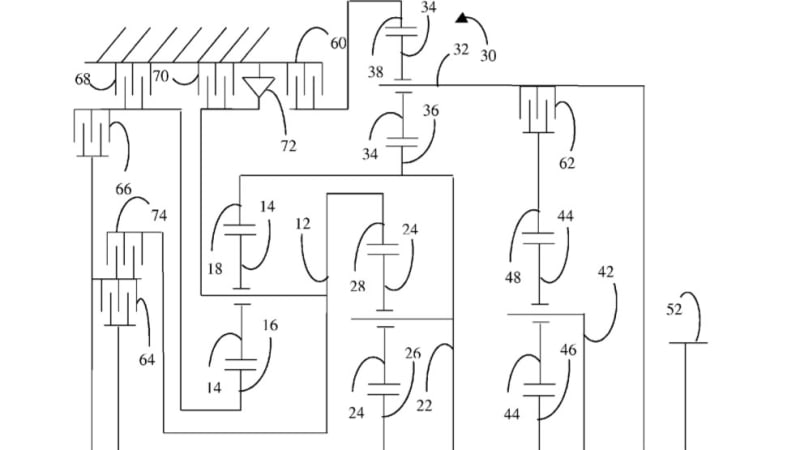
A new patent document published on April 9 by the U.S. Patent and Trademark Office suggests that Ford is eyeing an 11-speed automatic transmission.
The document includes details for three different embodiments of the transmission using different combinations of clutches, brakes and gears. Currently the company has only announced plans for a 10-speed automatic transmission that will arrive in the 2017 F-150 Raptor pickup truck. Ford powertrain spokesman Paul Seredynski wouldn’t confirm that Ford is developing an 11-speed automatic transmission.
“As a technology leader, we submit patents on innovative ideas as a normal course of business. Patent submissions help protect our new ideas but do not necessarily indicate future business or product plans,” he said in an official statement.
Ford is already able to claim an average 20 MPG, which is a two-MPG improvement for the 3.5-liter EcoBoost 2015 F-150 in two-wheel drive form compared to the previous generation equipped with the same engine by shaving up to 700 lbs from the curb weight of the old truck courtesy of an aluminum body.
Ford filed the patent on October 4, 2013.
The document includes details for three different embodiments of the transmission using different combinations of clutches, brakes and gears. Currently the company has only announced plans for a 10-speed automatic transmission that will arrive in the 2017 F-150 Raptor pickup truck. Ford powertrain spokesman Paul Seredynski wouldn’t confirm that Ford is developing an 11-speed automatic transmission.
“As a technology leader, we submit patents on innovative ideas as a normal course of business. Patent submissions help protect our new ideas but do not necessarily indicate future business or product plans,” he said in an official statement.
Ford is already able to claim an average 20 MPG, which is a two-MPG improvement for the 3.5-liter EcoBoost 2015 F-150 in two-wheel drive form compared to the previous generation equipped with the same engine by shaving up to 700 lbs from the curb weight of the old truck courtesy of an aluminum body.
Ford filed the patent on October 4, 2013.
Multi-Speed Transmission Patent
http://www.freepatentsonline.com/y2015/0099603.html

Lexus Fanatic


Joined: Oct 2003
Posts: 94,696
Likes: 290
From: Virginia/D.C. suburbs
When you start to have that many different gears on one transmission, where is the point of diminishing returns where you might as well go to a CVT with an infinite number of ratios? 

Lexus Fanatic


Joined: Jan 2005
Posts: 20,248
Likes: 275
that was my thinking too.. of course, CVTs are not ready yet to replace real AT's, no matter how much better they can be these days.

Lexus Champion
Joined: Feb 2011
Posts: 3,309
Likes: 31
From: Canada
It would be nice to have CVTs but it is much, much easier to add planetary gearsets to create ever more forward gears than it is to improve the CVT. The current mechanical CVT (belt and pulley) can only handle (it would seem) about 270 lb.ft / 370 Nm of torque (the Nissan VQ35 engine's peak torque); any more torque and the CVT is likely to slip and lose efficiency.
And although this article did not state what vehicle Ford would use this 11-speed transmission in, I gather that they intend to use it in their trucks, where high torque is important, making the CVT a non-viable option.
And again, although it is not stated, but making a 11-speed transmission does NOT necessarily mean that the spacing between gears is smaller; it could very well mean that Ford provides a greater spread between low gears and high gears: extra low 1st- and 2nd-gears and extra tall 10th- and 11th-gears. This would be particularly well suited to using smaller engines (turbocharged V6s in place of V8s) in Ford trucks: extra low gears on the low end to provide more torque, and extra tall high gears to keep engine speed down on the highway.
Trending Topics
Lexus Fanatic
Joined: Oct 2003
Posts: 94,696
Likes: 290
From: Virginia/D.C. suburbs
Originally Posted by Sulu
And although this article did not state what vehicle Ford would use this 11-speed transmission in, I gather that they intend to use it in their trucks, where high torque is important, making the CVT a non-viable option.
And again, although it is not stated, but making a 11-speed transmission does NOT necessarily mean that the spacing between gears is smaller; it could very well mean that Ford provides a greater spread between low gears and high gears: extra low 1st- and 2nd-gears and extra tall 10th- and 11th-gears. This would be particularly well suited to using smaller engines (turbocharged V6s in place of V8s) in Ford trucks: extra low gears on the low end to provide more torque, and extra tall high gears to keep engine speed down on the highway.
And again, although it is not stated, but making a 11-speed transmission does NOT necessarily mean that the spacing between gears is smaller; it could very well mean that Ford provides a greater spread between low gears and high gears: extra low 1st- and 2nd-gears and extra tall 10th- and 11th-gears. This would be particularly well suited to using smaller engines (turbocharged V6s in place of V8s) in Ford trucks: extra low gears on the low end to provide more torque, and extra tall high gears to keep engine speed down on the highway.
ClubLexus Stories
Celebrating Lexus & Toyota from Around the Globe

Lexus NX 350h: A Fuel-Sipping Secret Hot Hatch???
Michael S. Palmer
5 Best & 5 Worst Lexus Daily Drivers
Joe Kucinski
Top 5 Hottest Lexus & Toyotas in 2026 (Hardest To Buy)
Brett Foote
2026 Lexus IS 350 F Sport Review: The Last of Its Kind Still Rocks
Michael S. Palmer
Top 10 Most Confusing Things Lexus Has Ever Done!
Joe Kucinski
2026 Lexus ES Review: Lexus Re-Embraces Founding Principles
Michael S. Palmer
10 Lexus Bargains That are Cheaper Than a New Toyota RAV4
Joe Kucinski
8 Weirdest Things Lexus Has Ever Built
Verdad Gallardo
10 Lexus Designs That Have Aged Like Fine Wine
Verdad Gallardo


Out of Warranty


Joined: Aug 2001
Posts: 14,925
Likes: 13
From: Houston, Republic of Texas
The problem has been with a CVT is that it requires a rather large hydraulic pump - which in turn saps the efficiency of the transmission, negating its economic advantages over a conventional 5 or 6 speed automatic. AutoManuals have appeared over the past two years that are able to take advantage of computers to coordinate engine and transmission in throttle actuation, gear selection and clutch operation, basically putting a set of actuators on a fairly conventional clutch and gearbox. It's pretty cool technology designed to keep the engine running in that sweet spot, but still shows some rough edges when asked to creep or perform tasks outside the normal performance envelope.
In operation, it works like some of the earliest two-speed "automatic" transmissions of the late '40's and early '50's that were mechanically operated by governors. Throttle down to move away from a stop, then at about 15-18 mph, "lift to shift" - get off the gas and wait for that "CLACK" from under the floorboard that said you were now in high gear.
Thankfully AMT's are a lot more sophisticated now. Here's a test drive of a Suzuki Celerio, a small 4-door as currently sold in India that uses the Asin AMT, basically an Asin manual transmission with a set of actuators and a special function that allows it to creep without exacting too much wear on the clutch without needing a torque converter.
Transmission demo starts at about 3:25
In operation, it works like some of the earliest two-speed "automatic" transmissions of the late '40's and early '50's that were mechanically operated by governors. Throttle down to move away from a stop, then at about 15-18 mph, "lift to shift" - get off the gas and wait for that "CLACK" from under the floorboard that said you were now in high gear.
Thankfully AMT's are a lot more sophisticated now. Here's a test drive of a Suzuki Celerio, a small 4-door as currently sold in India that uses the Asin AMT, basically an Asin manual transmission with a set of actuators and a special function that allows it to creep without exacting too much wear on the clutch without needing a torque converter.
Transmission demo starts at about 3:25
Last edited by Lil4X; Apr 13, 2015 at 04:22 PM.
Lexus Fanatic
Joined: Jan 2005
Posts: 20,248
Likes: 275
First time i hear that CVT's have efficiency problems, they are very efficient in real life and in tests, as we can see by new CVTs in group tests and government data.
We had SMT in Toyota's in Europe, and it is not optimal solution... Toyota, owner of Aisin, is offering them only on cars where rock bottom price is needed (currently Aygo only)... lots of long life both performance and reliability issues.
We had SMT in Toyota's in Europe, and it is not optimal solution... Toyota, owner of Aisin, is offering them only on cars where rock bottom price is needed (currently Aygo only)... lots of long life both performance and reliability issues.
Lexus Fanatic
Joined: Oct 2003
Posts: 94,696
Likes: 290
From: Virginia/D.C. suburbs

Lexus Fanatic
Joined: Nov 2011
Posts: 35,649
Likes: 426
From: ON/NY
I disagree. For small cars, CTVs are more than ready to replace ATs. Mine has simulated shift when giving harder starts. When I want to conserve, the CTV never moves past 1300rpm with a linear acceleration. I'm currently averaging 36 mpg.