



The Virtual Dashboard

Thread Starter
Out of Warranty


Joined: Aug 2001
Posts: 14,925
Likes: 13
From: Houston, Republic of Texas
 The Virtual Dashboard
Automakers are investigating the possibility of an all-digital dashboard display that could be configurable by the owner. Yes, it shows up from time to time in "concept" cars, but not too many manufacturers have committed one to the assembly line. It's not exactly rocket science, the engine computer in your car is already collecting plenty of data, all you need to do is display it. It's actually accessible via your OBDII port, and there are several apps available for your tablet that will display it - some of those are even configurable to let you design your own display. If you really go nuts, this can be your instrument panel:
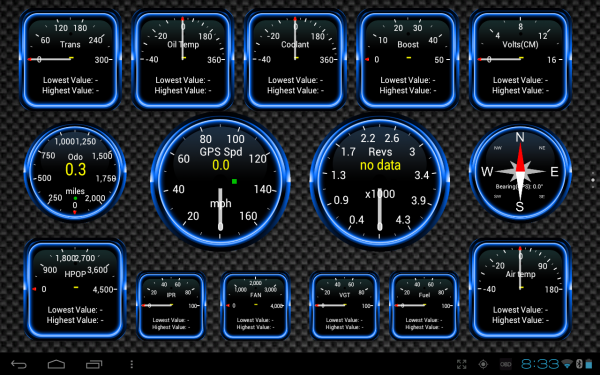
You can select not only the background, but the instruments, whether "analog" or "digital" displays, their size and location on the screen. There are many variations on the gauge styles, and the look is limited by your own imagination. Is this a matter of style, safety, or just your own personal taste?
The aircraft industry - which has led the way in instrumentation for years - has come to recognize the "glass cockpit" as a far more efficient way to display critical data in ways that make instant sense to the pilot. Rather than a field of "steam gauges" (analog), they've moved on to a single display (with a backup panel alongside) that can put all of the necessary information in one place and make its display meaningful.
Digital displays have long been sought as some kind of zoomy styling exercise, but in practice they have proven to be both impractical and even dangerous. A digital dash is always tempting because we are capturing digital data from the ECU, so why not display it? While it's meaningful to the computer, it doesn't translate well to human intelligence.
I worked with a client known for oilfield instrumentation for over sixty years as they developed a digital panel for all of the driller's instruments on a drilling rig. In theory it was brilliant, but in practice it could have been dangerous. It seems that, faced with a set of changing numbers, it takes as much as two or three seconds to determine if the numbers are increasing or decreasing, particularly if they are moving rather quickly and the user is fatigued. We had to provide digital bar graphs alongside each readout to help communicate the trend of the instrument. Eventually, we had to color the background to provide a red warning highlight to anything running out of spec.
Well, that was fine at night, but in glaring sun, it appeared too faint. We eventually went back to a digital representation of a conventional dial gauge. Humans easily interpret dials, known as "steam gauges" in the trade. We can see relative position and interpret it and any trend almost instantly. Designers of military aircraft panels learned years ago that "up" was the proper location for the optimal reading so that when all needles were pointed skyward, all was well. Without a reference point, raw numbers are almost meaningless.
This is an important consideration, to keep your scan going. You don't want to be distracted from what's going on the other side of the windshield any more than necessary. "OK, oil pressure is 32, is that good or bad, and why? . . . wait, was that a decimal in there?" Nope, WAY too long.
I've been involved on another forum watching the development of a "different" sort of car, (a 2-seat tandem, 84 mpg, $6800 base commuter vehicle). Think of it as a 3-wheeled motorcycle with air conditioning, power windows, seat belts and air bags. The process has been interesting to watch. Their test mules were run with Geo Metro instruments, but then it was time to get serious about production and call in the experts. The 900cc engine was redeveloped by IMG, a German engineering consulting firm, and their transmissions (MT and Automanual) by Asin, makers of Mazda, Suzuki, and other Japanese transmissions. One of their engineering and production partners is Continental, the German-based company that produces not only tires, but state of the art electronics and instrumentation. They will be doing both the infotainment system and the standard instrument panel (and as I currently understand them, a series of instrumentation options).
Here, your dashboard is limited only by your imagination. Your engine management system is reading all kinds of inputs, it's your task to decide which of them you want to see. Want to see #3 plug firing? Here it is. Ideally, you would have a "road" screen" to give you the bare essentials for driving, maybe an integrated "navigation" screen to show not only your position and route, but all of the "miles to" features now handled by some "nav pods" external to the main display. Your infotainment selection, HVAC settings, and others could be fed via bluetooth as well. Of course a series of "diagnostic screens" could be displayed to help review your performance status and troubleshoot your vehicle's ills while in your driveway.
All of this data is already being gathered and presented to your OBDII port. A simple bluetooth device plugged in there would transmit this engine data up to a tablet mounted in place of your current instrument panel and you could assemble the presentation you want from a series of templates. Tesla has developed a single large sub-panel mounted in the stack that has most of the same capabilities. Here's a couple of samples of Continental's work, from their web page -

With these tablet displays, you can upload additional templates as you choose, and modify them to your own taste. The interesting part is that with the plunging price of basic (BT & wifi only, no data) tablets, they're rapidly reaching price parity with the old steam gauges in your present car. The old needles and numbers are still good, just the way we see them will change.
You can select not only the background, but the instruments, whether "analog" or "digital" displays, their size and location on the screen. There are many variations on the gauge styles, and the look is limited by your own imagination. Is this a matter of style, safety, or just your own personal taste?
The aircraft industry - which has led the way in instrumentation for years - has come to recognize the "glass cockpit" as a far more efficient way to display critical data in ways that make instant sense to the pilot. Rather than a field of "steam gauges" (analog), they've moved on to a single display (with a backup panel alongside) that can put all of the necessary information in one place and make its display meaningful.
Digital displays have long been sought as some kind of zoomy styling exercise, but in practice they have proven to be both impractical and even dangerous. A digital dash is always tempting because we are capturing digital data from the ECU, so why not display it? While it's meaningful to the computer, it doesn't translate well to human intelligence.
I worked with a client known for oilfield instrumentation for over sixty years as they developed a digital panel for all of the driller's instruments on a drilling rig. In theory it was brilliant, but in practice it could have been dangerous. It seems that, faced with a set of changing numbers, it takes as much as two or three seconds to determine if the numbers are increasing or decreasing, particularly if they are moving rather quickly and the user is fatigued. We had to provide digital bar graphs alongside each readout to help communicate the trend of the instrument. Eventually, we had to color the background to provide a red warning highlight to anything running out of spec.
Well, that was fine at night, but in glaring sun, it appeared too faint. We eventually went back to a digital representation of a conventional dial gauge. Humans easily interpret dials, known as "steam gauges" in the trade. We can see relative position and interpret it and any trend almost instantly. Designers of military aircraft panels learned years ago that "up" was the proper location for the optimal reading so that when all needles were pointed skyward, all was well. Without a reference point, raw numbers are almost meaningless.
This is an important consideration, to keep your scan going. You don't want to be distracted from what's going on the other side of the windshield any more than necessary. "OK, oil pressure is 32, is that good or bad, and why? . . . wait, was that a decimal in there?" Nope, WAY too long.
I've been involved on another forum watching the development of a "different" sort of car, (a 2-seat tandem, 84 mpg, $6800 base commuter vehicle). Think of it as a 3-wheeled motorcycle with air conditioning, power windows, seat belts and air bags. The process has been interesting to watch. Their test mules were run with Geo Metro instruments, but then it was time to get serious about production and call in the experts. The 900cc engine was redeveloped by IMG, a German engineering consulting firm, and their transmissions (MT and Automanual) by Asin, makers of Mazda, Suzuki, and other Japanese transmissions. One of their engineering and production partners is Continental, the German-based company that produces not only tires, but state of the art electronics and instrumentation. They will be doing both the infotainment system and the standard instrument panel (and as I currently understand them, a series of instrumentation options).
Here, your dashboard is limited only by your imagination. Your engine management system is reading all kinds of inputs, it's your task to decide which of them you want to see. Want to see #3 plug firing? Here it is. Ideally, you would have a "road" screen" to give you the bare essentials for driving, maybe an integrated "navigation" screen to show not only your position and route, but all of the "miles to" features now handled by some "nav pods" external to the main display. Your infotainment selection, HVAC settings, and others could be fed via bluetooth as well. Of course a series of "diagnostic screens" could be displayed to help review your performance status and troubleshoot your vehicle's ills while in your driveway.
All of this data is already being gathered and presented to your OBDII port. A simple bluetooth device plugged in there would transmit this engine data up to a tablet mounted in place of your current instrument panel and you could assemble the presentation you want from a series of templates. Tesla has developed a single large sub-panel mounted in the stack that has most of the same capabilities. Here's a couple of samples of Continental's work, from their web page -
With these tablet displays, you can upload additional templates as you choose, and modify them to your own taste. The interesting part is that with the plunging price of basic (BT & wifi only, no data) tablets, they're rapidly reaching price parity with the old steam gauges in your present car. The old needles and numbers are still good, just the way we see them will change.

Lexus Fanatic


Joined: Oct 2003
Posts: 94,699
Likes: 290
From: Virginia/D.C. suburbs

Not something I'd be terribly interested in, though I can understand the appeal it would have to some drivers. Personally, I thought the device that the Ford Mustang came out with, several years ago, that could change the dash lighting to any of some 120 different colors, was more interesting....though I also see no reason why that device couldn't be integrated with this one that varies the gauge pattern itself.

Lexus Champion
Joined: Feb 2011
Posts: 3,309
Likes: 31
From: Canada
The reconfigurable, all-electronic, *virtual* dashboard is indeed the next step. We already see examples in production, the electronic dashboard in the new Mercedes-Benz S-Class being the most obvious example. We have had electronic, segmented-LCD (with simple number and letter displays based upon a matrix of limited, fixed segments) odometers rather than mechanical ones for about 20 years now. That has led to the simple trip computers with parameters such as instantaneous fuel consumption, average fuel consumption and range-to-empty that we can cycle through, even on economy cars these days.
In fact, there are likely very few examples of true mechanical steam gauges used in new cars anymore; they are electromechanical gauges where the needles are driven by electromagnets rather than mechanical linkages and gears. These electromechanical gauges allow Lexus to switch its mechanical state-of-battery-charge gauge to a tachometer in their new hybrid vehicles. If we are switching the displays on mechanical gauges (with real, sweeping needles), it is not a stretch to imagine that we will soon get more precise and more efficient by replacing the real, mechanical needles with virtual, electronic ones. At that time, we may see more examples of dashboards similar to Saab's "Black Panel" of the mid-1990s. The night panel allowed Saab drivers to switch off illumination to all dashboard instruments except the speedometer; the illumination behind other instruments would automatically switch back on if something (such as high coolant temperature) required driver attention.
We are almost there with virtual dashboards on all cars but not quite yet. Before we get there, we have to bring down the cost of these displays. Very high resolution, highly-reliable LCD displays that are suitable for the daily grind of automotive use are still expensive. We see that on the central stack infotainment displays -- some are high-resolution while others are lower resolution. When we see high-resolution displays in all infotainment displays, we will start to see more mass-market cars adopt reconfigurable, all-electronic, virtual dashboards.
In fact, there are likely very few examples of true mechanical steam gauges used in new cars anymore; they are electromechanical gauges where the needles are driven by electromagnets rather than mechanical linkages and gears. These electromechanical gauges allow Lexus to switch its mechanical state-of-battery-charge gauge to a tachometer in their new hybrid vehicles. If we are switching the displays on mechanical gauges (with real, sweeping needles), it is not a stretch to imagine that we will soon get more precise and more efficient by replacing the real, mechanical needles with virtual, electronic ones. At that time, we may see more examples of dashboards similar to Saab's "Black Panel" of the mid-1990s. The night panel allowed Saab drivers to switch off illumination to all dashboard instruments except the speedometer; the illumination behind other instruments would automatically switch back on if something (such as high coolant temperature) required driver attention.
We are almost there with virtual dashboards on all cars but not quite yet. Before we get there, we have to bring down the cost of these displays. Very high resolution, highly-reliable LCD displays that are suitable for the daily grind of automotive use are still expensive. We see that on the central stack infotainment displays -- some are high-resolution while others are lower resolution. When we see high-resolution displays in all infotainment displays, we will start to see more mass-market cars adopt reconfigurable, all-electronic, virtual dashboards.

Lexus Champion
Joined: Apr 2011
Posts: 2,010
Likes: 0
From: CA
Trending Topics
Thread Starter
Out of Warranty
Joined: Aug 2001
Posts: 14,925
Likes: 13
From: Houston, Republic of Texas
Ask and you shall receive. You just know that once these panels and supporting software become available, the apps for customizing your own personal dashboard will flood the market. There will be downloadable templates and total personal customs available. Like body kits and sound systems, but cheaper.
ClubLexus Stories
Celebrating Lexus & Toyota from Around the Globe

Lexus NX 350h: A Fuel-Sipping Secret Hot Hatch???
Michael S. Palmer
5 Best & 5 Worst Lexus Daily Drivers
Joe Kucinski
Top 5 Hottest Lexus & Toyotas in 2026 (Hardest To Buy)
Brett Foote
2026 Lexus IS 350 F Sport Review: The Last of Its Kind Still Rocks
Michael S. Palmer
Top 10 Most Confusing Things Lexus Has Ever Done!
Joe Kucinski
2026 Lexus ES Review: Lexus Re-Embraces Founding Principles
Michael S. Palmer
10 Lexus Bargains That are Cheaper Than a New Toyota RAV4
Joe Kucinski
8 Weirdest Things Lexus Has Ever Built
Verdad Gallardo
10 Lexus Designs That Have Aged Like Fine Wine
Verdad Gallardo
Lexus Fanatic
Joined: Oct 2003
Posts: 94,699
Likes: 290
From: Virginia/D.C. suburbs
Bob....would you want (or drive) a system like this if it indeed became available?
I myself am not wild about the system as a whole, but one thing I DO like about it is the chance to get ammeter, oil-temperature, and oil-pressure gauges as part of the package. Unless you buy a heavier-duty pickup or a high-performance car, standard gauges usually include only speedo, tach, fuel-level, and coolant-temperature.....with the the rest being idiot lights. Unfortunately, by the time some of those idiot lights flash (you can't spot an early-warning pattern), there usually isn't much you can do about it, or the engine may be quickly damaged if not shut off immediately.
I myself am not wild about the system as a whole, but one thing I DO like about it is the chance to get ammeter, oil-temperature, and oil-pressure gauges as part of the package. Unless you buy a heavier-duty pickup or a high-performance car, standard gauges usually include only speedo, tach, fuel-level, and coolant-temperature.....with the the rest being idiot lights. Unfortunately, by the time some of those idiot lights flash (you can't spot an early-warning pattern), there usually isn't much you can do about it, or the engine may be quickly damaged if not shut off immediately.
Last edited by mmarshall; Aug 3, 2014 at 06:41 PM.


There was a time when I thought profligate instrumentation was the hallmark of quality. I no longer feel this way. The ECM collects and digests mountains of operating data. It is fairly simple to connect to the CAN bus and gather a ton of networked data from a system with a widespread standard for data capture and representation.
Does it mean there is value in having it displayed in your car? Not really. What you really want is the ability to LOG this data and mine it with simple tools. This way you can see short and long term trends. You can set arbitrary limits and measure deviation from those limits.
In my primary profession, my peers all deal with mountains of event data daily. There's no way to look at it ALL at any given time because it comes in faster than any human can interpret it. So we log it, and selectively mine it for clues about what we really want to know - who compromised their machine today when they opened a javascript enabled PDF from what appeared to be a prime vendor?
To the average person, having all these displays showing data they can not possibly understand only means Service Advisers will be talking more owners off ledges every day. "But the display says the #4 fuel injector is at 2.1 today and it's always at 1.8. Something MUST be wrong with my car!" Odds are, nothing is wrong enough to need fixing, and the Service Adviser knows this is a dry hole. They'll waste countless hours replacing parts to no avail, and the customer will continue to complain, and maybe even try to lemon law the vehicle all because a number changed on a display.
No, as much as I like the idea of having the data at my fingertips, I really don't see the value in presenting any more data to the public than they can be trusted to interpret. Just give me the ability to log a few terabytes so I can connect and use "professional only" grade tools to mine this information when I need to find a real problem or a tweak to an operating parameter.
Does it mean there is value in having it displayed in your car? Not really. What you really want is the ability to LOG this data and mine it with simple tools. This way you can see short and long term trends. You can set arbitrary limits and measure deviation from those limits.
In my primary profession, my peers all deal with mountains of event data daily. There's no way to look at it ALL at any given time because it comes in faster than any human can interpret it. So we log it, and selectively mine it for clues about what we really want to know - who compromised their machine today when they opened a javascript enabled PDF from what appeared to be a prime vendor?
To the average person, having all these displays showing data they can not possibly understand only means Service Advisers will be talking more owners off ledges every day. "But the display says the #4 fuel injector is at 2.1 today and it's always at 1.8. Something MUST be wrong with my car!" Odds are, nothing is wrong enough to need fixing, and the Service Adviser knows this is a dry hole. They'll waste countless hours replacing parts to no avail, and the customer will continue to complain, and maybe even try to lemon law the vehicle all because a number changed on a display.
No, as much as I like the idea of having the data at my fingertips, I really don't see the value in presenting any more data to the public than they can be trusted to interpret. Just give me the ability to log a few terabytes so I can connect and use "professional only" grade tools to mine this information when I need to find a real problem or a tweak to an operating parameter.
Thread Starter
Out of Warranty
Joined: Aug 2001
Posts: 14,925
Likes: 13
From: Houston, Republic of Texas
Well, as far as idiot lights go, the "glass cockpit" would make a few new options available. Martin-Decker/Totco, my old oilfield instrumentation client pioneered displaying out-of-spec readings by changing the background of that instrument to a bright red. If it failed altogether, that red background would flash. That oughta get the driller's attention!
Recently, NASCAR adopted this same idea, as the number of instruments in front of the driver became more numerous, drawing the driver's attention to a developing problem became critical. Solution? A combination gauge and idiot light. Don't mess with success.
Recently, NASCAR adopted this same idea, as the number of instruments in front of the driver became more numerous, drawing the driver's attention to a developing problem became critical. Solution? A combination gauge and idiot light. Don't mess with success.
Production cars need as few instruments as possible and need to keep any warning indicators as simple as possible. One should never underestimate the level of unsophistication in the average motorist.

Lead Lap

Joined: Nov 2006
Posts: 4,585
Likes: 24
From: Washington
And this was possible because they finally joined the late 20th century and allowed EFI to replace carburetors...
Production cars need as few instruments as possible and need to keep any warning indicators as simple as possible. One should never underestimate the level of unsophistication in the average motorist.
Production cars need as few instruments as possible and need to keep any warning indicators as simple as possible. One should never underestimate the level of unsophistication in the average motorist.


CL Community Team
Joined: Aug 2006
Posts: 12,582
Likes: 236
From: San Francisco, CA
Not really necessary to have a temp gauge. Most modern cars won't over heat and its not really necessary to know what temperature its at. Its going to stay at its optimal. I think automakers included it because they needed an even number of dials for symmetry. RPM and speed and gas are a must. But I guess engine temp gauges are coming back since its good to know for hybrids and for auto start/stop systems
I can't wait for LCD screens to be made available for gauge clusters. The most customizable options, the better. I am however, a bit apprehensive about LCD dashes ala model S. Its scary even for a techie like myself.
I can't wait for LCD screens to be made available for gauge clusters. The most customizable options, the better. I am however, a bit apprehensive about LCD dashes ala model S. Its scary even for a techie like myself.
Last edited by RXSF; Aug 3, 2014 at 10:16 PM.
Lexus Fanatic
Joined: Oct 2003
Posts: 94,699
Likes: 290
From: Virginia/D.C. suburbs
Well, as far as idiot lights go, the "glass cockpit" would make a few new options available. Martin-Decker/Totco, my old oilfield instrumentation client pioneered displaying out-of-spec readings by changing the background of that instrument to a bright red. If it failed altogether, that red background would flash. That oughta get the driller's attention!
Recently, NASCAR adopted this same idea, as the number of instruments in front of the driver became more numerous, drawing the driver's attention to a developing problem became critical. Solution? A combination gauge and idiot light. Don't mess with success.
Recently, NASCAR adopted this same idea, as the number of instruments in front of the driver became more numerous, drawing the driver's attention to a developing problem became critical. Solution? A combination gauge and idiot light. Don't mess with success.