



Badge Background

Thread Starter
Out of Warranty


Joined: Aug 2001
Posts: 14,925
Likes: 13
From: Houston, Republic of Texas
 Badge Background
 Somebody's been doing their homework. Or not, depending on how they got involved in this little bit of trivia. Ever wonder what the significance was of the various manufacturer's logos and badges might be? Frankly it hadn't crossed my mind, but this list should prove interesting . . .
 http://gawlowski.com/matt/cars/car_logos.html

Lexus Champion
Joined: Dec 2006
Posts: 3,370
Likes: 0
From: NY

Lexus Fanatic


Joined: Oct 2003
Posts: 94,702
Likes: 290
From: Virginia/D.C. suburbs
Some believe that the Mitsubishi logo represents a ship's propellers (Mitsuibishi was involved in shipbuilding early in the company's existence). However, a more commonly accepted explanation is that the logo is formed by the joining of two family emblems and does not represent any part of a ship.
The name of the former Mitsubishi sedan flagship, the Diamante, is derived directly from the "Diamond" tradition.
The history of the Scion logo is uncertain, though there's an apparent 'S' cutting verticall through the center of the logo.
Rei Yoshimara, a world-renowned corporate image-creator, designed the Mazda logo. The 'V' represents wings outstretched.
The Pontiac logo represents an arrowhead. This logo was introduced in 1958, replacing the Indian Chief head silhouette emblem used since 1928.
The Volkswagen logo is simple, but the name has an interesting meaning - in German, it translates as the "Peoples' Car".
The modern Corvette logo is a variation of that designed by Robert Bartholomew (an interior designer at Chevrolet) in 1953. It features two flags, one a checkered flag and the other one featuring to icons, a Chevrolet bowtie logo and a fleur-de-lis. The fleur-de-lis was chosen since Chevrolet was a French name, and a fleur-de-lis is a French symbol meaning peace and purity.
The V8's used in Corvettes today, BTW, trace their direct lineage, in one form or another, to those first introduced in 1955...the Chevy short-stroke V8, in small-block and large-block forms, were legendary for their staying power.
Last edited by mmarshall; Sep 29, 2007 at 06:18 PM.

Lexus Test Driver
Joined: Nov 2005
Posts: 1,209
Likes: 3
From: IL
Regarding the Corvette emblem -
I'm surprised there wasn't mention of how it was originally supposed to be a checkered flag and an American flag. When I visited the Corvette Museum in Kentucky they had it there on display.
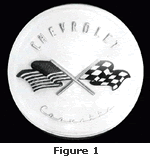
Taken from this website the explanation is as follows:
I'm surprised there wasn't mention of how it was originally supposed to be a checkered flag and an American flag. When I visited the Corvette Museum in Kentucky they had it there on display.
Taken from this website the explanation is as follows:
The original Corvette logo was designed by Robert Bartholomew, an interior designer at Chevrolet in 1953. This emblem was destined to appear on the 1953 Corvette prototype which was introduced to the public for the first time at New York's Waldorf-Astoria hotel in January of 1953. It had crossing staffs with the checkered flag on the right hand side, and the American flag on the left hand side. However, four days before the Corvette was to go on display at the show, Chevrolet management decided that it should be redesigned. The problem with the proposed emblem was that it included the American flag which is illegal to use on a commerical product. Right before the show, redesigned emblems were attached to the front hood and steering wheel of the Corvette. The new emblem contained the checkered flag on the right side as well as the white racing flag, red Chevrolet bow-tie symbol and a fleur-de-lis.
Trending Topics
ClubLexus Stories
Celebrating Lexus & Toyota from Around the Globe

Lexus NX 350h: A Fuel-Sipping Secret Hot Hatch???
Michael S. Palmer
5 Best & 5 Worst Lexus Daily Drivers
Joe Kucinski
Top 5 Hottest Lexus & Toyotas in 2026 (Hardest To Buy)
Brett Foote
2026 Lexus IS 350 F Sport Review: The Last of Its Kind Still Rocks
Michael S. Palmer
Top 10 Most Confusing Things Lexus Has Ever Done!
Joe Kucinski
2026 Lexus ES Review: Lexus Re-Embraces Founding Principles
Michael S. Palmer
10 Lexus Bargains That are Cheaper Than a New Toyota RAV4
Joe Kucinski
8 Weirdest Things Lexus Has Ever Built
Verdad Gallardo
10 Lexus Designs That Have Aged Like Fine Wine
Verdad Gallardo
Lexus Champion
Joined: Mar 2005
Posts: 8,695
Likes: 2
From: CA
One thing is that Mr. Toyoda's company was switched from Toyoda to Toyota because the character involves 8 strokes, and 8 is a lucky number in many Asian countries.
Furthermore, if the translation does become "an abundance of rice," as the site says in a number of Asian cultures (Chinese) that is a very lucky thing, having a bounty of rice is considered a harbinger of wealth and fortune.
Furthermore, if the translation does become "an abundance of rice," as the site says in a number of Asian cultures (Chinese) that is a very lucky thing, having a bounty of rice is considered a harbinger of wealth and fortune.
You are quite correct, the number 8 sounds similar to "rich" when pronounced in Chinese may be similar to Japanese pronunciation. Also the abundance of rice certainly means wealth as enigma888 mentioned, since being able to have enough rice to eat was one of the most important things back then.
In fact, I really like the story behind the Toyota logo though, being an amalgamation of 3 virtues; sounds like it has a pretty deep meaning. But does anyone think that someone actually developed it upon that basis?
In fact, I really like the story behind the Toyota logo though, being an amalgamation of 3 virtues; sounds like it has a pretty deep meaning. But does anyone think that someone actually developed it upon that basis?
Thread Starter
Out of Warranty
Joined: Aug 2001
Posts: 14,925
Likes: 13
From: Houston, Republic of Texas
I suspect that most of these badges/corporate logos were first developed in a design studio and THEN the PR department had to wring some kind of cosmic message out of the committee's final selection. Just the way corporations work . . .

Lexus Fanatic
Joined: Oct 2003
Posts: 94,702
Likes: 290
From: Virginia/D.C. suburbs

