


Japanese mag scans (Coco-bun translates, 4-cylinder Lexus hybrid)

Guest
Posts: n/a
 Japanese mag scans (Coco-bun translates, 4-cylinder Lexus hybrid)
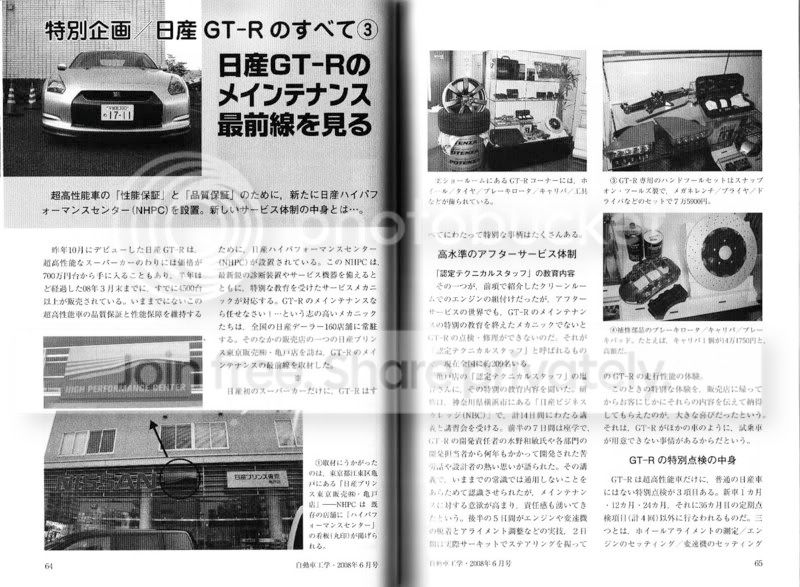
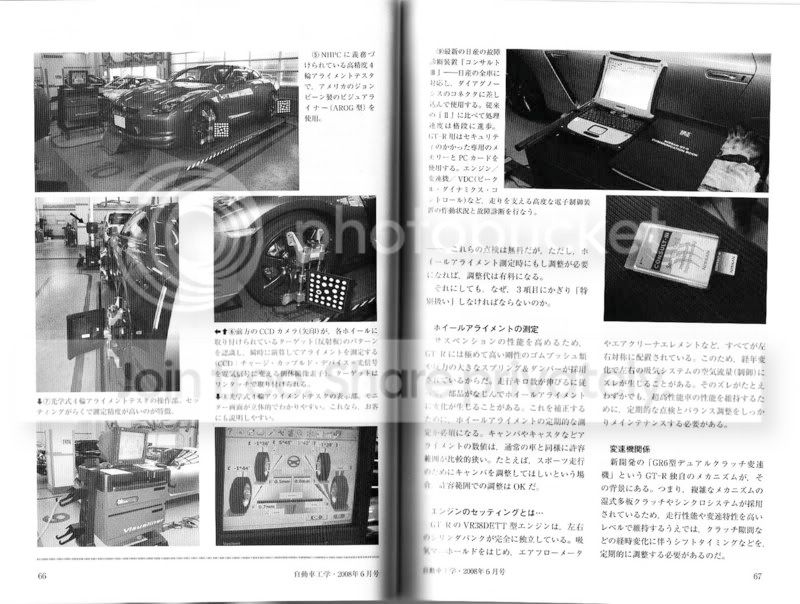
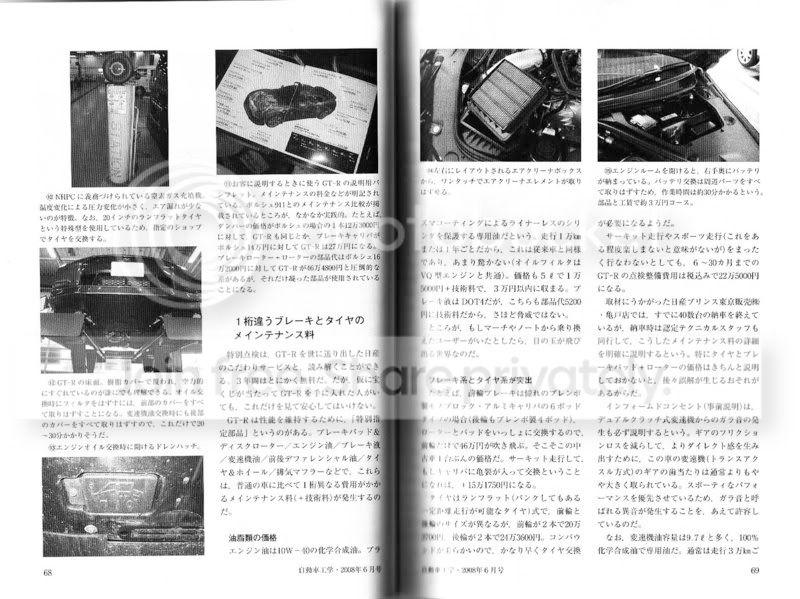
Scans from the latest Jidosha Kogaku (Automotive Engineering). A relatively low-circulation trade journal.
Every detail about the GT-R
Very quick translations (sorry, its really long); The whole article is 30-pages long so I can't post everything.
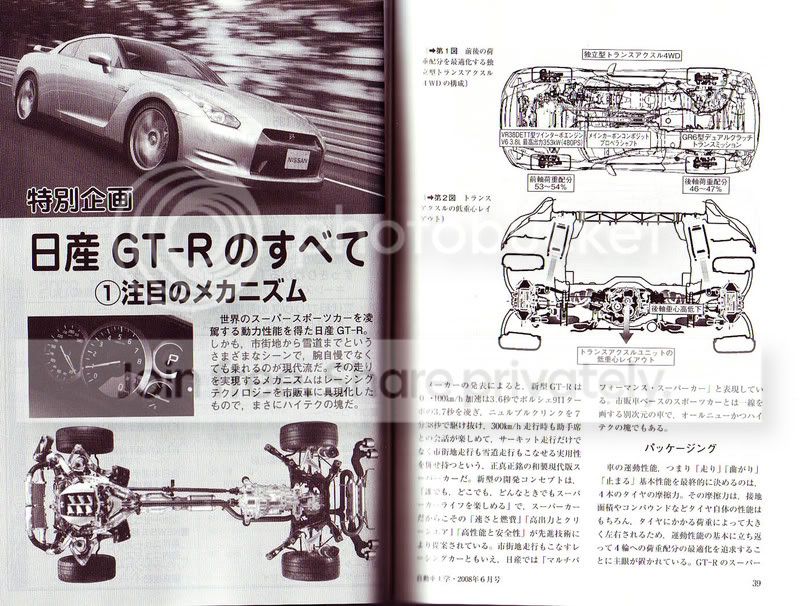
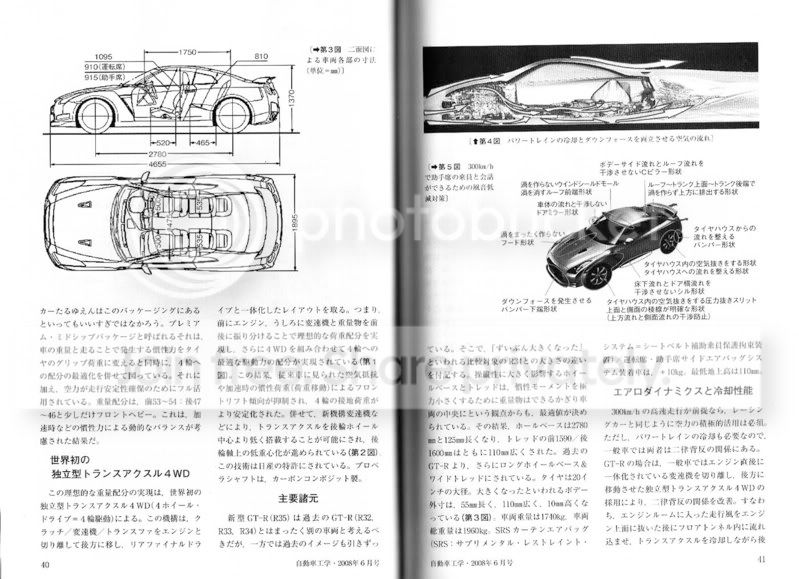
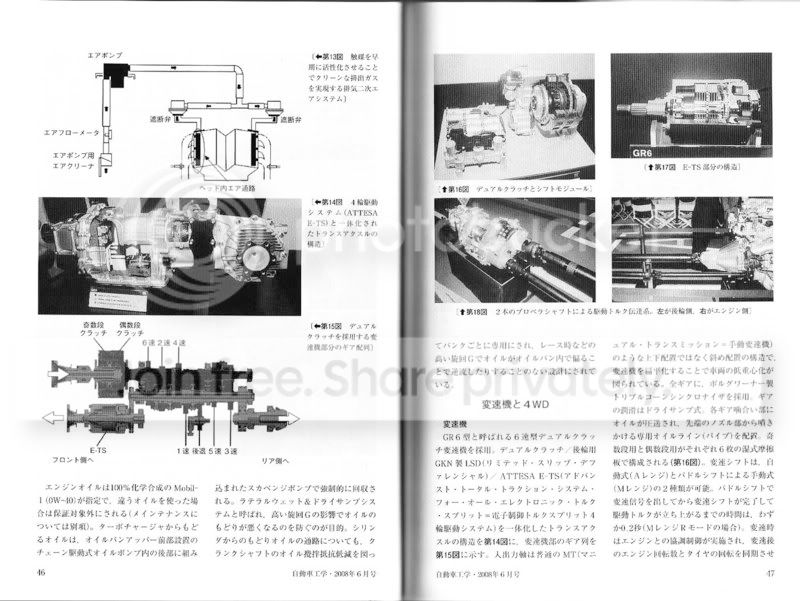
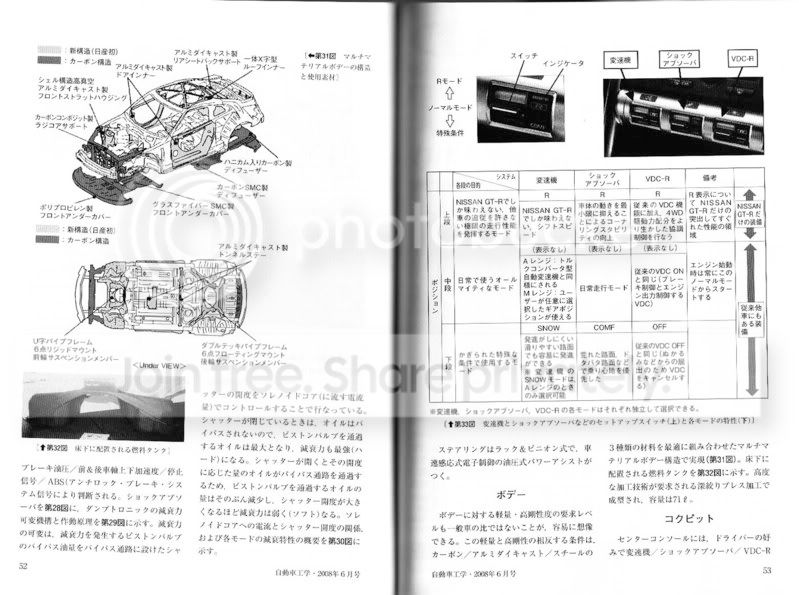
GR-6 transmission mounted in rear, two carbon-fiber propeller drive shafts connect engine, transmission, and transaxle. While very complex, this allows a well-balanced and low-slung weight distribution (along with an advanced dry-sump system). Weight distro is 53-54:46-47, slightly heavier in the front. (page 39). The dimensions of the GT-R are dramatically larger then the previous R34 GTR; 55mm longer, 110mm wider, 10mm taller, and with 20-inch wheels. Vehicle also has significantly improved safety compared to the R34, such as SRS curtain airbags (+10kg weight) and advanced crumple zones in case of collision. While the GT-R is much heavier then its predecessor, the vehicle uses a significant amount of light weight materials (page 52). Such as honey-comb type carbon-fiber rear diffuser, fiberglass SMC-type front undercover, die-cast aluminum front/rear strut housing, carbon-fiber radiator core support, aluminum inner doors, magnesium oil pan, etc.
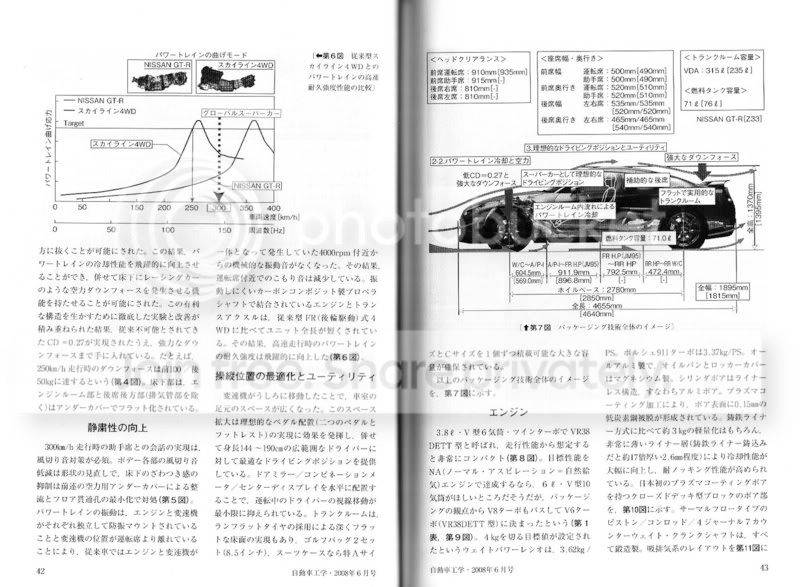
A lot of effort was put into aerodynamics. The contour of exterior design was designed with aerodynamics as a priority (detailed picture page 41 for explanation on each). For instance, the 'dimples' and contour of the hood allows air to flow centrally over the car, C-pillar and roofline is designed with rear-kink to keep this airflow over to the back and create down force in the rear. Raised rear creates ground-effect like effect, in all, at 250km, the GT-R produces 100kg downforce upfront, and 50kg in the rear while achieving CD 0.27. In summary, what makes the GT-R fast isn't any one technical feature but rather the meticulous design and thought that went into the vehicle as a whole.
Building the VR38
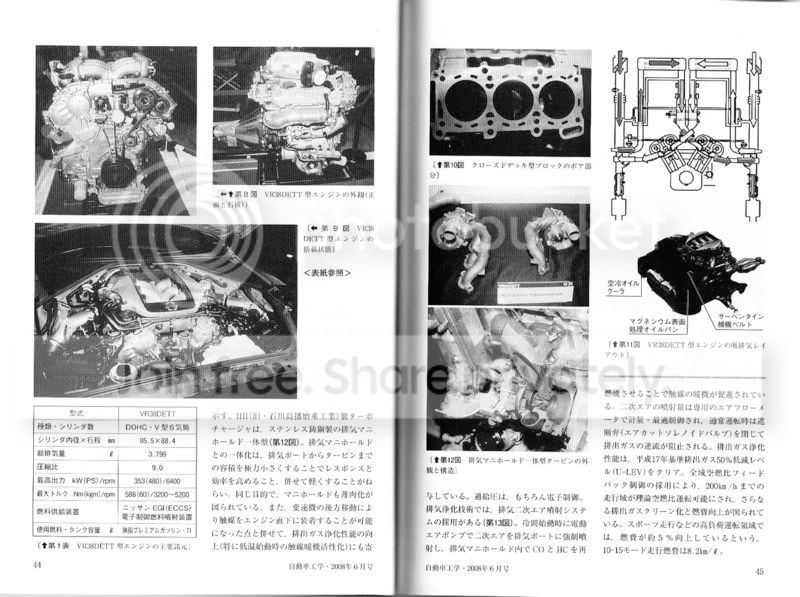
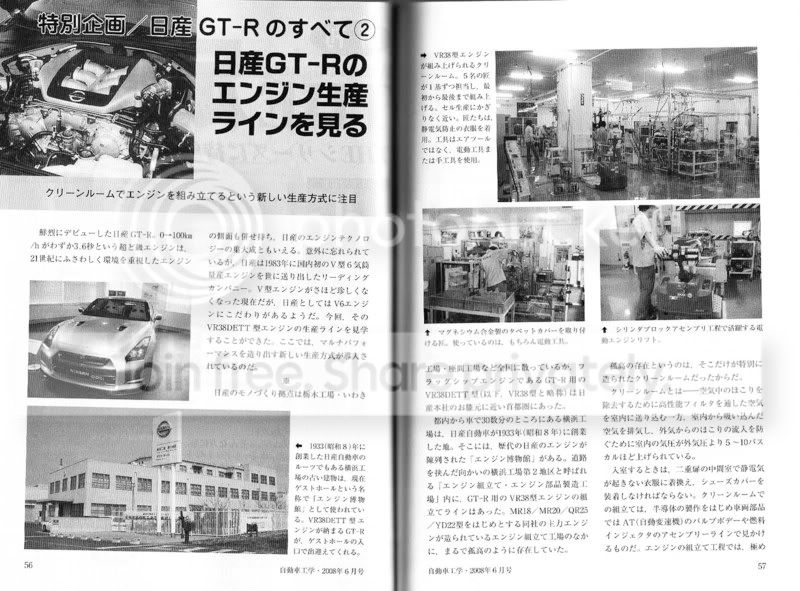
The VR38 engine is built in Nissan's old Yokohama Factory (built 1933) adjacent to the companies' "Engine Museum" . The VR38 is built completely independently to the other engines manufactured there in a clean room. The pressure within the clean roomis raised 5-10 pascals so dust and air from the outside cannot enter the facility. The clean room requires shoe covers and gloves before entering, and no air based tools are allowed. The VR38 will also be the first to be using Nissan's new "Plasma-coating" technology that took 8 years to develop.
The bare engine has over 360 parts, and each engine is built by five people and is lead by a "Takumi" or Master and takes about 100 minutes to build one engine. The clean room took 6-months to build and only hire veteran technicians to build the engines, and these technicians are allowed to work in the clean room. The plant currently has 3 Takumis (Masters), 10 vice-Takumis, and 10 technicians in training. They are between 23-50 in age.
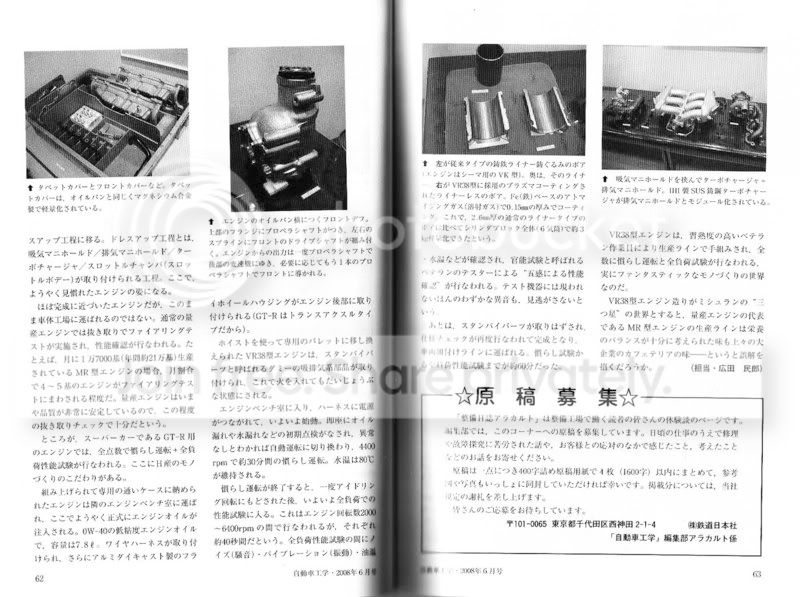
The Takumi has the final say on what engines are suitable or not. The facility has 3 test rooms equipped with a test bench, and each engine is tested for multiple criteria, however, the Takumi is allowed to dismiss the engine for reasons such as sound differences and other subjective criteria. Each bare engine goes through a motoring test on the test bench (which is run at 200 rpm and 13-point check), and in addition every engine goes through a fairing test. Out of the 17,000 MR engines that are built in the Yokohama plant only 5 each month are randomly taken out to do this test, however, every VR38 engine is required to go through this test before its sent out. After the engine is completely dressed and finished, the engine will be tested again at 4,400 rpm for 30 minutes, then the engine will be idled, after which, the engine will be tested again at 2,000-6400rpm in intervals of 40 seconds; this test takes close to an hour to finish. If the engine passes, a VR38 is ready to be put in a GT-R
Every detail about the GT-R
Very quick translations (sorry, its really long); The whole article is 30-pages long so I can't post everything.
GR-6 transmission mounted in rear, two carbon-fiber propeller drive shafts connect engine, transmission, and transaxle. While very complex, this allows a well-balanced and low-slung weight distribution (along with an advanced dry-sump system). Weight distro is 53-54:46-47, slightly heavier in the front. (page 39). The dimensions of the GT-R are dramatically larger then the previous R34 GTR; 55mm longer, 110mm wider, 10mm taller, and with 20-inch wheels. Vehicle also has significantly improved safety compared to the R34, such as SRS curtain airbags (+10kg weight) and advanced crumple zones in case of collision. While the GT-R is much heavier then its predecessor, the vehicle uses a significant amount of light weight materials (page 52). Such as honey-comb type carbon-fiber rear diffuser, fiberglass SMC-type front undercover, die-cast aluminum front/rear strut housing, carbon-fiber radiator core support, aluminum inner doors, magnesium oil pan, etc.
A lot of effort was put into aerodynamics. The contour of exterior design was designed with aerodynamics as a priority (detailed picture page 41 for explanation on each). For instance, the 'dimples' and contour of the hood allows air to flow centrally over the car, C-pillar and roofline is designed with rear-kink to keep this airflow over to the back and create down force in the rear. Raised rear creates ground-effect like effect, in all, at 250km, the GT-R produces 100kg downforce upfront, and 50kg in the rear while achieving CD 0.27. In summary, what makes the GT-R fast isn't any one technical feature but rather the meticulous design and thought that went into the vehicle as a whole.
Building the VR38
The VR38 engine is built in Nissan's old Yokohama Factory (built 1933) adjacent to the companies' "Engine Museum" . The VR38 is built completely independently to the other engines manufactured there in a clean room. The pressure within the clean roomis raised 5-10 pascals so dust and air from the outside cannot enter the facility. The clean room requires shoe covers and gloves before entering, and no air based tools are allowed. The VR38 will also be the first to be using Nissan's new "Plasma-coating" technology that took 8 years to develop.
The bare engine has over 360 parts, and each engine is built by five people and is lead by a "Takumi" or Master and takes about 100 minutes to build one engine. The clean room took 6-months to build and only hire veteran technicians to build the engines, and these technicians are allowed to work in the clean room. The plant currently has 3 Takumis (Masters), 10 vice-Takumis, and 10 technicians in training. They are between 23-50 in age.
The Takumi has the final say on what engines are suitable or not. The facility has 3 test rooms equipped with a test bench, and each engine is tested for multiple criteria, however, the Takumi is allowed to dismiss the engine for reasons such as sound differences and other subjective criteria. Each bare engine goes through a motoring test on the test bench (which is run at 200 rpm and 13-point check), and in addition every engine goes through a fairing test. Out of the 17,000 MR engines that are built in the Yokohama plant only 5 each month are randomly taken out to do this test, however, every VR38 engine is required to go through this test before its sent out. After the engine is completely dressed and finished, the engine will be tested again at 4,400 rpm for 30 minutes, then the engine will be idled, after which, the engine will be tested again at 2,000-6400rpm in intervals of 40 seconds; this test takes close to an hour to finish. If the engine passes, a VR38 is ready to be put in a GT-R


Guest
Posts: n/a

Honda IMA Hybrid (CR-Z) Source: Mag-X
>> Honda's IMA hybrid has been seen testing with Fit/Jazz front end attached to an Honda Airwave body.
>> Targeted to be released on March 2009 and priced around $19,000.
>> For fuel efficiency, the vehicle is aiming for 37km/L in Japan's 10-15 mode.
Toyota 'SAI' Source: Mag-X and Bestcar
>> As has been previously announced, Toyota plans of expanding the Prius range beyond a single vehicle. Currently, code-named the 'SAI', Toyota plans on having a larger hybrid that has more conventional styling and can slot in below the Camry in terms of size. The vehicle will be the base for the planned Lexus hybrid.
>> The engine will be the THSIII version of the current 2.4L inline-4 THSII in the Camry hybrid.
>> The rear trunk will be unique dual luggage lid system, being both a conventional rear trunk, that can also open up like a hatch.
Toyota Mark X
>> expected in 09. The Mark X plans on having the 2.5L 4GR, 3L 3GR, as well as the 3.5L 2GR engines in the line-up.
>> the new model will have a paddle-shift AT in its S package.
>> Will have a optional glass-roof.
Honda Odyssey and Freed
>> the 4th-gen JDM Odyssey will be released in November 08. 2.4L i-VTEC I-4 + CVT will be the base engine. The car will feature Honda's IHCC, intelligent Highway Cruise Control.
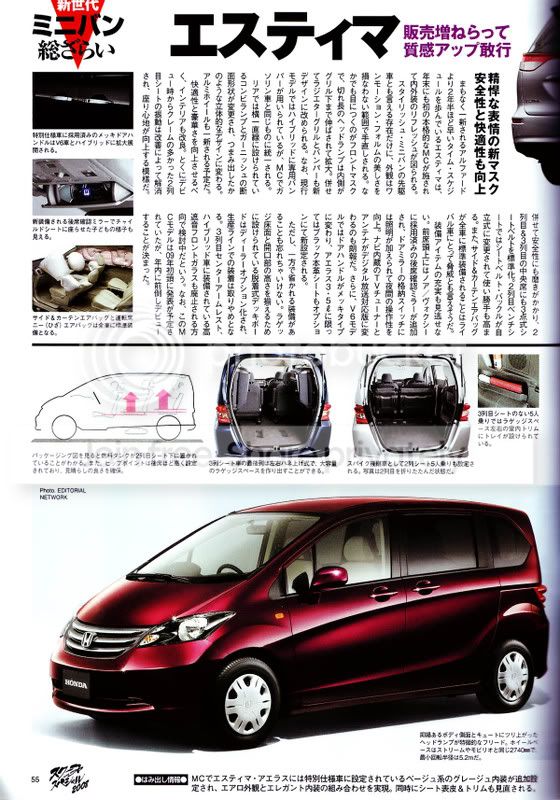
>> Honda will announce a new model called the "Freed" on May 29th 2008. It will have seating for six with a third row of seats. Based engine will be a 1.5L + CVT. The minivan will be no longer then the Mobilio or Stream at 2740mm.


>> Honda's IMA hybrid has been seen testing with Fit/Jazz front end attached to an Honda Airwave body.
>> Targeted to be released on March 2009 and priced around $19,000.
>> For fuel efficiency, the vehicle is aiming for 37km/L in Japan's 10-15 mode.
Toyota 'SAI' Source: Mag-X and Bestcar
>> As has been previously announced, Toyota plans of expanding the Prius range beyond a single vehicle. Currently, code-named the 'SAI', Toyota plans on having a larger hybrid that has more conventional styling and can slot in below the Camry in terms of size. The vehicle will be the base for the planned Lexus hybrid.
>> The engine will be the THSIII version of the current 2.4L inline-4 THSII in the Camry hybrid.
>> The rear trunk will be unique dual luggage lid system, being both a conventional rear trunk, that can also open up like a hatch.
Toyota Mark X
>> expected in 09. The Mark X plans on having the 2.5L 4GR, 3L 3GR, as well as the 3.5L 2GR engines in the line-up.
>> the new model will have a paddle-shift AT in its S package.
>> Will have a optional glass-roof.
Honda Odyssey and Freed
>> the 4th-gen JDM Odyssey will be released in November 08. 2.4L i-VTEC I-4 + CVT will be the base engine. The car will feature Honda's IHCC, intelligent Highway Cruise Control.
>> Honda will announce a new model called the "Freed" on May 29th 2008. It will have seating for six with a third row of seats. Based engine will be a 1.5L + CVT. The minivan will be no longer then the Mobilio or Stream at 2740mm.



Trending Topics



Yes.  If this is true it makes my whole argument about turbo 4s or hybrid 4s in the "Right" Lexus car all the better and credible
 I actually hope this is true and it does come out. And if it really does come out, all of us can witness with our own eyes if a 4 cylinder engine in any Lexus car will hurt the brand image and prestige or if Lexus will continue on their merry way
If this is true it makes my whole argument about turbo 4s or hybrid 4s in the "Right" Lexus car all the better and credible I actually hope this is true and it does come out. And if it really does come out, all of us can witness with our own eyes if a 4 cylinder engine in any Lexus car will hurt the brand image and prestige or if Lexus will continue on their merry way


Racer


Joined: Dec 2004
Posts: 1,791
Likes: 0
From: so. cal
Yes. If this is true it makes my whole argument about turbo 4s or hybrid 4s in the "Right" Lexus car all the better and credible I actually hope this is true and it does come out. And if it really does come out, all of us can witness with our own eyes if a 4 cylinder engine in any Lexus car will hurt the brand image and prestige or if Lexus will continue on their merry way
If this is true it makes my whole argument about turbo 4s or hybrid 4s in the "Right" Lexus car all the better and credible I actually hope this is true and it does come out. And if it really does come out, all of us can witness with our own eyes if a 4 cylinder engine in any Lexus car will hurt the brand image and prestige or if Lexus will continue on their merry way
Lexus Test Driver
Joined: Apr 2002
Posts: 1,323
Likes: 0
From: Ft. Lauderdale, FL
Coco-bun, thank you for taking the time to translate that for us!
I'm assuming this car will be FWD? So sizewise, are we looking around the size of a Corolla? The current Camry uses the 4cl-hybrid with 200hp. Putting that system in a smaller car would have ample accerleation with good economy. I just PRAY they style the heck out of it because I'd cry if there was something looking as different as a Prius wearing an L-badage. The drawings look pretty good, but I'm guessing those are pure speculation.
Also, price-wise, what do you all predict? Are they going to add a 3rd car in the $30,000 range or price it at the TSX?
I'm assuming this car will be FWD? So sizewise, are we looking around the size of a Corolla? The current Camry uses the 4cl-hybrid with 200hp. Putting that system in a smaller car would have ample accerleation with good economy. I just PRAY they style the heck out of it because I'd cry if there was something looking as different as a Prius wearing an L-badage. The drawings look pretty good, but I'm guessing those are pure speculation.
Also, price-wise, what do you all predict? Are they going to add a 3rd car in the $30,000 range or price it at the TSX?
Still counts though as Lexus is world wide and it will still be under the Lexus name. Hopefully at least
Anyway, if that is the case, I bet a year or two later you'll have Americans complaining why we don't get them over here
Anyway, if that is the case, I bet a year or two later you'll have Americans complaining why we don't get them over here
I have to say that I feel like they could make a hybrid version of the IS using the 2.5L V6 that would serve the same purpose, and that actually makes more sense to me than creating an entirely new car.
IS 300h with ~225HP and 37MPG combined. Makes a lot of sense and seems realistic to me.
This Lexus hybrid should be something completely different IMO. Not a compact sedan.
IS 300h with ~225HP and 37MPG combined. Makes a lot of sense and seems realistic to me.
This Lexus hybrid should be something completely different IMO. Not a compact sedan.