


Real wheels vs Rep wheels.. Opinions...


Driver
Joined: Nov 2014
Posts: 169
Likes: 0
From: AZ

I wouldn't say reps are unsafe, I would say authentic are safer.
I wouldn't say reps are bad, I would say authentic are better.
Really it's where you want to spend your money. I wanted forged rims so I bought used Infiniti OEM forged (way cheaper) for my current car 2005 350Z.
When I get my ISF, I'll hunt for the OEM forged if I don't pick up a 2012+
I wouldn't say reps are bad, I would say authentic are better.
Really it's where you want to spend your money. I wanted forged rims so I bought used Infiniti OEM forged (way cheaper) for my current car 2005 350Z.
When I get my ISF, I'll hunt for the OEM forged if I don't pick up a 2012+

Former Sponsor
Joined: Feb 2015
Posts: 873
Likes: 2
From: CA
Hi All!
We've seen this conversation come up quite a bit before and don't intend to fuel debate, but want to add a few tidbits given our perspective on things. We are enthusiasts, but we are also a wheel company ourselves, so please don't mind if we use our own material for reference The same details can be compared to other brands/companies as well of course (and really, car parts other than wheels)! We won't comment on the original Vs rep aspect (this is best left for the end user), but will focus on the technical aspects.
More money spent =/= a better quality product. While a higher price will sometimes be justified by a better product, this is not always the case. A $6,000 set of wheels will not necessarily be twice as good as a $3,000 set of wheels. Furthermore, a $2,000 set of wheels isn't inherently 'better' than a $1,300 set of wheels, either. Some manufacturing processes will be higher cost, such as multi-piece wheels & forged wheels, but the idea is to look even closer. Consider wheels analogous to clothing - not all designer goods are actually worth the extra money, or necessarily even better quality than other, cheaper, alternatives. By no means does this imply that all cheap products are fine, but it brings me to my next point.
Try to look beyond the price tag & look for signs of a quality product & company that will stand behind their product. I think we can agree that one of the most important factors to consider are the standards to which the wheels are manufactured and whether the company shows the longevity and ability/know-how to stand behind their product.
Things like JWL/VIA are important and many look to TUV as one of the highest marks when it comes to wheel certifications & strength tests. Simply because a wheel does not have a TUV certification does not imply that it wouldn't pass if tested, it only means that the company behind the product hasn't gone to the lengths for the certification (which isn't necessarily a bad thing). However, if a company's product is TUV, then you can have some comfort knowing it's passed some rigorous testing for European standards & use.
Load rating is another often overlooked subject, but is relevant to consider. A wheel with a higher load rating means it has passed testing to ensure safe installation on a heavier/larger vehicle. Combine safety standards with load rating and you'll be able to determine whether a wheel can be trusted. (If interested in some of our current TUV certifications, please check out our European site here -> http://vmrwheels.eu/certificates.html)
So you've determined a wheel is strong and a company will back up their product. Is there anything else to consider? Weight? It's actually not difficult to make a safe wheel - steelies are generally safe but weigh a ton! The real trick is making a wheel that is safe, aesthetically pleasing, and light weight. Depending on your goal with the car, weight may or may not be much of a factor. You never want to install boat anchors for wheels but if a wheel weighs comparable to OEM wheels, you will see no real change in performance. Some will even argue there are a number of much more important factors for the track (i.e. tire compound, suspension, seat time, etc.), but we understand that a lighter wheel is generally the goal when after performance!
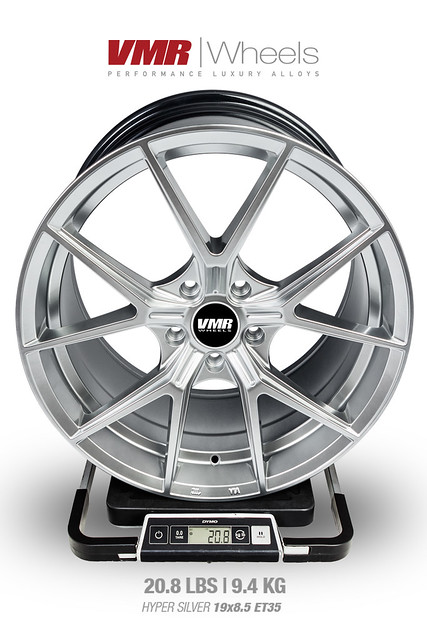
If you're after performance and not wanting to spring for forged wheels, flow formed wheels are generally considered a halfway ground between a cast wheel and a forged wheel, a hybrid of sorts. Flow formed wheels (sometimes also called flow forged, rim rolled, rotary forged, etc. by other brands) are actually cast wheels with specially treated barrels similar to a forging procedure (high pressure + heat). You can think of the end result is something like a single piece wheel that has a cast face but forged barrel. The technology is really amazing because if harnessed properly by the wheel manufacturer, it allows for significant weight reduction without causing the price to skyrocket anywhere near the cost of a forged wheel. Just as an example of how much the flow formed manufacturing process can help save weight, this is one of our 19x8.5 V804 flow formed wheels weighing in at 20.8 Lbs:
Our advice? Look at the various styles the different brands offer and look for a company that is knowledgeable about the product they sell and stands behind it (really, advice that can be applied to any aftermarket parts purchase). We can't speak for other brands but our goal is to produce quality wheels with all the proper certifications, excessively high load ratings, and the best customer service possible, all at a reasonable prices.
If anyone has any questions please don't hesitate to reach out if there's anything we can do for you (or any other ClubLexus users, for that matter) - we are always here to help and happy to share details when we can! Oh, and click the image in our signature if you're interested in checking out our lineup at all
We've seen this conversation come up quite a bit before and don't intend to fuel debate, but want to add a few tidbits given our perspective on things. We are enthusiasts, but we are also a wheel company ourselves, so please don't mind if we use our own material for reference
The same details can be compared to other brands/companies as well of course (and really, car parts other than wheels)! We won't comment on the original Vs rep aspect (this is best left for the end user), but will focus on the technical aspects.More money spent =/= a better quality product. While a higher price will sometimes be justified by a better product, this is not always the case. A $6,000 set of wheels will not necessarily be twice as good as a $3,000 set of wheels. Furthermore, a $2,000 set of wheels isn't inherently 'better' than a $1,300 set of wheels, either. Some manufacturing processes will be higher cost, such as multi-piece wheels & forged wheels, but the idea is to look even closer. Consider wheels analogous to clothing - not all designer goods are actually worth the extra money, or necessarily even better quality than other, cheaper, alternatives. By no means does this imply that all cheap products are fine, but it brings me to my next point.
Try to look beyond the price tag & look for signs of a quality product & company that will stand behind their product. I think we can agree that one of the most important factors to consider are the standards to which the wheels are manufactured and whether the company shows the longevity and ability/know-how to stand behind their product.
Things like JWL/VIA are important and many look to TUV as one of the highest marks when it comes to wheel certifications & strength tests. Simply because a wheel does not have a TUV certification does not imply that it wouldn't pass if tested, it only means that the company behind the product hasn't gone to the lengths for the certification (which isn't necessarily a bad thing). However, if a company's product is TUV, then you can have some comfort knowing it's passed some rigorous testing for European standards & use.
Load rating is another often overlooked subject, but is relevant to consider. A wheel with a higher load rating means it has passed testing to ensure safe installation on a heavier/larger vehicle. Combine safety standards with load rating and you'll be able to determine whether a wheel can be trusted. (If interested in some of our current TUV certifications, please check out our European site here -> http://vmrwheels.eu/certificates.html)
So you've determined a wheel is strong and a company will back up their product. Is there anything else to consider? Weight? It's actually not difficult to make a safe wheel - steelies are generally safe but weigh a ton! The real trick is making a wheel that is safe, aesthetically pleasing, and light weight. Depending on your goal with the car, weight may or may not be much of a factor. You never want to install boat anchors for wheels but if a wheel weighs comparable to OEM wheels, you will see no real change in performance. Some will even argue there are a number of much more important factors for the track (i.e. tire compound, suspension, seat time, etc.), but we understand that a lighter wheel is generally the goal when after performance!
If you're after performance and not wanting to spring for forged wheels, flow formed wheels are generally considered a halfway ground between a cast wheel and a forged wheel, a hybrid of sorts. Flow formed wheels (sometimes also called flow forged, rim rolled, rotary forged, etc. by other brands) are actually cast wheels with specially treated barrels similar to a forging procedure (high pressure + heat). You can think of the end result is something like a single piece wheel that has a cast face but forged barrel. The technology is really amazing because if harnessed properly by the wheel manufacturer, it allows for significant weight reduction without causing the price to skyrocket anywhere near the cost of a forged wheel. Just as an example of how much the flow formed manufacturing process can help save weight, this is one of our 19x8.5 V804 flow formed wheels weighing in at 20.8 Lbs:
Our advice? Look at the various styles the different brands offer and look for a company that is knowledgeable about the product they sell and stands behind it (really, advice that can be applied to any aftermarket parts purchase). We can't speak for other brands but our goal is to produce quality wheels with all the proper certifications, excessively high load ratings, and the best customer service possible, all at a reasonable prices.
If anyone has any questions please don't hesitate to reach out if there's anything we can do for you (or any other ClubLexus users, for that matter) - we are always here to help and happy to share details when we can!
Oh, and click the image in our signature if you're interested in checking out our lineup at all

Thread
Thread Starter
Forum
Replies
Last Post