


LED vs HID Headlamps


Advanced


Joined: Jun 2013
Posts: 532
Likes: 15
From: Singapore

And Xenons at this temperature has the best output (measured by Lumens) compared to lower temps (3000K and below or 5000K and above)
On another note, i am not too sure if you can take two LED projectors and total the Lumens?
Its like taking two torch lights side-by-side, you may increase the spread but it isnt really brighter right? I suspect you might need to increase the LED output more than putting more LED side by side. i might be wrong though.
Anyone here can en"light"en us?


Lead Lap

Joined: Aug 2011
Posts: 4,687
Likes: 543
From: Ca
Yes, from my memory, we can take two projectors, and total the lumens. It is that simple.
If the two beams do not coalesce, then the intensity of brightness in Lux is the same, but the total surface area illuminated is doubled, and the total lumen volume count is also doubled.
If the two beams coalesce to the point of being 100% coincident, then the total surface area illuminated is the same, but the intensity of the light in Lux is doubled, and the total volume Lumen count is also doubled.
The trick with understanding lighting is that doubling the intensity of light, will NOT double the longitudinal throw distance.
To double the longitudinal throw distance, we must quadruple the total lumen count and hence quadruple the intensity of light.
The total power or volume of light in Lumens is like the power of an engine in horsepower/kilowatts.
Total Lumens = Intensity of Brightness in Lux multiplied by the Surface Area of Illumination
Doubling the intensity of brightness, will double the lumens.
Likewise, doubling the surface area of illumination, will also double the total lumen count.
Power in Horsepower/KiloWatts = Torque in lbs-ft/Nm multiplied by the Speed in RPM
The reflector of a light is equivalent to the gearbox of a car.
Just as the gearbox alters the ratio of the torque to the speed, the reflector of a light alters the ratio between the intensity of light, and the surface area illuminated.
The larger the reflector, the greater the intensity of the hot spot, but the smaller the hot spot size, hence the smaller the surface area illuminated.
The greater the intensity of light, the further it will throw longitudinally.
We must increase the intensity of light four times, to be able to double the longitudinal distance of throw.
When we examine the light beam on a wall, there is a central hot spot, and a peripheral spill of light.
The central hotspot is indirect light that has been reflected from the reflector.
The surrounding spill of light, is light that has come directly from the emitter or original source.
Around the central hot spot, there is a secondary ring/band of light - that is known as the corona.
The deeper the reflector relative to the diameter of the reflector, the narrower the spill of light, but the wider and more prominent the corona ring/band of light!
In other words, light that should have spilled laterally sideways, is now focused into the secondary ring of light known as the corona, encircling the central hot spot.
The difference between LED's and HID's is the source.
The LED's are more efficient, and therefore cooler, with a longer life span, and start quickly, so that they can be used for the high beam flasher as well.
However, the LED's are not capable of outputting large amounts of light in Lumens.
Thus, multiple LED's are often used to compensate.
A multiple LED unit can produce: fewer, as many, if not more total Lumen volume as a HID, depending on the type of LED emitter used and its efficiency, the number of LED emitters used, the voltage, and the current used.
Generally speaking, when large amounts of light is required, eg tennis courts, football fields, and Olympic stadiums, LED's are not used, but high intensity discharge xenon lights are used...
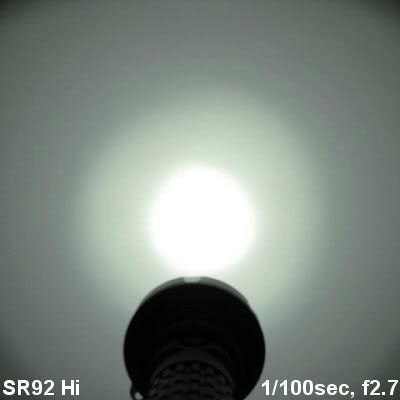
If the two beams do not coalesce, then the intensity of brightness in Lux is the same, but the total surface area illuminated is doubled, and the total lumen volume count is also doubled.
If the two beams coalesce to the point of being 100% coincident, then the total surface area illuminated is the same, but the intensity of the light in Lux is doubled, and the total volume Lumen count is also doubled.
The trick with understanding lighting is that doubling the intensity of light, will NOT double the longitudinal throw distance.
To double the longitudinal throw distance, we must quadruple the total lumen count and hence quadruple the intensity of light.
The total power or volume of light in Lumens is like the power of an engine in horsepower/kilowatts.
Total Lumens = Intensity of Brightness in Lux multiplied by the Surface Area of Illumination
Doubling the intensity of brightness, will double the lumens.
Likewise, doubling the surface area of illumination, will also double the total lumen count.
Power in Horsepower/KiloWatts = Torque in lbs-ft/Nm multiplied by the Speed in RPM
The reflector of a light is equivalent to the gearbox of a car.
Just as the gearbox alters the ratio of the torque to the speed, the reflector of a light alters the ratio between the intensity of light, and the surface area illuminated.
The larger the reflector, the greater the intensity of the hot spot, but the smaller the hot spot size, hence the smaller the surface area illuminated.
The greater the intensity of light, the further it will throw longitudinally.
We must increase the intensity of light four times, to be able to double the longitudinal distance of throw.
When we examine the light beam on a wall, there is a central hot spot, and a peripheral spill of light.
The central hotspot is indirect light that has been reflected from the reflector.
The surrounding spill of light, is light that has come directly from the emitter or original source.
Around the central hot spot, there is a secondary ring/band of light - that is known as the corona.
The deeper the reflector relative to the diameter of the reflector, the narrower the spill of light, but the wider and more prominent the corona ring/band of light!
In other words, light that should have spilled laterally sideways, is now focused into the secondary ring of light known as the corona, encircling the central hot spot.
The difference between LED's and HID's is the source.
The LED's are more efficient, and therefore cooler, with a longer life span, and start quickly, so that they can be used for the high beam flasher as well.
However, the LED's are not capable of outputting large amounts of light in Lumens.
Thus, multiple LED's are often used to compensate.
A multiple LED unit can produce: fewer, as many, if not more total Lumen volume as a HID, depending on the type of LED emitter used and its efficiency, the number of LED emitters used, the voltage, and the current used.
Generally speaking, when large amounts of light is required, eg tennis courts, football fields, and Olympic stadiums, LED's are not used, but high intensity discharge xenon lights are used...

Last edited by peteharvey; Aug 22, 2013 at 03:46 AM.


Lexus Test Driver
Joined: Apr 2005
Posts: 1,419
Likes: 10
From: ON, Canada
I want to know, too. The Japanese article that I posted said 1400 lumens per unit. But really need someone to define clearly what is a unit.
peteharvey, I think you are the most knowledgeable person on this subject so far. Please shed some "light" on this topic.
One consideration for calculating the total lumens for the LED is for the twin headlights, only one is turned on when the low beam is active. Correct me if I am wrong.
peteharvey, I think you are the most knowledgeable person on this subject so far. Please shed some "light" on this topic.
One consideration for calculating the total lumens for the LED is for the twin headlights, only one is turned on when the low beam is active. Correct me if I am wrong.
Lead Lap
Joined: Aug 2011
Posts: 4,687
Likes: 543
From: Ca
http://monoist.atmarkit.co.jp/mn/art...4/news035.html
Andy, your link basically says that the Lexus LS pioneered the very first LED headlamps in 2007 using 5 LED emitters per side with 50 Watts of power consumption.
In 2009, the 2nd generation emitters came out reducing the unit to only 3 LED emitters per side and 33 Watts power consumption.
In 2011, the 3rd gen emitters came out, reducing the unit to only 2 LED emitters per side, and 26 Watts power consumption.
In 2013, the 4th gen LED emitters came out, reducing the unit to only the 1 LED emitter per side, with 22 Watts power consumption.
Where the 1st gen LED emitters only pumped out 400 lumens, the current 4th gen emitters in new 3IS pumps out 1400 lumens, so only 1 LED emitter is necessary per side.
The LED emitters are actually becoming larger in size over the years.
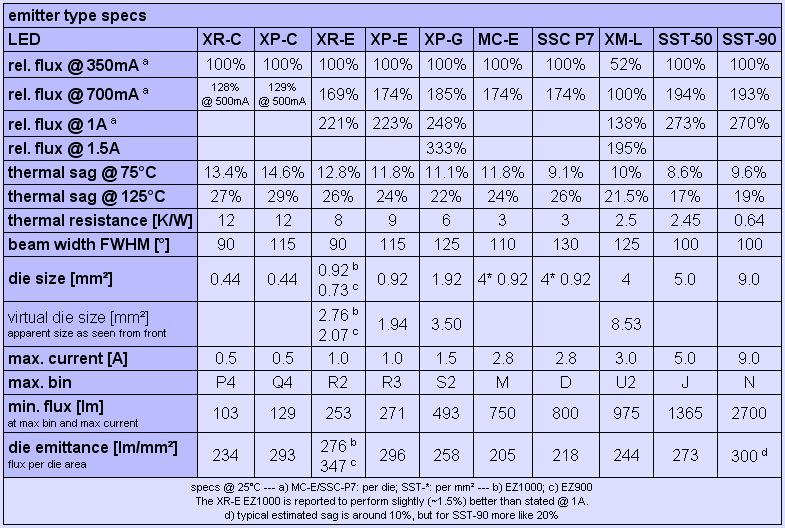
In the old days, in the chart below, the Cree XR-E emitter had a die size of only 0.92 square mm.
Presently, the Cree XM-L emitter has a die size of 2mm by 2mm for a surface area of 4 square mm.
The larger die size is able to handle more current/amperage, by withstanding more heat build up, to output more light.
As can be seen in the chart below, the Cree XM-L U2 model, with a 4 sq mm die size, can handle up to 3 amps, and output 975 lumens.
Meanwhile a competing brand called Luminus produces the SST-50 J model with a 5 square mm die size, can handle up to 5 amps, and can output 1375 lumens.
The Luminus SST-90 N model with a 9 sq mm die size, can handle up to 9 amps to output up to 2700 lumens per emitter!
Although the two Luminus models produce more grunt, the Cree XM-L is actually more energy efficient.
It's like comparing a V8 to a V6.
Cree does have a new XM-L2 emitter that may be able to output 1400 emitter lumens each.
I'm not sure which make/model of LED emitters is used in Lexus 3IS.
Even though the Luminus emitters are not as energy efficient as the Cree XM-L emitters, the Luminus emitters are still far more efficient than the HID's.
Comparing the Luminus emitters to the HID, the HID is like the V8's - not energy efficient, but more powerful.
However, the article doesn't say anything about the lumen output of the HID Xenon headlamps for comparison to the LED headlamps, but HID's can do a lot more than 1400 lumens per side.
Battery powered HID's can do 5,000 lumens or even 10,000 lumens.
A HID harbour spotlight can output 63,000 Lumens!!!
Of course, it is plugged into the wall, and is not battery powered...
http://www.candlepowerforums.com/vb/...ght=HID+lumens
Andy, your link basically says that the Lexus LS pioneered the very first LED headlamps in 2007 using 5 LED emitters per side with 50 Watts of power consumption.
In 2009, the 2nd generation emitters came out reducing the unit to only 3 LED emitters per side and 33 Watts power consumption.
In 2011, the 3rd gen emitters came out, reducing the unit to only 2 LED emitters per side, and 26 Watts power consumption.
In 2013, the 4th gen LED emitters came out, reducing the unit to only the 1 LED emitter per side, with 22 Watts power consumption.
Where the 1st gen LED emitters only pumped out 400 lumens, the current 4th gen emitters in new 3IS pumps out 1400 lumens, so only 1 LED emitter is necessary per side.
The LED emitters are actually becoming larger in size over the years.
In the old days, in the chart below, the Cree XR-E emitter had a die size of only 0.92 square mm.
Presently, the Cree XM-L emitter has a die size of 2mm by 2mm for a surface area of 4 square mm.
The larger die size is able to handle more current/amperage, by withstanding more heat build up, to output more light.
As can be seen in the chart below, the Cree XM-L U2 model, with a 4 sq mm die size, can handle up to 3 amps, and output 975 lumens.
Meanwhile a competing brand called Luminus produces the SST-50 J model with a 5 square mm die size, can handle up to 5 amps, and can output 1375 lumens.
The Luminus SST-90 N model with a 9 sq mm die size, can handle up to 9 amps to output up to 2700 lumens per emitter!
Although the two Luminus models produce more grunt, the Cree XM-L is actually more energy efficient.
It's like comparing a V8 to a V6.
Cree does have a new XM-L2 emitter that may be able to output 1400 emitter lumens each.
I'm not sure which make/model of LED emitters is used in Lexus 3IS.
Even though the Luminus emitters are not as energy efficient as the Cree XM-L emitters, the Luminus emitters are still far more efficient than the HID's.
Comparing the Luminus emitters to the HID, the HID is like the V8's - not energy efficient, but more powerful.
However, the article doesn't say anything about the lumen output of the HID Xenon headlamps for comparison to the LED headlamps, but HID's can do a lot more than 1400 lumens per side.
Battery powered HID's can do 5,000 lumens or even 10,000 lumens.
A HID harbour spotlight can output 63,000 Lumens!!!
Of course, it is plugged into the wall, and is not battery powered...
http://www.candlepowerforums.com/vb/...ght=HID+lumens

Last edited by peteharvey; Aug 22, 2013 at 02:36 PM.
Lead Lap
Joined: Aug 2011
Posts: 4,687
Likes: 543
From: Ca
...On another note, i am not too sure if you can take two LED projectors and total the Lumens?
Its like taking two torch lights side-by-side, you may increase the spread but it isnt really brighter right? I suspect you might need to increase the LED output more than putting more LED side by side. i might be wrong though.
Anyone here can en"light"en us?
Its like taking two torch lights side-by-side, you may increase the spread but it isnt really brighter right? I suspect you might need to increase the LED output more than putting more LED side by side. i might be wrong though.
Anyone here can en"light"en us?
If we put two flashlights side by side, and we make sure that one beam sits perfectly on top of the other, then there is an increase in intensity, and more longitudinal throw; however, the total surface area of illumination is the same, and has not been increased nor doubled.
Since total Lumens = Intensity in Lux multiplied by the Surface Area of Illumination in square meters, both an increase in the intensity, or an increase in the surface area of illumination will result in more total Lumen output.
The trickiest word in lighting is the word "brightness".
Because brightness can mean greater intensity, so that the light can travel further longitudinally.
Brightness can also mean the same intensity and longitudinal throw, but a much wider surface area of illumination.
The word brightness should be avoided, because it can mean both.
Putting two flashlights, one beam on top of the other, will double the intensity.
Doubling the intensity will increase the throw, but it will not double the throw longitudinally.
To longitudinally double the throw, we must increase the intensity by four times!
It's like audio amplifiers - to double the volume, we must increase the Wattage something like 8 times, because it is mathematically cubed, or in other words, to the power of three @ 2 x 2 x 2...
Last edited by peteharvey; Aug 22, 2013 at 02:37 PM.


Lead Lap
Joined: Aug 2013
Posts: 758
Likes: 26
From: Sweden
Advanced
Joined: Jun 2013
Posts: 532
Likes: 15
From: Singapore
Xenons will require replacement (every 3-5 years)
It depends on how long you keep your car too.
Lexus Test Driver
Joined: Apr 2005
Posts: 1,419
Likes: 10
From: ON, Canada
Thanks Peteharvey for posting such a useful information. I have already saved it as a reference.
jennypenny, to add info to your comment. After a few years of HID usage (mainly depends on how much mileage you put on your car), the HID will become slightly whiter (i.e. higher color temperature (K) but it will be dimmer.
jennypenny, to add info to your comment. After a few years of HID usage (mainly depends on how much mileage you put on your car), the HID will become slightly whiter (i.e. higher color temperature (K) but it will be dimmer.