


Rolls-Royce electric airplane


Thread Starter

Joined: Oct 2008
Posts: 42,476
Likes: 321
From: California
 Rolls-Royce electric airplane
Hits 387.4 mph
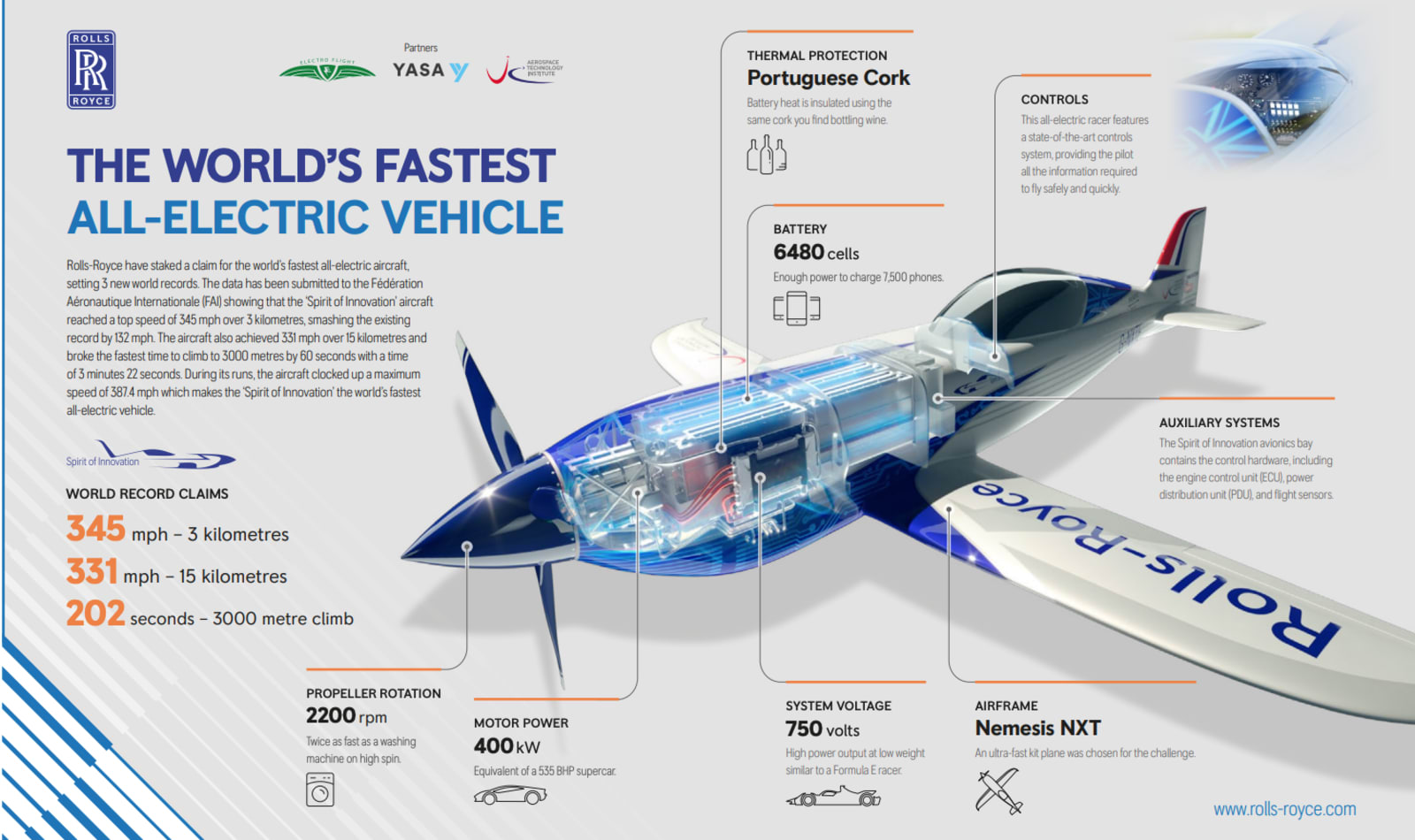
Just two months after its maiden flight, Rolls-Royce's "Spirit of Innovation" has hit a top speed of 387.4 mph, tentatively smashing the speed record for electric airplanes, Gizmodo has reported. It also claimed the top speed of 345.4 MPH over a 3 kilometer (1.86 mile) course and lowest time to a 3,000 meter (9,843 feet) altitude (202 seconds). The records have yet to be certified, but if the 345.5 mph speed stands, it would beat the current record of 213 mph — held by a Siemens-powered Extra 330LE — by an impressive 132 mph.
Rolls-Royce (the aviation, not the car company), conducted the tests on November 16 as part of its ACCEL (accelerating electrification of flight) project. To have the records certified, it's submitting the trials to the Fédération Aéronautique Internationale (FAI), the body in charge of world aviation records. If confirmed, the speeds would be pretty impressive considering that the plane only made its maiden flight in September — suggesting that with more time, it could go even faster.
Rolls-Royce (the aviation, not the car company), conducted the tests on November 16 as part of its ACCEL (accelerating electrification of flight) project. To have the records certified, it's submitting the trials to the Fédération Aéronautique Internationale (FAI), the body in charge of world aviation records. If confirmed, the speeds would be pretty impressive considering that the plane only made its maiden flight in September — suggesting that with more time, it could go even faster.


The Spirit of Innovation is an old-school "tail-dragger" airplane (steering at the rear) with the canopy pushed way back, and looks as fast as it goes. It's powered by a 400 kW (535 HP), 750 volt motor. Rolls-Royce said it uses the "most power-dense propulsion battery pack ever assembled in aerospace," with 6,480 cells.
As Engadget detailed in an explainer, electric airplanes aren't practical since current batteries are 50 times less energy dense than jet fuel. However, they do hold some promise for very short trips, like a 30 minute jaunt between Vancouver and Victoria in Canada. And unlike non-turbocharged ICE engines, electric motors retain full power as an airplane climbs, making them ideal for time-to-altitude record attempts — as the Spirit of Innovation has just shown.
As Engadget detailed in an explainer, electric airplanes aren't practical since current batteries are 50 times less energy dense than jet fuel. However, they do hold some promise for very short trips, like a 30 minute jaunt between Vancouver and Victoria in Canada. And unlike non-turbocharged ICE engines, electric motors retain full power as an airplane climbs, making them ideal for time-to-altitude record attempts — as the Spirit of Innovation has just shown.
Source
Last edited by bitkahuna; Nov 22, 2021 at 11:32 AM.


Lexus Fanatic


Joined: Oct 2003
Posts: 94,511
Likes: 261
From: Virginia/D.C. suburbs
In the past, tail-wheel aircraft could usually be flown only by the most skilled pilots, because the aft-center of gravity made them more unstable and difficult to maneuver while on the ground, during take-off, and approach/landing, particularly in crosswinds and/or turbulence, where "Ground-Loop" accidents are commonplace. That occurs where the rear of the plane, in forward motion, spins around on its landing gear and swaps-ends with the front because of the tail-heaviness. The article doesn't say (and, though a former pilot and Ground-Instructor, I have been out of the flight-business for some years)......but it begs the question if manufacturers of tail-wheel planes have developed electronic stability-systems for the flight-controls that help prevent those ground-loops.

Thread
Thread Starter
Forum
Replies
Last Post
Hoovey689
Car Chat
6
Feb 11, 2021 10:23 AM
Hoovey689
Car Chat
5
Oct 4, 2018 02:21 PM
Hoovey689
Car Chat
0
May 31, 2018 01:39 PM