


Tesla "Battery Day" is here


Lexus Test Driver
Joined: Jan 2007
Posts: 7,460
Likes: 232
From: CA

The $140K before tax is nuts. When the Model S P100D was introduced back in 2017 it was $130K. Now a 2020 Model S performance is about $105K.
I would imagine that in 2024 a new Plaid Model S would be much less than $140K. The folks with money to spare can pay for the R&D for the first 3 years. Even if I could afford one (and I cannot), I wouldn't get one. The performance is about .5 seconds quicker than the current Model S performance. The added range is definitely a big plus, but not worth $35K IMO. I can't help but wonder that Elon is simply trying to "one up" the Lucid Air by stating specs that are slightly better than that car. Elon loves challenges.
He did the same thing when the Taycan's numbers were released last year, he immediately sent a Model S to the Ring to do his his one step better routine. Competition is great!
I guess the $35K difference will also go towards reengineering the rear axle to accommodate two motors, the new battery pack structure and perhaps a new suspension, maybe an update to the interior and exterior (wider fenders etc). I can't see how this will all happen in a year.
I would imagine that in 2024 a new Plaid Model S would be much less than $140K. The folks with money to spare can pay for the R&D for the first 3 years. Even if I could afford one (and I cannot), I wouldn't get one. The performance is about .5 seconds quicker than the current Model S performance. The added range is definitely a big plus, but not worth $35K IMO. I can't help but wonder that Elon is simply trying to "one up" the Lucid Air by stating specs that are slightly better than that car. Elon loves challenges.
He did the same thing when the Taycan's numbers were released last year, he immediately sent a Model S to the Ring to do his his one step better routine. Competition is great!
I guess the $35K difference will also go towards reengineering the rear axle to accommodate two motors, the new battery pack structure and perhaps a new suspension, maybe an update to the interior and exterior (wider fenders etc). I can't see how this will all happen in a year.

EV ftw!!!


Joined: Nov 2002
Posts: 8,970
Likes: 563
From: Lake Ontario
I guess this criteria (your statement above) is what some people will consider more important than the overall feel/usability/quality of the car. I'm in the latter camp - annihilating every car in a straight line is definitely not as big of a deal to me.

Regardless it will be interesting to see/drive it when it's available in the future.
Lexus Test Driver
Joined: Jan 2007
Posts: 7,460
Likes: 232
From: CA
This yardstick seems very academic to me.
I guess this criteria (your statement above) is what some people will consider more important than the overall feel/usability/quality of the car. I'm in the latter camp - annihilating every car in a straight line is definitely not as big of a deal to me.
Regardless it will be interesting to see/drive it when it's available in the future.
I guess this criteria (your statement above) is what some people will consider more important than the overall feel/usability/quality of the car. I'm in the latter camp - annihilating every car in a straight line is definitely not as big of a deal to me.
Regardless it will be interesting to see/drive it when it's available in the future.

2024 is 7 years after 2017. for a new model (plaid) that is leaps and bounds faster and better than the 2017 model, for the price to be not much different (8%) is awesome.
Even if I could afford one (and I cannot), I wouldn't get one.

the plaid is the bragging rights car, like a dodge demon or something.
EV ftw!!!
Joined: Nov 2002
Posts: 8,970
Likes: 563
From: Lake Ontario
Yes indeed.

Lead Lap


Joined: Jan 2003
Posts: 4,957
Likes: 501
From: Maryland
I like fast cars (come on, it’s fun) but for once I really don’t need the plaid version of the Model S. I think that is a bit overkill for me and I would probably pass out from the g forces. I’ll take a P100D which is enough for me. The exterior and interior is nicer than the Model 3 but it needs a nice refresh for me to spend the extra money over the Model 3.

Lexus Champion
Joined: Sep 2010
Posts: 2,218
Likes: 300
From: NA
I like fast cars (come on, it’s fun) but for once I really don’t need the plaid version of the Model S. I think that is a bit overkill for me and I would probably pass out from the g forces. I’ll take a P100D which is enough for me. The exterior and interior is nicer than the Model 3 but it needs a nice refresh for me to spend the extra money over the Model 3.
Lexus Test Driver
Joined: Jan 2007
Posts: 7,460
Likes: 232
From: CA
The Teslas are also so damn cheap to run. Below is an article about a 100k mile Tesla Model 3. It has 5% battery degradation and cost the owner less than $5k in electricity and maintenance cost. EVs are far cheaper to run than ICE with much better bang for the buck performance.
Tesla Model 3 with 100,000 miles shows extreme low cost and minimal battery degradation
Today we take a look at one of the first Tesla Model 3 cars with 100,000 miles and the owner’s experience with service, maintenance, and battery degradation.
There are quite a few high-mileage Tesla vehicles out there.
I have a Tesla Model X with over 400,000 miles on it.
But there are not that many Model 3 and Model Y vehicles, which are Tesla’s latest generation vehicles, with 6-figure mileage yet.
Kazi Imam has one of the first Model 3 with over 100,000 miles and he talked to Electrek about his experience with the electric car to date.
He put 100,000 miles on the 2018 Model 3 Long Range over just over 2 years:
Imam told Electrek that he was quite impressed by the cost of ownership of the Model 3.
Over 100,000 miles, which would take the average driver 6 years to travel, the Model 3 only cost him $4,730, including the cost of electricity:
“I was astonished at the little cost of maintenance and service for the car. The total cost of electricity was $2,985. Total maintenance and service cost was $1,741.11; so the total cost of owners
Most of that maintenance and service cost were tires.
Imam gave us a breakdown on all the service performed by Tesla on the Model 3 over time.
The air filter had to be replaced:
“At 36,000 miles, the HVAC system started giving that musky odor and I had to get the air filters replaced and the evaporator cleaned which was $136.50.”
This is a common issue with many owners reporting a “mildew smell” that has something to do with the way the air is circulated.
Tesla is said to have fixed the issue through a software update to better circulate the air automatically, but some owners still have to replace the air filter.
Alternatively, owners can also replace the air filter themselves if they don’t want to pay Tesla to do it.
You can buy air filter replacements on Amazon for a fraction of the price and Tesla has an easy do-it-yourself guide to replace the filter.
Tires, as for most electric cars, are the biggest maintenance and service costs for Tesla vehicles.
It’s no different for Imam’s Model 3:
“I got the tires replaced at around 45,000 miles from Costco tires which was $1200, as they also offer lifetime free rotations.”
More recently, he did a little more maintenance:
“At 95,000 miles, the wiper blades were changed, wheel alignment, and brake bleed was done for $410.61.”
He also gave us a breakdown of things that Tesla replaced and fixed under warranty or goodwill.
Impressively, nothing until over 50,000 miles on the Model 3:
The Tesla Model 3 cost Imam less than $3,000 in electricity.
The battery degradation was also minimal on the Model 3 over 100,000 miles.
Imam told Electrek:
“The battery degradation appears to be minimal as I currently get 305 at 100%, but it does fluctuate from time to time.”
This is a roughly 5% degradation over 2 years and 100,000 miles, but that number of cycles would normally be achieved over 5-6 years on average.
Overall, the owner says that he is impressed with the electric vehicle:
“All in all, I am impressed with Tesla’s service, especially with them replacing things for free when I was well past my warranty period. I was always provided a loaner Tesla vehicle as well.”
He says that the car still drives as new.
If you have a high-mileage electric vehicle, let us know about your experience in the comment section below.
FTC: We use income earning auto affiliate links. More.
Tesla Model 3 with 100,000 miles shows extreme low cost and minimal battery degradation
Today we take a look at one of the first Tesla Model 3 cars with 100,000 miles and the owner’s experience with service, maintenance, and battery degradation.
There are quite a few high-mileage Tesla vehicles out there.
I have a Tesla Model X with over 400,000 miles on it.
But there are not that many Model 3 and Model Y vehicles, which are Tesla’s latest generation vehicles, with 6-figure mileage yet.
Kazi Imam has one of the first Model 3 with over 100,000 miles and he talked to Electrek about his experience with the electric car to date.
He put 100,000 miles on the 2018 Model 3 Long Range over just over 2 years:
Imam told Electrek that he was quite impressed by the cost of ownership of the Model 3.
Over 100,000 miles, which would take the average driver 6 years to travel, the Model 3 only cost him $4,730, including the cost of electricity:
“I was astonished at the little cost of maintenance and service for the car. The total cost of electricity was $2,985. Total maintenance and service cost was $1,741.11; so the total cost of owners
Most of that maintenance and service cost were tires.
Imam gave us a breakdown on all the service performed by Tesla on the Model 3 over time.
The air filter had to be replaced:
“At 36,000 miles, the HVAC system started giving that musky odor and I had to get the air filters replaced and the evaporator cleaned which was $136.50.”
This is a common issue with many owners reporting a “mildew smell” that has something to do with the way the air is circulated.
Tesla is said to have fixed the issue through a software update to better circulate the air automatically, but some owners still have to replace the air filter.
Alternatively, owners can also replace the air filter themselves if they don’t want to pay Tesla to do it.
You can buy air filter replacements on Amazon for a fraction of the price and Tesla has an easy do-it-yourself guide to replace the filter.
Tires, as for most electric cars, are the biggest maintenance and service costs for Tesla vehicles.
It’s no different for Imam’s Model 3:
“I got the tires replaced at around 45,000 miles from Costco tires which was $1200, as they also offer lifetime free rotations.”
More recently, he did a little more maintenance:
“At 95,000 miles, the wiper blades were changed, wheel alignment, and brake bleed was done for $410.61.”
He also gave us a breakdown of things that Tesla replaced and fixed under warranty or goodwill.
Impressively, nothing until over 50,000 miles on the Model 3:
- At 51,000 miles, the wooden trim dashboard started to peel and that was replaced under warranty.
- At 63,000 miles, the passenger window started to squeak whenever it was used, so the window seal had to be replaced, which was also covered under warranty.
- At 71,000 miles, the car had a front left safety restraint fault error, which was fixed under goodwill.
- At 93,000 miles, the driver’s headrest looked worn out and was replaced for free as well.
- Tesla also installed a missing breather on top of the HV battery and replaced the charge port insulator pins with updated parts under warranty service.
The Tesla Model 3 cost Imam less than $3,000 in electricity.
The battery degradation was also minimal on the Model 3 over 100,000 miles.
Imam told Electrek:
“The battery degradation appears to be minimal as I currently get 305 at 100%, but it does fluctuate from time to time.”
This is a roughly 5% degradation over 2 years and 100,000 miles, but that number of cycles would normally be achieved over 5-6 years on average.
Overall, the owner says that he is impressed with the electric vehicle:
“All in all, I am impressed with Tesla’s service, especially with them replacing things for free when I was well past my warranty period. I was always provided a loaner Tesla vehicle as well.”
He says that the car still drives as new.
If you have a high-mileage electric vehicle, let us know about your experience in the comment section below.
FTC: We use income earning auto affiliate links. More.


Lexus Test Driver
Joined: Jan 2007
Posts: 7,460
Likes: 232
From: CA
The new battery will be used in next year's Plaid Model S. Tesla's rate of innovation is pretty incredible.
Tesla's CEO answered Whole Mars Catalog's question "will plaid s have a structural pack? I assume the extra power of the 4680 cells helps?", with a simple "Yeah."
That would explain why the Model S Plaid is not yet ready for the market launch. The company is waiting for the 4680 cells/structural packs to be ready, and the plan is late 2021.
This is by the way the same timeline as for the Tesla Cybertruck, and not far away from Tesla Semi.
The 4680 is a new type of cylindrical cells, currently under development by Tesla. It will store five times more energy, should allow to increase range by 16% (so we expect a corresponding energy density/lower losses) and offer up to six times the power output. The power output and the limited overheating are one of the key factors for the high-performance Plaid car.

 The cells to be used in new structural battery to further lower the weight and by the way increase the stiffness of the car.
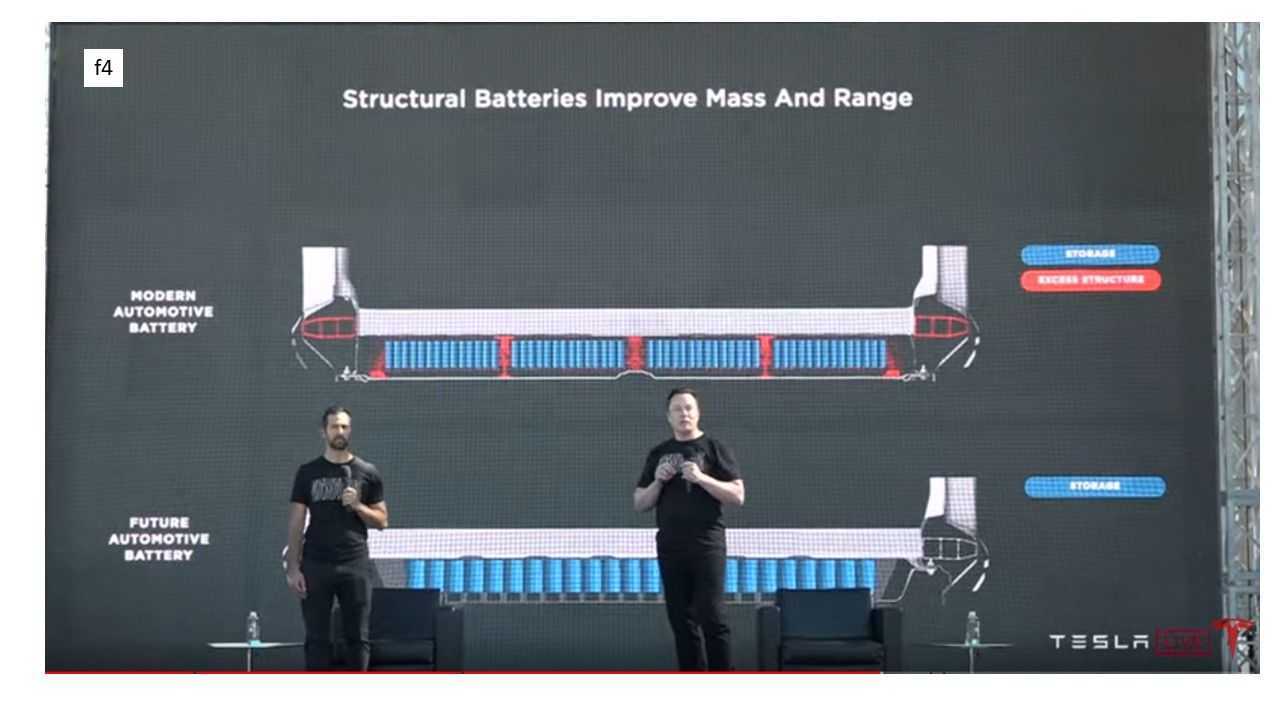 Solely the new cell design and battery integration with the car allows to increase the range by up to roughly 30%, without changes in the battery chemistry.
That would explain why the Plaid's projected range is 520+ miles, compared to 402 miles (EPA) in the top of the range Model S Long Range. That's 29.3% more.

Elon Musk: Tesla Model S Plaid To Have Structural Battery, 4680 Cells
And the latest 4680 lithium-ion cells will make up the structure.
Elon Musk has confirmed today that the upcoming Tesla Model S Plaid, scheduled for late 2021, will be equipped with the all-new structural battery pack, consisting of the all-new 4680 lithium-ion cells, announced at Tesla Battery Day.Tesla's CEO answered Whole Mars Catalog's question "will plaid s have a structural pack? I assume the extra power of the 4680 cells helps?", with a simple "Yeah."
That would explain why the Model S Plaid is not yet ready for the market launch. The company is waiting for the 4680 cells/structural packs to be ready, and the plan is late 2021.
This is by the way the same timeline as for the Tesla Cybertruck, and not far away from Tesla Semi.
The 4680 is a new type of cylindrical cells, currently under development by Tesla. It will store five times more energy, should allow to increase range by 16% (so we expect a corresponding energy density/lower losses) and offer up to six times the power output. The power output and the limited overheating are one of the key factors for the high-performance Plaid car.
The cells to be used in new structural battery to further lower the weight and by the way increase the stiffness of the car.Solely the new cell design and battery integration with the car allows to increase the range by up to roughly 30%, without changes in the battery chemistry.That would explain why the Plaid's projected range is 520+ miles, compared to 402 miles (EPA) in the top of the range Model S Long Range. That's 29.3% more.

Thread
Thread Starter
Forum
Replies
Last Post
EZZ
Car Chat
8
Aug 5, 2020 01:42 PM