When you click on links to various merchants on this site and make a purchase, this can result in this site earning a commission. Affiliate programs and affiliations include, but are not limited to, the eBay Partner Network.
I have to say this is lightyears better looking than the standard Prius. Makes me wonder why Toyota would need to build two of the same vehicle. They very could have easily used the same body for both models. Very strange.
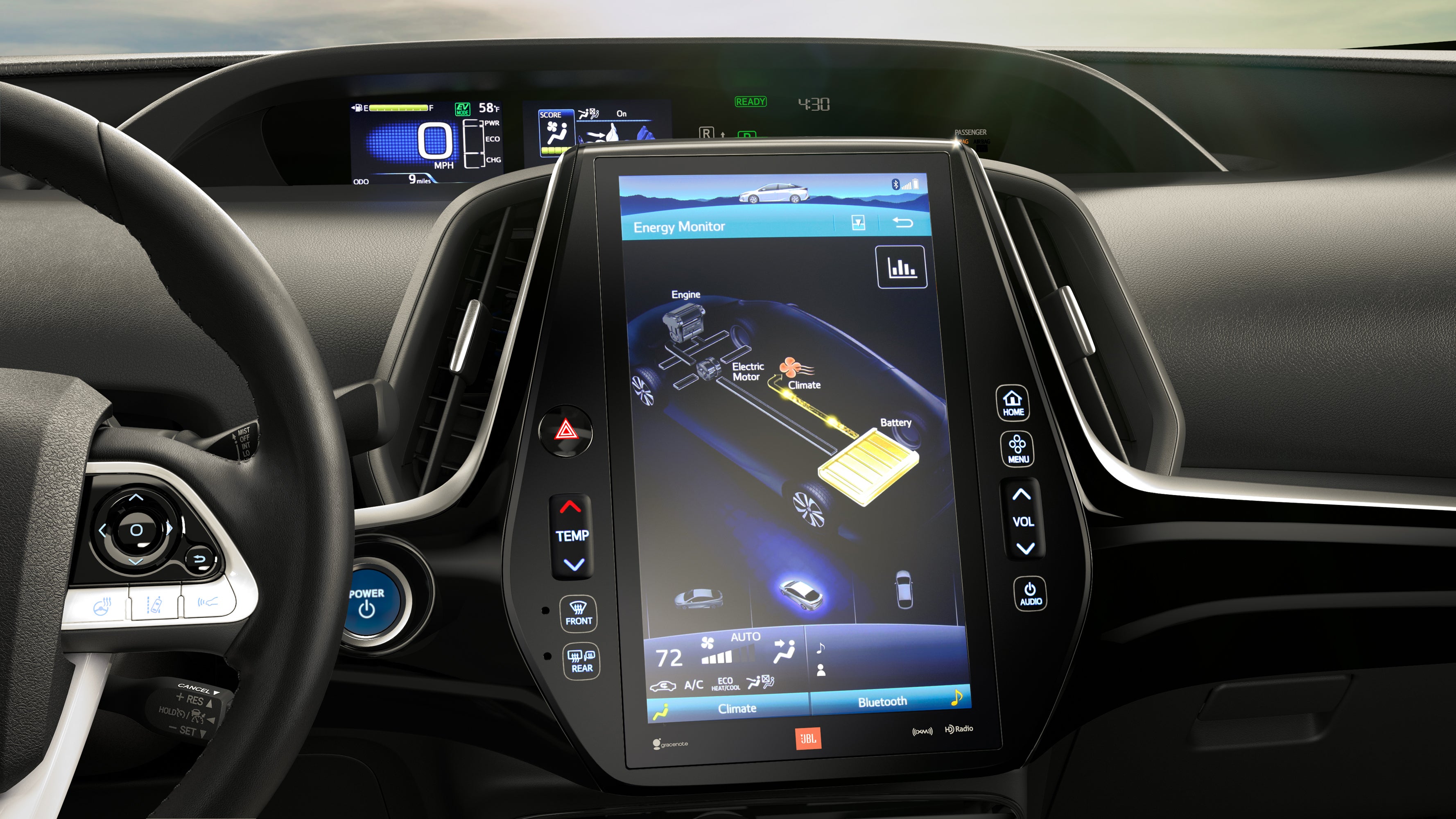
22 mile plug-in range. I guess that is decent, if you commute to work (plus be able to recharge at the office) and you are not stuck in traffic. Nice job on the Tesla-like console.
I have to say this is lightyears better looking than the standard Prius. Makes me wonder why Toyota would need to build two of the same vehicle. They very could have easily used the same body for both models. Very strange.
Toyota did use the same body for the Prius and Prius Prime, just different front and rear ends (fascias).
Originally Posted by JessePS
22 mile plug-in range. I guess that is decent, if you commute to work (plus be able to recharge at the office) and you are not stuck in traffic. Nice job on the Tesla-like console.
Of course, there is the tendency to compare the EV range of the Prius Prime with the range of the other plug-in hybrid, the new Volt, or even battery-electric vehicles like the Nissan Leaf, but that is not a fair comparison.
The Leaf has a HUGE battery sitting underneath just about the whole passenger compartment (underneath the driver and front passenger seats, under the rear footwell and under the rear seat where without the need for a fuel tank, that space is taken up by the battery).
The Volt also has a HUGE battery, taking up room in the central tunnel from the front seats back in a T-shape to under the rear seat. In the first-generation Volt, the battery prevented a centre passenger in the rear seat.
The Prius Prime, however, likely has a small battery, in comparison. The regular Prius' battery shares space under the rear seat with the fuel tank. The Prius Prime probably keeps that battery and adds another battery under the rear cargo floor.
Modern hybrid and electric vehicle batteries just do not have enough capacity so there is a trade-off: If you want EV range, you need a huge battery that takes up passenger and/or cargo space. If you want passenger and cargo space, you need a smaller battery that reduces EV range.
- Luxury Prius, not just PHEV. Luxury Toyota in the sense of Mirai.
- different front, back, rear window, roof.
- 4 seater design with foldable rear seats
- rear cargo floor higher by 7.7cm
- 11.6" HD screen with all new HD graphics/software
- Seats for USA with Mirai design, Japanese have diamond patter like in luxury vehicles (look great).
- Full LED lighting front and back except for reverse light.
- Adaptive LED high beam system, detects traffic and blocks high beam only partially, where needed.
- World first solar panels that charge the battery pack as well as 12v battery (for charging your devices, Japan/Europe only)
- World first heat pump and inverter a/c electric heating/cooling system for better battery performance (big issue in EVs in winter)
- 22 miles USA, 50 km Europe, 60km Japanese cycle ev.
- Dual motor for powering wheels, faster acceleration than normal Prius despite 300lbs extra
- 135kmh/81mph top EV-only speed.
- Rear hatch construction in carbon firbre, first for Toyota.
- Rear window has cool design that goes from roof into the spoiler (two bulges, double bubble design)
- 120 MPGe (Volt is 106 MPGe)
- Same MPG as regular Prius when in fuel mode
- Can charge battery with engine as well
- Navigation based predictive brake regenration
- Standard TSS+
- laminated front windshield, front windows, more sound deadening, different engine behaviour for more silent drive compared to regular Prius
- Luxury Prius, not just PHEV. Luxury Toyota in the sense of Mirai.
- different front, back, rear window, roof.
- 4 seater design with foldable rear seats
- rear cargo floor higher by 7.7cm
- 11.6" HD screen with all new HD graphics/software
- Seats for USA with Mirai design, Japanese have diamond patter like in luxury vehicles (look great).
- Full LED lighting front and back except for reverse light.
- Adaptive LED high beam system, detects traffic and blocks high beam only partially, where needed.
- World first solar panels that charge the battery pack as well as 12v battery (for charging your devices, Japan/Europe only)
- World first heat pump and inverter a/c electric heating/cooling system for better battery performance (big issue in EVs in winter)
- 22 miles USA, 50 km Europe, 60km Japanese cycle ev.
- Dual motor for powering wheels, faster acceleration than normal Prius despite 300lbs extra
- 135kmh/81mph top EV-only speed.
- Rear hatch construction in carbon firbre, first for Toyota.
- Rear window has cool design that goes from roof into the spoiler (two bulges, double bubble design)
- 120 MPGe (Volt is 106 MPGe)
- Same MPG as regular Prius when in fuel mode
- Can charge battery with engine as well
- Navigation based predictive brake regenration
- Standard TSS+
- laminated front windshield, front windows, more sound deadening, different engine behaviour for more silent drive compared to regular Prius
The 2017 #Prius Prime is here. With its striking new design, it’s a plug-in hybrid that’s as inspiring to the senses as it is mindful of the world around us.
The new prius doesn't bother me, but this prime looks pretty good
It doesn't seem to be from the battery packaging size like the Volt used to be, but my estimation is that it has to do with weight rating and performance specifications. With the added weight of the larger battery pack, maybe they needed to limit other weight capacities to maintain certain ratings for fuel efficiency estimates or other issues.