Fuel Consumption Testing Changes MY 2015 in Canada to resemble EPA's


Thread Starter
The pursuit of F


Joined: Jul 2006
Posts: 8,296
Likes: 303
From: Toronto, Canada
 Fuel Consumption Testing Changes MY 2015 in Canada to resemble EPA's
http://www.nrcan.gc.ca/energy/effici...ks/buying/7491
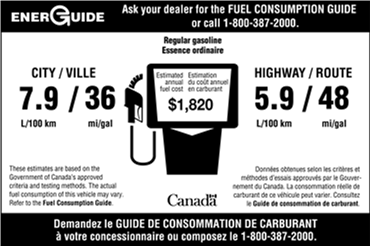
2014:
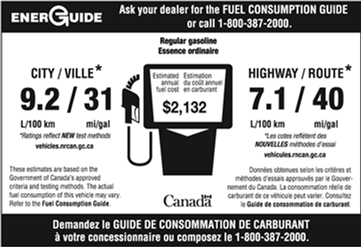
2015:
2014:
2015:
New Test Methods for Model Year 2015
Starting with 2015 model year vehicles, manufacturers will use an improved testing procedure to determine the fuel consumption ratings of new light-duty vehicles. The Government of Canada approved new test methods better approximate typical driving conditions and styles by adjusting city and highway ratings to account for air conditioner usage, cold temperature operation and driving at higher speeds with more rapid acceleration and braking. These new test methods (5-cycle testing) result in higher fuel consumption ratings that are more representative of a vehicle’s on-road fuel consumption compared to the current (2-cycle testing) methodology.
It is important to know that this change will take place in 2014. During this transition year, many dealerships will have 2014 model year vehicles alongside 2015 model year vehicles. For 2015 vehicles, the EnerGuide label will look the same but will provide fuel consumption ratings based on the new test methods. It may appear that the 2015 vehicle has worse fuel consumption than the 2014 vehicle because, for the same make and model, the new test methods can produce fuel consumption ratings that are 10 to 20 percent higher than the current ratings. The 2015 vehicle does not, in fact, consume more fuel than the 2014 vehicle under the same driving conditions. The following labels show how the ratings for the same vehicle will change based on the new test methods.
Remember: Manufacturers are not producing less fuel-efficient vehicles - the new test methods used to determine the fuel consumption ratings are more reflective of on-road driving conditions and styles.
Published ratings are a useful tool for comparing vehicles before you buy, but keep in mind that even the new ratings that better reflect everyday driving are based on standardized tests and may not accurately predict the fuel consumption you will get on the road. Your fuel consumption will vary depending on how, where and when you drive.
To see the ratings of all 1995–2014 model year vehicles adjusted to reflect the improved testing, use our Fuel Consumption Ratings web tool.
How vehicles are tested
Vehicle manufacturers follow a controlled laboratory testing procedure to generate the fuel consumption data that they submit to the Government of Canada. This controlled method of fuel consumption testing, including the use of standardized fuels, test cycles and calculations, is used instead of on-road driving to ensure that all vehicles are tested under identical conditions and that the results are consistent and repeatable.
Selected test vehicles are “run in” for about 6 000 km before testing. A vehicle being tested is then mounted on a two-wheel chassis dynamometer programmed to take into account the aerodynamic efficiency, weight and rolling resistance of the vehicle. A trained driver runs the vehicle through a standardized driving routine that simulates trips in the city or on the highway. Fuel consumption ratings are derived from the emissions generated during the driving cycles.
All vehicles, including those with four-wheel drive (4X4) or all-wheel drive (AWD), are tested in two-wheel drive mode. However, tests are adjusted to reflect the increased weight and engine load using 4X4 and AWD systems.
Detailed test information:
2-cycle testing
5-cycle testing
Which vehicles are tested
Vehicle manufacturers are not required to submit fuel consumption data for the following:
sport utility vehicles (SUVs) and passenger vans with a gross vehicle weight rating (GVWR) of more than 4 536 kg (10 000 pounds [lb.]) – GVWR is the weight of the vehicle plus maximum carrying capacity (passengers and cargo)
other vehicles with a GVWR of more than 3 856 kg (8 500 lb.) or a curb weight of more than 2 722 kg (6 000 lb.) – curb weight is the weight of the vehicle without passengers and cargo
Vehicles that exceed these limits are not tested, so their fuel consumption is not available for the Fuel Consumption Guide or the EnerGuide label.
Also, in some cases, fuel consumption information was unavailable before publication, so some new vehicle models may not appear in the Fuel Consumption Guide. To find the latest updated ratings, use our Fuel Consumption Ratings web tool or consult your vehicle manufacturer or dealer.
Starting with 2015 model year vehicles, manufacturers will use an improved testing procedure to determine the fuel consumption ratings of new light-duty vehicles. The Government of Canada approved new test methods better approximate typical driving conditions and styles by adjusting city and highway ratings to account for air conditioner usage, cold temperature operation and driving at higher speeds with more rapid acceleration and braking. These new test methods (5-cycle testing) result in higher fuel consumption ratings that are more representative of a vehicle’s on-road fuel consumption compared to the current (2-cycle testing) methodology.
It is important to know that this change will take place in 2014. During this transition year, many dealerships will have 2014 model year vehicles alongside 2015 model year vehicles. For 2015 vehicles, the EnerGuide label will look the same but will provide fuel consumption ratings based on the new test methods. It may appear that the 2015 vehicle has worse fuel consumption than the 2014 vehicle because, for the same make and model, the new test methods can produce fuel consumption ratings that are 10 to 20 percent higher than the current ratings. The 2015 vehicle does not, in fact, consume more fuel than the 2014 vehicle under the same driving conditions. The following labels show how the ratings for the same vehicle will change based on the new test methods.
Remember: Manufacturers are not producing less fuel-efficient vehicles - the new test methods used to determine the fuel consumption ratings are more reflective of on-road driving conditions and styles.
Published ratings are a useful tool for comparing vehicles before you buy, but keep in mind that even the new ratings that better reflect everyday driving are based on standardized tests and may not accurately predict the fuel consumption you will get on the road. Your fuel consumption will vary depending on how, where and when you drive.
To see the ratings of all 1995–2014 model year vehicles adjusted to reflect the improved testing, use our Fuel Consumption Ratings web tool.
How vehicles are tested
Vehicle manufacturers follow a controlled laboratory testing procedure to generate the fuel consumption data that they submit to the Government of Canada. This controlled method of fuel consumption testing, including the use of standardized fuels, test cycles and calculations, is used instead of on-road driving to ensure that all vehicles are tested under identical conditions and that the results are consistent and repeatable.
Selected test vehicles are “run in” for about 6 000 km before testing. A vehicle being tested is then mounted on a two-wheel chassis dynamometer programmed to take into account the aerodynamic efficiency, weight and rolling resistance of the vehicle. A trained driver runs the vehicle through a standardized driving routine that simulates trips in the city or on the highway. Fuel consumption ratings are derived from the emissions generated during the driving cycles.
All vehicles, including those with four-wheel drive (4X4) or all-wheel drive (AWD), are tested in two-wheel drive mode. However, tests are adjusted to reflect the increased weight and engine load using 4X4 and AWD systems.
Detailed test information:
2-cycle testing
5-cycle testing
Which vehicles are tested
Vehicle manufacturers are not required to submit fuel consumption data for the following:
sport utility vehicles (SUVs) and passenger vans with a gross vehicle weight rating (GVWR) of more than 4 536 kg (10 000 pounds [lb.]) – GVWR is the weight of the vehicle plus maximum carrying capacity (passengers and cargo)
other vehicles with a GVWR of more than 3 856 kg (8 500 lb.) or a curb weight of more than 2 722 kg (6 000 lb.) – curb weight is the weight of the vehicle without passengers and cargo
Vehicles that exceed these limits are not tested, so their fuel consumption is not available for the Fuel Consumption Guide or the EnerGuide label.
Also, in some cases, fuel consumption information was unavailable before publication, so some new vehicle models may not appear in the Fuel Consumption Guide. To find the latest updated ratings, use our Fuel Consumption Ratings web tool or consult your vehicle manufacturer or dealer.


Thread
Thread Starter
Forum
Replies
Last Post