


Effects on increasing exhaust size in steps?


Pole Position
Joined: Dec 2005
Posts: 270
Likes: 0
From: Chicago 'burbs

yeah, but you have a 290 HP w/ vvt-i, not 250 HP no vvt-i. I think that would make a difference right there, no?

Lexus Test Driver
Joined: Aug 2005
Posts: 1,354
Likes: 1
From: SoCal
True, but i dont understand how you guys are using HP ratings to determine piping diameter. I dont have much experience w/ the technical part but i can think critically about it. I am still a 4liter that revs up to 6000rpm.
At first i wanted 2.25 piping, but the place where i go to only has 2.5" mandrel bent piping. Ive done some research, the stock mufflers arent a straight through design, so that should give some backpressure, as well as the stock headers and cats. My setup will be louder than i want, low end will be a bit weaker, but my highend will be much better.


True, but i dont understand how you guys are using HP ratings to determine piping diameter. I dont have much experience w/ the technical part but i can think critically about it. I am still a 4liter that revs up to 6000rpm.
At first i wanted 2.25 piping, but the place where i go to only has 2.5" mandrel bent piping. Ive done some research, the stock mufflers arent a straight through design, so that should give some backpressure, as well as the stock headers and cats. My setup will be louder than i want, low end will be a bit weaker, but my highend will be much better.
At first i wanted 2.25 piping, but the place where i go to only has 2.5" mandrel bent piping. Ive done some research, the stock mufflers arent a straight through design, so that should give some backpressure, as well as the stock headers and cats. My setup will be louder than i want, low end will be a bit weaker, but my highend will be much better.
Using these numbers:
- 2.5" duals will present no obstruction to flow with a 450+hp engine
- 2.25" duals will present no obstruction to flow with a 320+hp engine
- 2" duals will present no obstruction to flow with a 240+hp engine
It is preferred to offer your engine the smallest possible pipe that will not obstruct exhaust flow. This will ensure that at high rpms, your exhaust piping will capacitate the maximum flow. But, more importantly, it will ensure that at low rpms, your exhaust piping will offer your exhaust gases the best chance to maintain their momentum. This contriction without restriction philosophy ensures gains will be actualized across the entire power band.
2.25" piping is still top end biased. You will pull very hard from 4-6k rpms, perhaps even harder than in the 2.5" system. However, you will be assured to get to 4k rpms significantly quicker with the 2.25" piping.
Also, take a look at the stock mufflers. They are essentially a straight-through design.

Great discussion, guys. 
I've been following this thread since in the beginning and I am learning a lot.
Thank you.
----
Stephen,
This muffler shop offers 2.25 mandrel bend. They are located in Bakersfield.
http://www.bobsmuffler.com/index.html
It is only a few hours driving from Los Angeles.
Perhaps you should give them a call for a quote.
----
I think Blizzy is correct about getting "the smallest possible pipe that will not obstruct exhaust flow". The 2.25 pipe is the best to maintain the powerband gain. I found an info about it from "bobs muffler" site above:
Hope that helps.
- Dom -
I've been following this thread since in the beginning and I am learning a lot.
Thank you.
----
Stephen,
This muffler shop offers 2.25 mandrel bend. They are located in Bakersfield.
http://www.bobsmuffler.com/index.html
It is only a few hours driving from Los Angeles.
Perhaps you should give them a call for a quote.
----
I think Blizzy is correct about getting "the smallest possible pipe that will not obstruct exhaust flow". The 2.25 pipe is the best to maintain the powerband gain. I found an info about it from "bobs muffler" site above:
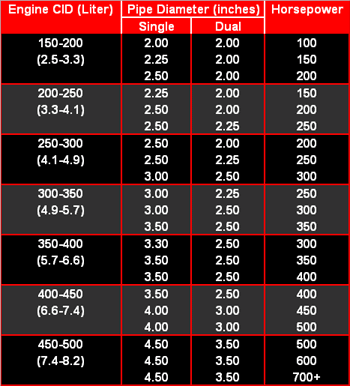
This information is provided as a guideline to pipe size selection for peak performance at full throttle levels. For vehicles that are street driven on a daily basis, consider using the next smaller pipe diameter for best results.
Smaller diameter pipes will produce low-to mid-RPM torque.
Larger diameters produce mid-to high RPM torque.
------
Bigger is NOT ALWAYS better !!
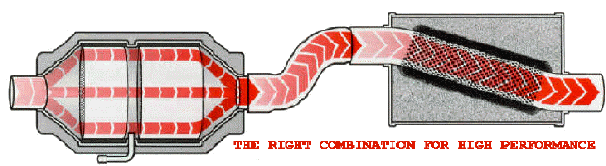
As a general rule, you can enlarge the pipe diameter of your O.E.M. exhaust system by 1/4 to 3/4 inch to increase horsepower. However, any additional increase in pipe diameter is likely to decrease your performance. Improving performance is more about improving air flow than about enlarging pipe diameters.
Smaller diameter pipes will produce low-to mid-RPM torque.
Larger diameters produce mid-to high RPM torque.
------
Bigger is NOT ALWAYS better !!
As a general rule, you can enlarge the pipe diameter of your O.E.M. exhaust system by 1/4 to 3/4 inch to increase horsepower. However, any additional increase in pipe diameter is likely to decrease your performance. Improving performance is more about improving air flow than about enlarging pipe diameters.
- Dom -
Dom-
Great addition to the thread.
Airflow is definitely all about maintaining momentum. Big pipe hurts this by presenting gases room to expand and scatter. Small pipe hurts this by obstructing flow when the car is exhausting the most air. Choosing the proper pipe diameter is the most influential exhaust decision.
Notice the chart saying 2.5" is large enough for a single exhaust in a 4.0L engine with 250hp. Area=(pi)*(r)^2. Increasing radius definitely increases pipe cross sectional area exponentially.
Great addition to the thread.
Airflow is definitely all about maintaining momentum. Big pipe hurts this by presenting gases room to expand and scatter. Small pipe hurts this by obstructing flow when the car is exhausting the most air. Choosing the proper pipe diameter is the most influential exhaust decision.
Notice the chart saying 2.5" is large enough for a single exhaust in a 4.0L engine with 250hp. Area=(pi)*(r)^2. Increasing radius definitely increases pipe cross sectional area exponentially.

Lexus Champion
Joined: Feb 2001
Posts: 2,506
Likes: 26
From: Mississippi
Here's a question...
What is the stock OD of the exhaust pipe throughout?
I bought my two Magnaflow cats online and they are suppossed to be stock replacements. They are 2" in/out as quoted from their web page. So is the whole system 2"?
And look what I just found. This is interesting...
http://www.popularhotrodding.com/eng.../photo_19.html
Maybe I'll try 2.25" from x-pipe to 3.25" Flow Master muffers...
What is the stock OD of the exhaust pipe throughout?
I bought my two Magnaflow cats online and they are suppossed to be stock replacements. They are 2" in/out as quoted from their web page. So is the whole system 2"?
And look what I just found. This is interesting...
http://www.popularhotrodding.com/eng.../photo_19.html
Maybe I'll try 2.25" from x-pipe to 3.25" Flow Master muffers...
Lexus Champion
Joined: Feb 2001
Posts: 2,506
Likes: 26
From: Mississippi
Lexus Test Driver
Joined: Aug 2005
Posts: 1,354
Likes: 1
From: SoCal
Thx for the info guys. The exhaust shop that i go to doesnt have 2.25 mandrel bent piping, hopefully i can find something closer to home to do this setup. I was quoted 2.5in mandrel aluminized piping+2 o2 bungs + hpipe from the stock cats to the stock mufflers for 350. But i will most likely pursue the 2.25 now. THX!


Lead Lap
Joined: Mar 2006
Posts: 706
Likes: 0
From: OR
I had this idea for awhile, and I think it would make more sense on a 400. How about side pipes? Summit racing sells universal ones, and they look awesome (IMHO) on long wheelbase cars.
While I own a 300, i'm looking for the same exhaust "style" as skip: kinda quiet up to 3K and after that let it be as loud as it wants...without losing torque.
great thread
While I own a 300, i'm looking for the same exhaust "style" as skip: kinda quiet up to 3K and after that let it be as loud as it wants...without losing torque.
great thread