


LEDs vs. Halogens.


Lexus Fanatic


Joined: May 2012
Posts: 68,631
Likes: 4,045
From: Maryland

You do get SOME of the multi-beam features in the US, just not most. My multibeams have all kinda different lighting elements that light up in turns and with high beams, etc. You can see the small beam units turning on and off.

Thread Starter
Lexus Fanatic


Joined: Oct 2003
Posts: 94,422
Likes: 249
From: Virginia/D.C. suburbs
A valid point that has been made (and that also backs up my own experience) is that the early halogens tended to burn out very quickly. I think the first car I owned that had them was a 1984 Mazda. The upgrade in night vision that the earlier incandescent/sealed-beam units American automakers had been using was enormous....but the trade-off was a very short bulb-life. I used to drive 24,000 miles a year back then, with a lot of it in the dark, and typical halogen units, for me, would last maybe 8-9 months (15-20K miles?). Replacing them, though, was relatively simple for DYI, though you had to take the grille-trim and headlight-rim bezels off to do it. GE or Sylvania halogen units were usually $9.95, on sale, at the then-Trak-Auto stores. I'd buy them and replace them both up front two at a time, as it made more sense to do that, since if one of them went, the other one was likely to do so shortly. Later on, of course, automakers switched the halogen bulbs to the twist-insert method behind the permanent-plastic headlight covers, so you only replaced the bulbs, not the whole unit. You also had to wear protective glasses and gloves while handling/installing the sensitive bulbs, because the gases in them could explode.

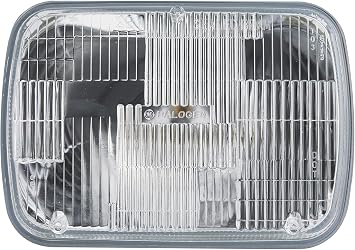
More modern halogens, of course, last longer (i haven't had to replace any for years), but, on average, still not as long as HIDs/Xenons and other advanced systems. I haven't owned many new vehicles with the more advanced headlight themselves, but my Lacrosse had some other LED systems on it. The only lighting-failure I've had on it, though, is one taillight bulb, not up front.
However, if and when they do fail, halogens are still a lot cheaper than the more advanced systems. I have never actually dealt personally with it, but I have heard of some of those advanced units costing $800-900 (or more) apiece.
More modern halogens, of course, last longer (i haven't had to replace any for years), but, on average, still not as long as HIDs/Xenons and other advanced systems. I haven't owned many new vehicles with the more advanced headlight themselves, but my Lacrosse had some other LED systems on it. The only lighting-failure I've had on it, though, is one taillight bulb, not up front.
However, if and when they do fail, halogens are still a lot cheaper than the more advanced systems. I have never actually dealt personally with it, but I have heard of some of those advanced units costing $800-900 (or more) apiece.

Lexus Champion

Joined: Nov 2013
Posts: 13,260
Likes: 1,883
From: WA
My Highlander has halogen projectors. My GS has the triple LED projectors, and my Tacoma has the optional LED reflector headlamps.
The LEDs in my GS are awesome but I would probably say that the Tacoma's LEDs are slightly better, at least they seem like they put out more light. They're pretty incredible.
The halogens in the Highlander are very weak.
The LEDs in my GS are awesome but I would probably say that the Tacoma's LEDs are slightly better, at least they seem like they put out more light. They're pretty incredible.
The halogens in the Highlander are very weak.


Lexus Fanatic

Joined: Sep 2010
Posts: 25,992
Likes: 4,312
From: Alberta
Have not seen any data on reliability, HID vs halogen vs LED so I'm going to have to revert to my observations. Made in Japan Koito is far more reliable than anything else out there. Here is a 50 year old Koito original to the car still works.


Lexus Champion


Joined: Apr 2007
Posts: 11,041
Likes: 98
From: Southeastern PA
I would never say "never", but I would have a really hard time getting a car with halogen headlights at this point. My car has xenon, my wife's car has LEDs, and those 2 cars are, far and away, the best headlights I have ever had on a vehicle. Sure, not all are created equal. The HIDs on my wife's prior Mazda CX-9 were vastly inferior to any other HID/LED headlights I've had over the past 2 years. The also weren't bi-xenon, which I really like on my BMW.
But I just can't see myself getting another car with halogens--partly because any car that had them would very likely be either a car or a trim level that I'm not interested in--I don't envision the headlights would be the single deciding factor, in any case.
But I just can't see myself getting another car with halogens--partly because any car that had them would very likely be either a car or a trim level that I'm not interested in--I don't envision the headlights would be the single deciding factor, in any case.
Lexus Fanatic
Joined: May 2012
Posts: 68,631
Likes: 4,045
From: Maryland
Lexus Fanatic
Joined: May 2012
Posts: 68,631
Likes: 4,045
From: Maryland
I'm sure. They're just simple incandescent bulbs.
https://shop.advanceautoparts.com/p/...tm_medium=ymme
https://shop.advanceautoparts.com/p/...tm_medium=ymme


One thing that I do notice with HIDs and LEDs, it seems that the bluish/white light gets "absorbed" more by darker pavements, especially during rain. With older halogen bulbs, the yellow light seems to contrast better with the pavement.
I recently upgraded the lights on my motorcycle. It originally came with a halogen headlight, and the previous owner "upgraded" the stock halogen bulb with a cheap direct replacement LED bulb. These bulbs are the modern incarnation of the blue coated halogen bulbs of the 90ies. I bought a proper LED headlight assembly from Denali Electronics, as well as a set of their auxilary driving lights. These are pretty expensive, about $500 for the headlight and $500 for the driving lights with all the brackets and mounts, but they are insanely bright compared to the old headlight, and comply with all the DOT regulations.


Lexus Fanatic
Joined: Sep 2010
Posts: 25,992
Likes: 4,312
From: Alberta
I've noticed the same thing. Pure green light is fantastic in foggy and rainy conditions but isn't used in vehicle lighting for obvious reasons.

Lead Lap
Joined: Mar 2015
Posts: 4,517
Likes: 345
From: In your head
Depends on your surroundings.If your in a city, leds as new, LED street lights will overpower any halogen. In dark winding roads, with little lighting, its a toss up and I dont mind either.
And then of course their are those who drive with massive light bars, multiple offroad lights at max brightness in the middle of a traffic jam on a major highway....
And then of course their are those who drive with massive light bars, multiple offroad lights at max brightness in the middle of a traffic jam on a major highway....