


Ford Mustang Mach-E


Lexus Test Driver
Joined: Jan 2007
Posts: 7,460
Likes: 232
From: CA

Originally Posted by RNM GS3
^
Ford wants to kill the only successful nameplate they have left except F150.
Nothing about this is remotely a Mustang.
Those pics make it look like regular crossover in $30-35k price range.
Ford wants to kill the only successful nameplate they have left except F150.
Nothing about this is remotely a Mustang.
Those pics make it look like regular crossover in $30-35k price range.


Lexus Test Driver


Joined: Feb 2002
Posts: 8,206
Likes: 249
From: New York
Lexus Test Driver
Joined: Jan 2007
Posts: 7,460
Likes: 232
From: CA
Originally Posted by RNM GS3
They claim mid 5 or mid 6 seconds and that’s probably when it’s fully charged. So more like 7 to 8sec in real world.
The mid 3sec variant is over $60k - for that money I would take BMW X3M or M40i.
The mid 3sec variant is over $60k - for that money I would take BMW X3M or M40i.
Edit: the Mach E premium has a version less than $50k that does 0-60 in 4.8s. Sounds like a good deal to me.
Last edited by EZZ; Nov 15, 2020 at 11:02 AM.
Lexus Test Driver
Joined: Feb 2002
Posts: 8,206
Likes: 249
From: New York
Actually EVs run what they claim all day in the street. They usually get the perfect traction and launch due to max torque at 0 rpm. Takes 0 skill to drive an EV fast.
Edit: the Mach E premium has a version less than $50k that does 0-60 in 4.8s. Sounds like a good deal to me.
Edit: the Mach E premium has a version less than $50k that does 0-60 in 4.8s. Sounds like a good deal to me.
At less than full charge - they drop significantly in performance.
$50k for a small Ford crossover - ye amazing deal 😂
Lexus Test Driver
Joined: Jan 2007
Posts: 7,460
Likes: 232
From: CA
Originally Posted by RNM GS3
That is false.
At less than full charge - they drop significantly in performance.
$50k for a small Ford crossover - ye amazing deal 😂
At less than full charge - they drop significantly in performance.
$50k for a small Ford crossover - ye amazing deal 😂
. Most EVs will run higher charge in daily commutes so performance loss is greatly exaggerated

Lead Lap

Joined: Apr 2002
Posts: 4,892
Likes: 14
From: Virginia
As I put in the IG post, I think Ford must be pretty confident in the performance of the Mach-E to be willing to put the Mustang badge on it. Pretty excited to drive one. Yeah, the interior isn't super plush for a $50K+ vehicle, but I don't think many customers are going to care. And based on the many customers and families I spoke with yesterday, I think there are a ton of Ford fans that are eager to get into something "Mustang" that has 4 doors, cargo capacity and available all wheel drive.
Good tech, good specs on the range and acceleration for most buyers. Amazing that Ford can come to market with a modern EV (ignoring the Focus EV's of the past) faster than many other large traditional OEMs.
Good tech, good specs on the range and acceleration for most buyers. Amazing that Ford can come to market with a modern EV (ignoring the Focus EV's of the past) faster than many other large traditional OEMs.

Thread Starter
Joined: Oct 2008
Posts: 42,476
Likes: 321
From: California
Ford Mustang Mach-E official EPA range numbers are in
The Mach-E EV will travel between 211 and 300 miles on a charge
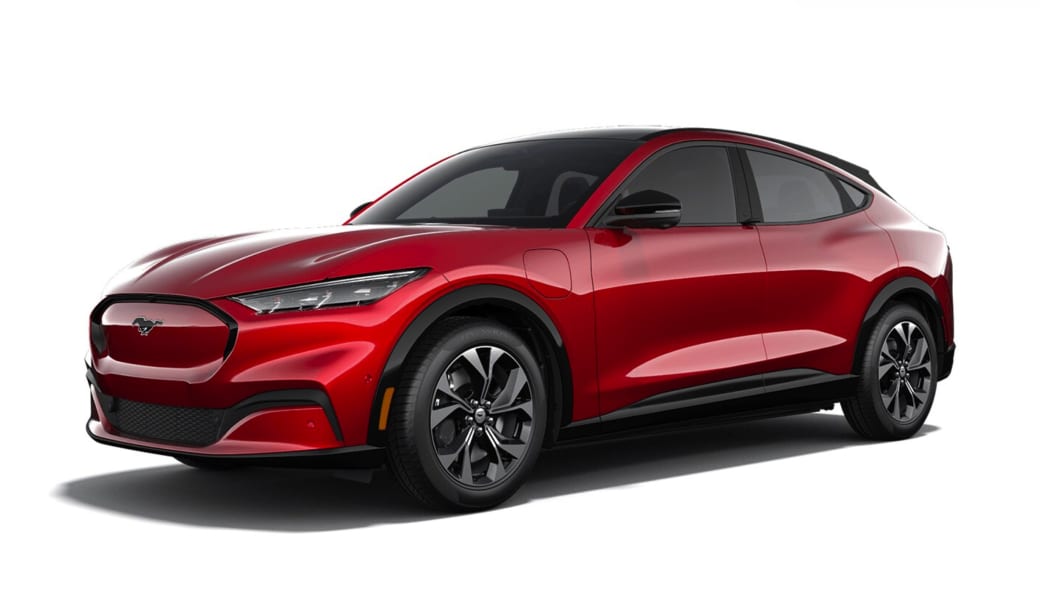
Official EPA range estimates for the 2021 Ford Mustang Mach-E are in, and they largely confirm Ford's initially released figures. The battery-powered 'Stang is good for up to 300 miles on a charge, but different variants have different range estimates.
The Mach-E is offered in standard- and extended-range versions, each with either rear-wheel drive or all-wheel drive. The standard-range Mach-E has a 75.7-kilowatt-hour battery. With rear-wheel drive that battery feeds a single, 255-hp permanent-magnet electric motor. Range for that version is 230 miles. With all-wheel drive, a second electric motor is added for a total of 332 horsepower. The standard-range eAWD version is good for 211 miles.
A larger, 98.8-kWh battery pack feeds the extended-range Mach-E. With rear-wheel drive, it powers a 282-hp electric motor and delivers 300 miles of range. The eAWD extended-range version again uses two motors, this time for 332 horsepower, and can travel 270 miles on a charge.
We're still waiting for the Feds to weigh in with range estimates for the Mustang Mach-E GT and Mach-E GT Performance Edition. Those performance models boast 459 horsepower and 612 lb-ft of torque.
The Mustang Mach-E offers a variety of chargers, and recharge time varies greatly depending on which one is used. A 120-volt mobile charger adds 3 miles of range per hour; a 240-volt mobile charger adds 22 miles for each hour, and a 240-volt home version refills the batteries at a rate of 32 miles for each hour. With the Mach-E's DC fast-charger hooked up to a 150 kW source, the car can replenish 47 miles in just 10 minutes.
The 2021 Ford Mustang Mach-E is priced from $43,995, before tax credits and incentives. Deliveries are scheduled to begin later this year.
The Mach-E is offered in standard- and extended-range versions, each with either rear-wheel drive or all-wheel drive. The standard-range Mach-E has a 75.7-kilowatt-hour battery. With rear-wheel drive that battery feeds a single, 255-hp permanent-magnet electric motor. Range for that version is 230 miles. With all-wheel drive, a second electric motor is added for a total of 332 horsepower. The standard-range eAWD version is good for 211 miles.
A larger, 98.8-kWh battery pack feeds the extended-range Mach-E. With rear-wheel drive, it powers a 282-hp electric motor and delivers 300 miles of range. The eAWD extended-range version again uses two motors, this time for 332 horsepower, and can travel 270 miles on a charge.
We're still waiting for the Feds to weigh in with range estimates for the Mustang Mach-E GT and Mach-E GT Performance Edition. Those performance models boast 459 horsepower and 612 lb-ft of torque.
The Mustang Mach-E offers a variety of chargers, and recharge time varies greatly depending on which one is used. A 120-volt mobile charger adds 3 miles of range per hour; a 240-volt mobile charger adds 22 miles for each hour, and a 240-volt home version refills the batteries at a rate of 32 miles for each hour. With the Mach-E's DC fast-charger hooked up to a 150 kW source, the car can replenish 47 miles in just 10 minutes.
The 2021 Ford Mustang Mach-E is priced from $43,995, before tax credits and incentives. Deliveries are scheduled to begin later this year.
Thread Starter
Joined: Oct 2008
Posts: 42,476
Likes: 321
From: California
Ford Mustang Mach-E GT Performance Edition
Nearly as quick as the GT500
It will be available halfway through 2021
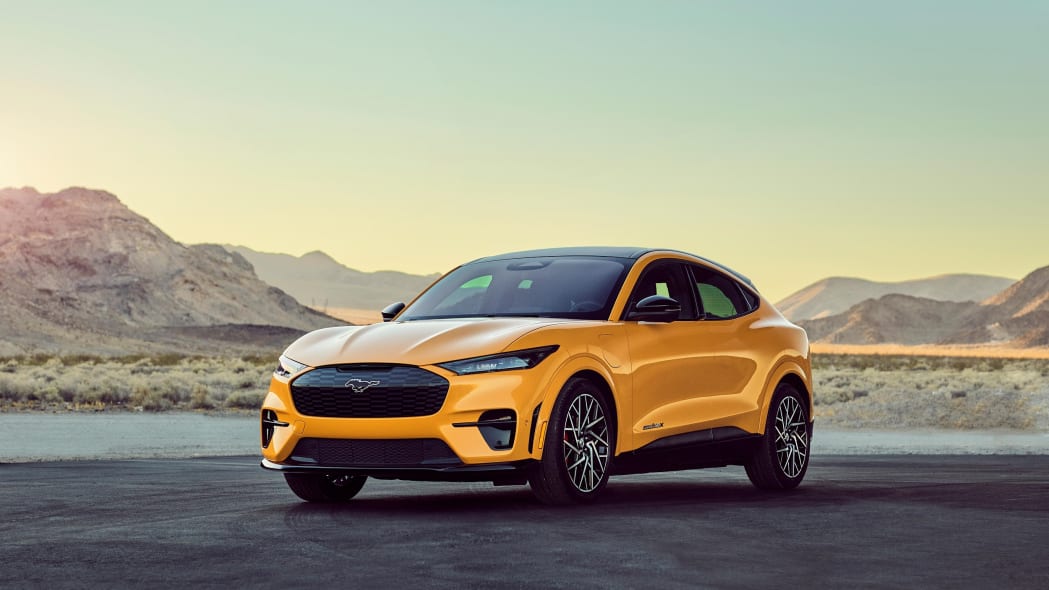
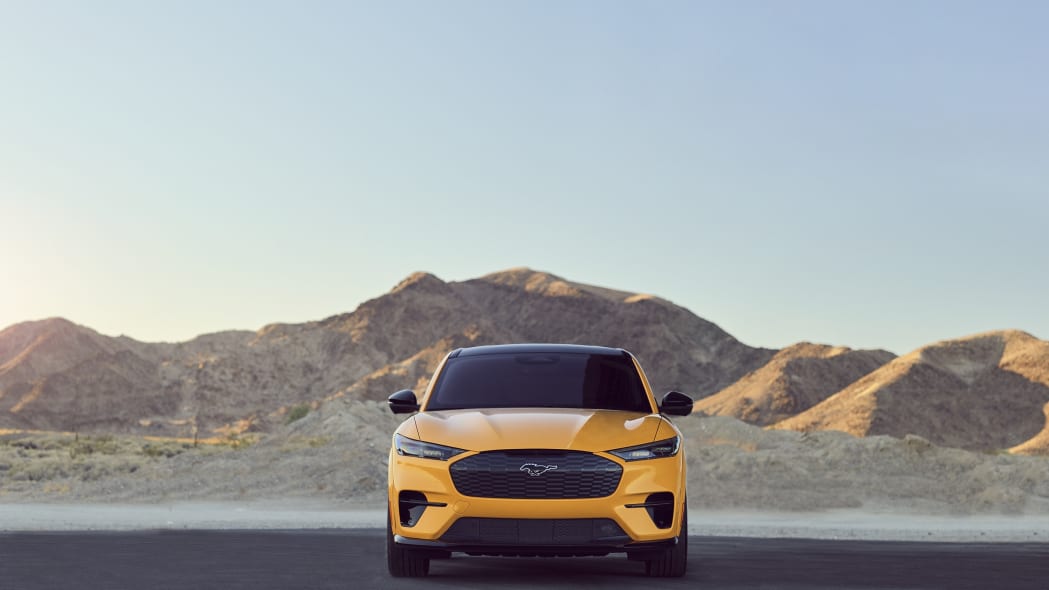

The Ford Mustang Mach-E electric crossover isn't technically related to the Ford Mustang, but it can certainly accelerate like one. It will soon gain a quicker variant appropriately named Performance Edition that can nearly outsprint the mighty, 760-horsepower GT500 in a straight line.
Based on the GT trim, the Performance Edition is powered by two electric motors that make 480 horsepower and a pickup-like 634 pound-feet of torque. For comparison, the regular Mach-E GT posts 480 and 600, respectively. Those figures lower its zero-to-60-mph time to 3.5 seconds, which is two-tenths of a second behind the aforementioned GT500 and three-tenths of a second quicker than the Mach-E GT it starts life as. The Performance Edition's top speed hasn't been published.
Ford built the Performance Edition on an 88-kilowatt-hour lithium-ion battery pack that stores enough electricity for up to 235 miles of driving range, though that figure hasn't been certified by the Environmental Protection Agency (EPA). Put another way, the 34 additional pound-feet of torque saps 15 miles of range from the Mach-E.
Moving beyond the powertrain, the Performance Edition gains 19-inch front rotors gripped by Brembo calipers, a sportier MagneRide suspension also offered on the two-door Mustang, a specific gray grille, and 20-inch wheels painted black. Inside, the passengers are treated to front sport seats and aluminum-look trim on the dashboard. Several colors borrowed from the Mustang, including Grabber Blue and Cyber Orange, are on the palette.
While the Mustang Mach-E is scheduled to enter production in Mexico by the end of 2020, the GT and GT Performance Edition will not be available until late summer 2021. That's a bit later than Ford announced. The GT starts at $62,700 before government incentives enter the equation; it wasn't included in Ford's recent price-slashing campaign. We don't yet know how much the Performance Edition will cost.
Based on the GT trim, the Performance Edition is powered by two electric motors that make 480 horsepower and a pickup-like 634 pound-feet of torque. For comparison, the regular Mach-E GT posts 480 and 600, respectively. Those figures lower its zero-to-60-mph time to 3.5 seconds, which is two-tenths of a second behind the aforementioned GT500 and three-tenths of a second quicker than the Mach-E GT it starts life as. The Performance Edition's top speed hasn't been published.
Ford built the Performance Edition on an 88-kilowatt-hour lithium-ion battery pack that stores enough electricity for up to 235 miles of driving range, though that figure hasn't been certified by the Environmental Protection Agency (EPA). Put another way, the 34 additional pound-feet of torque saps 15 miles of range from the Mach-E.
Moving beyond the powertrain, the Performance Edition gains 19-inch front rotors gripped by Brembo calipers, a sportier MagneRide suspension also offered on the two-door Mustang, a specific gray grille, and 20-inch wheels painted black. Inside, the passengers are treated to front sport seats and aluminum-look trim on the dashboard. Several colors borrowed from the Mustang, including Grabber Blue and Cyber Orange, are on the palette.
While the Mustang Mach-E is scheduled to enter production in Mexico by the end of 2020, the GT and GT Performance Edition will not be available until late summer 2021. That's a bit later than Ford announced. The GT starts at $62,700 before government incentives enter the equation; it wasn't included in Ford's recent price-slashing campaign. We don't yet know how much the Performance Edition will cost.
Lexus Test Driver
Joined: Jan 2007
Posts: 7,460
Likes: 232
From: CA
Nearly as quick as the GT500
It will be available halfway through 2021
The Ford Mustang Mach-E electric crossover isn't technically related to the Ford Mustang, but it can certainly accelerate like one. It will soon gain a quicker variant appropriately named Performance Edition that can nearly outsprint the mighty, 760-horsepower GT500 in a straight line.
Based on the GT trim, the Performance Edition is powered by two electric motors that make 480 horsepower and a pickup-like 634 pound-feet of torque. For comparison, the regular Mach-E GT posts 480 and 600, respectively. Those figures lower its zero-to-60-mph time to 3.5 seconds, which is two-tenths of a second behind the aforementioned GT500 and three-tenths of a second quicker than the Mach-E GT it starts life as. The Performance Edition's top speed hasn't been published.
Ford built the Performance Edition on an 88-kilowatt-hour lithium-ion battery pack that stores enough electricity for up to 235 miles of driving range, though that figure hasn't been certified by the Environmental Protection Agency (EPA). Put another way, the 34 additional pound-feet of torque saps 15 miles of range from the Mach-E.
Moving beyond the powertrain, the Performance Edition gains 19-inch front rotors gripped by Brembo calipers, a sportier MagneRide suspension also offered on the two-door Mustang, a specific gray grille, and 20-inch wheels painted black. Inside, the passengers are treated to front sport seats and aluminum-look trim on the dashboard. Several colors borrowed from the Mustang, including Grabber Blue and Cyber Orange, are on the palette.
While the Mustang Mach-E is scheduled to enter production in Mexico by the end of 2020, the GT and GT Performance Edition will not be available until late summer 2021. That's a bit later than Ford announced. The GT starts at $62,700 before government incentives enter the equation; it wasn't included in Ford's recent price-slashing campaign. We don't yet know how much the Performance Edition will cost.
Source


Lexus Fanatic


Joined: Sep 2010
Posts: 25,992
Likes: 4,311
From: Alberta
I would love this if it was not soiling the Mustang name. The range is puzzling though given the size of the battery pack. Also looking forward to the comments that is has too much power and is too fast.
Thread Starter
Joined: Oct 2008
Posts: 42,476
Likes: 321
From: California
2021 Ford Mustang Mach-E First Drive
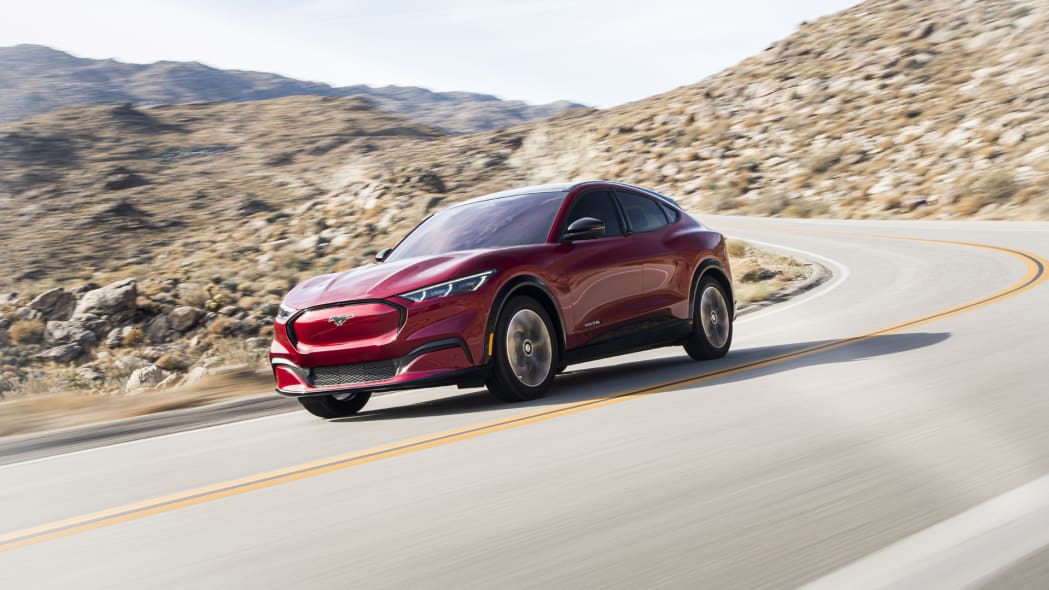
Like a summer tentpole movie that the studio won’t shut up about, certain cars can hardly live up to their marketing hype. That goes double for EVs, and triple for American EVs that makers or fans hope might knock Elon Musk down a peg. When the hype goes overboard – and Lord, has it gone overboard for the 2021 Ford Mustang Mach-E – it's hard not to brace for disappointment.
So sincere plaudits to Ford’s electric ingénue: Whether it’s a “Mustang” or not (it’s not), the Mach-E compact SUV is awfully good. How good? For the first time, we have a genuine, no-excuses competitor to Tesla’s benchmark EVs. In this case, it’s up against the Model Y, and in some areas, the Ford is better. That includes its curvaceous body, a superior interior and some 3,000 Ford dealers to service it versus 110 for Tesla. In other areas, including pure efficiency and an exponentially larger charging infrastructure, Tesla maintains an edge. But unlike, say, the overmatched Nissan Leaf versus a Model 3, no one is going to question your sanity if you choose the Ford. In fact, they’ll likely compliment your shrewd judgment and sense of style.
I set off from Brooklyn to see if my candy-apple-red Mach-E Premium could deliver its 270 miles of EPA-rated range. As with many EVs, that’s likely a “no,” especially if you’re mostly sticking to the highway. I’m actually good at maximizing EV mileage. Yet even using every ounce of self-restraint, I could only stay on pace for about 250 miles. That’s still excellent range in an AWD electric SUV. It’s about 25% better range than a pricier Audi e-Tron, which struggles to top even 200 real-world miles. The rear-drive Mach-E Premium should do even better, having reached the magic 300-mile mark in EPA estimates with its optional extended-range battery.
So sincere plaudits to Ford’s electric ingénue: Whether it’s a “Mustang” or not (it’s not), the Mach-E compact SUV is awfully good. How good? For the first time, we have a genuine, no-excuses competitor to Tesla’s benchmark EVs. In this case, it’s up against the Model Y, and in some areas, the Ford is better. That includes its curvaceous body, a superior interior and some 3,000 Ford dealers to service it versus 110 for Tesla. In other areas, including pure efficiency and an exponentially larger charging infrastructure, Tesla maintains an edge. But unlike, say, the overmatched Nissan Leaf versus a Model 3, no one is going to question your sanity if you choose the Ford. In fact, they’ll likely compliment your shrewd judgment and sense of style.
I set off from Brooklyn to see if my candy-apple-red Mach-E Premium could deliver its 270 miles of EPA-rated range. As with many EVs, that’s likely a “no,” especially if you’re mostly sticking to the highway. I’m actually good at maximizing EV mileage. Yet even using every ounce of self-restraint, I could only stay on pace for about 250 miles. That’s still excellent range in an AWD electric SUV. It’s about 25% better range than a pricier Audi e-Tron, which struggles to top even 200 real-world miles. The rear-drive Mach-E Premium should do even better, having reached the magic 300-mile mark in EPA estimates with its optional extended-range battery.
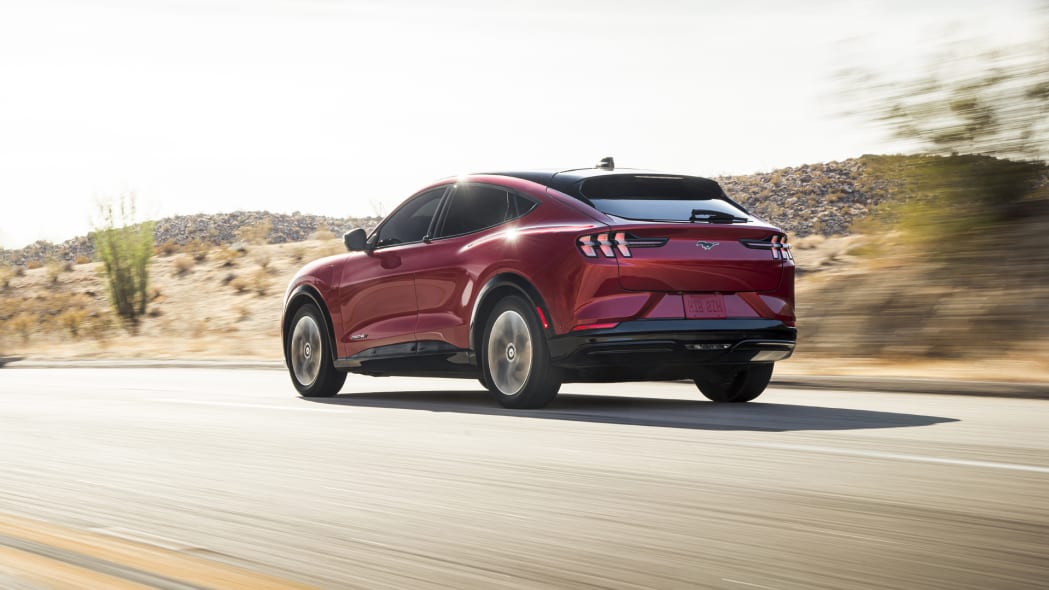
The most-affordable Mach-E Select starts from $43,995, but subtracting the $7,500 federal tax credit drops the price down to $36,495 (there are further state-level credits available as well). That's for a rear-wheel-drive model with the smaller, 76.8-kilowatt-hour Standard Range battery and 230 miles of range. It brings 266 horsepower and 317 pound-feet of torque. Optional AWD boosts torque to 428 lb-ft, with no change to horsepower, and a stingier, 211-mile electric leash.
Our Mach-E Premium test car, with dual-motor AWD, starts from $50,800. Its $5,000 Extended Range option includes a 98.4-kWh battery and 270 miles of range, plus more powerful motors that increase output to 346 hp and 428 lb-ft of torque (290 hp, 317 lb-ft of torque and 300 miles of range with RWD). A $400 coat of Rapid Red paint kicked the tally to $56,200. That’s Mustang Shelby GT350 money, and a boatload for a compact crossover that doesn't carry a luxury badge.
But it’s the feds to the rescue, with the available $7,500 tax credit for EVs. And the Mach-E Premium’s $48,700 post-credit price stood out when it stood next to an Audi e-Tron Sportback that I was also testing. The Audi is even quieter than the near-silent ‘Stang, among the quietest cars in auto history. The e-Tron is wildly more luxurious, essentially a dreamy Audi Q8 with electric drive. The e-Tron also cost $82,500 post-credit, nearly $34,000 more than the Ford. Is the Audi $34,000 better? Not even close, especially given its range shortfall.
With stamina covered, the Ford mostly nails the style, performance and tech. The Mach-E may be another cookie-cutter compact SUV, but it's at least from the batch that produced models like the Mazda CX-5. The Mach-E’s blunt prow, swelling fenders and aggressive stance make the Model Y seem pedestrian.
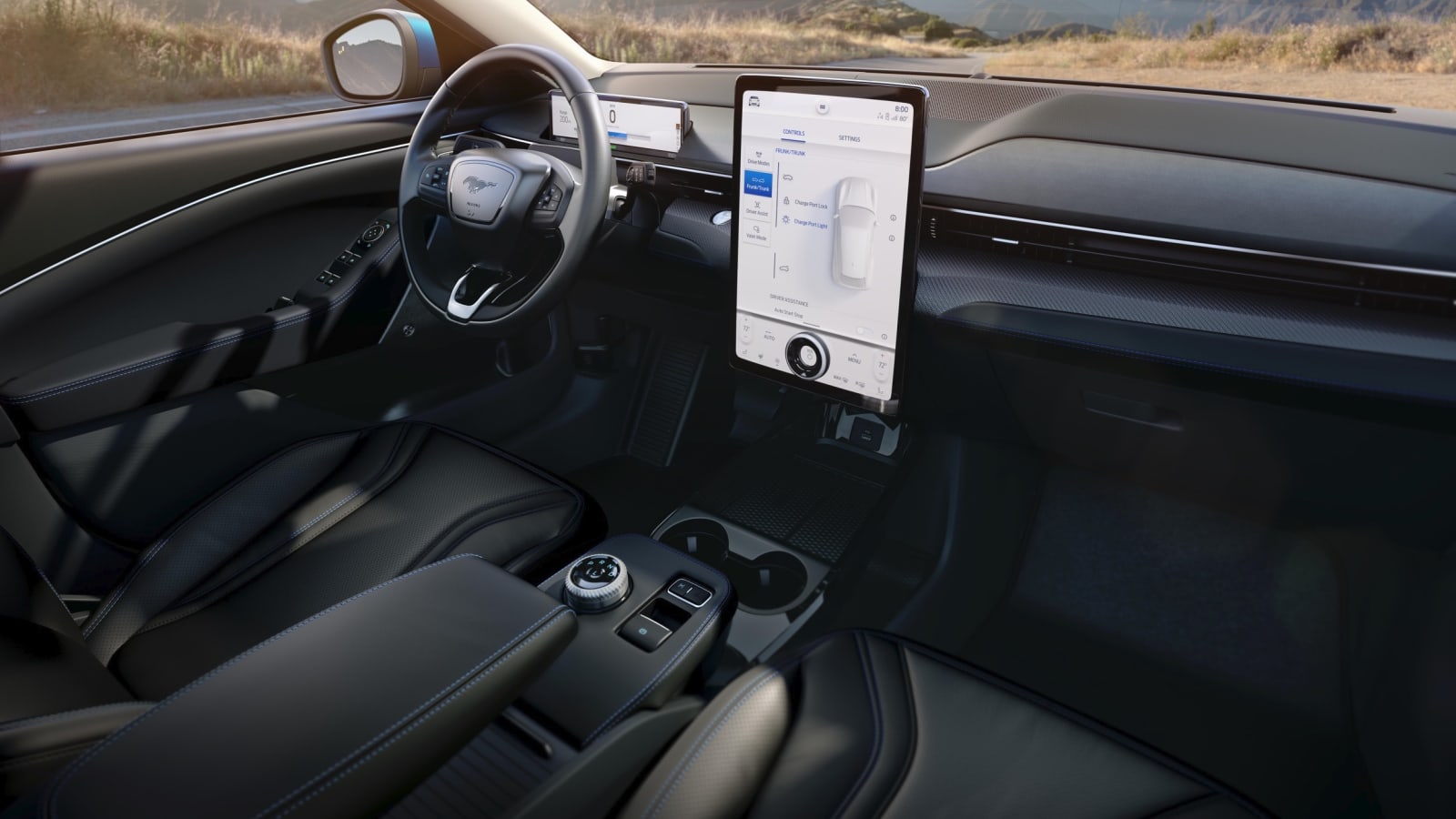
The interior adopts the TWA Lounge look that seems de rigueur in new EVs: It’s just you and that big, 15.5-inch center screen. But where the Model Y looks a bit barren – the vinyl-clad waiting area for coach passengers – the Ford’s minimalism is joined to more-appealing design and craftsmanship, richer materials and more-comfortable, supportive seats. Mach-E designers – perhaps realizing the intense consumer and critical spotlight on this EV – finessed details that sometimes escape Ford’s corporate attention. Knock-knock plastic is banished. Tactile stitching on faux-leather upholstery looks luxury-league. Oversized toggles for interior door releases are a cool touch. Push-button exterior doors include rear portals that automatically crack open when you press their round pad.
Remember when Ford’s infotainment system was the bane of the automotive world? Today, the company's newest Sync 4 unit is a solid base of operations, though it could still use Home and/or Back buttons to ease those operations. A knurled-metal audio dial is the only physical control, with a clever doughnut hole that exposes an on/off switch on the glass itself. There’s a lot going on in terms of icons, layered screens and apps, but after a few run-throughs, the Ford system was largely a breeze. Tesla’s screen is even larger, with more functions – some smart, like pet-protecting Dog Mode; some superfluous, like Fart Noises. And Sync couldn’t match the uncanny ease of Tesla’s voice commands (it’s hard to top Tesla for pure tech integration). But Ford’s own portrait-oriented screen seems easier to use while in motion, and comes smartly featured itself.
The stylishly canted roofline doesn’t impinge on the back seat, but it does create serious blind spots and detracts from cargo space. There’s 4.5 fewer cubic-feet of space behind the back seat than Ford's compact Escape, but then, also 7.8 more than the e-Tron Sportback. Tesla doesn't provide such a number for the Model Y.
As for driving, the Model Y sets a high bar: It’s rocket-ship fast, agile and fun, essentially a Model 3 sedan – easily the world’s best-selling EV – on tiptoes. But the Ford is a joy buzzer in its own right, with the screwed-down security of a low-center-of-gravity EV, and a chassis with a fine sense of the road. With 346 horses and 428 pound-feet of light-switch torque, this Mach-E Premium AWD makes effortless pace. Ford figures 4.8 seconds to 60 mph, the same as a Model Y Long Range, but the Tesla edge feels faster in the real world. With fewer electric horses, the Ford also runs out of grunt sooner as speeds climb. But in steady rain on winding, nighttime parkways north of Manhattan, the Mach-E romped past fossil-fueled cars, including a pesky BMW 3 Series, with intoxicating ease. As with Model Y, there’s a disconcerting lack of feedback from the front tires; one has to learn to trust the ample tire grip, and then it’s fine. The Ford glides so quietly and serenely that it might seem powered by invisible gamma rays.
At speeds below 20 mph, the Ford broadcasts a digital hum outside the vehicle to alert pedestrians. Three performance modes – Whisper, Engage and Unbridled – adjust throttle, digitized onboard sound and ambient lighting. That cabin soundtrack recalls a synthesized Ford V8, remixed by Kraftwerk. In sportier Engage mode, the over-loud sound becomes wearying within minutes, not as charming as the spaceship-y hum of a Porsche Taycan. Fortunately, it can be shut off in any mode. What can’t be shut off are gimmicky animations in the driver’s display, including a white lava-lamp effect in Whisper, and vaguely threatening orange spikes in Unbridled that grow or shrink as you accelerate and slow down. (I kept picturing Pinhead from "Hellraiser").
My sense is that, for 90-some percent of drivers, Whisper will be the set-and-forget mode. Light steering in Whisper mode actually feels best suited to the creamy-EV mission. In Unbridled mode, the Ford’s electric steering turns unpleasantly gluey and artificial – recalling the clamped-down sensation of older Hyundais with “Sport” modes – with no attendant increase in road feel. Engage mode is the tolerable midpoint, with added benefit of having no distracting anime show in the driver’s display.
Brakes bring their own issue for enthusiast drivers. No worries with the beautifully tuned regenerative portion, including an on-off screen switch for familiar “one-pedal” EV driving. That one-pedal mode was confident enough to trail a semi on a long downhill freeway run in pouring rain, and simply ease off the throttle whenever the truck’s brake lights flashed. Great stuff.
But when you want or need to apply the physical brakes, they become the Ford’s Achilles’, er, Foot. The pedal is neither linear nor progressive, so you’re often applying too much or too little pressure. I dare anyone: Just try to halt the Mach-E smoothly and forcefully from 70 or 80 mph, or in fast-corner entry, without upsetting the chassis or making mid-stream corrections. If Ford expects the upcoming GT version to drive like a legit high-performance SUV, these clumsy brakes need a retuning, pronto. That $61,600 GT (and GT Performance) is set to arrive in fall 2021, with 480 horses and 0-60 times as low as 3.5 seconds.

During my drive, Ford’s energy usage settled in at 3.0 miles for every kilowatt-hour in its battery. That’s 50% better than the electron-guzzling 2 miles-per-kWh I’ve seen in Audi’s e-Tron models. A cool onboard screen offers welcome transparency, displaying the percentage of energy going to propulsion, climate controls, accessories and ambient temperatures.
But the Model Y I tested was still 30% more efficient than the Mach-E, covering nearly four miles for every kilowatt-hour. To underline: Tesla remains the undisputed king of electric-motor and battery efficiency, including the Model Y Long Range’s 326-mile stamina, 56 more miles than the comparable AWD Mach-E.
Public charging is Tesla’s win as well. Ford is touting its welcome, nationwide partnership with operators including Electrify America and ChargePoint, but their DC fast-charging network remains a fraction of the size of Tesla’s. If you can find an EA or Chargepoint DC charger that operates near the advertised 150 kilowatts – I’ve had my struggles – Ford claims up to 61 miles of added range in 10 minutes flat.
Ford prefers to cite the "usable portion" of its Standard and Extended-Range batteries – hence the differences you might notice between the kWh numbers we note above versus what you might see in Ford's official specs. The amount beyond that "useable portion" is a buffer to ensure a long-lived battery, and Ford wants to highlight that buffer to put its efficiency handicap to Tesla in a better light. While it’s fine to note the buffer, it is troubling to see so many journalists falling in line to quote Ford’s preferred numbers, even as they cite the total battery capacities of Tesla and rivals. Apples-to-apples, people.
Another set of accounting numbers favors Ford, via the aforementioned $7,500 tax credit that is no longer available to Tesla buyers. Effectively, Tesla has sold too many cars to still qualify. Whether that is unfair to Tesla or at least counterproductive to the credit's purpose of getting people to buy electric is an argument for another day.
After teasing a $40,200 price, Tesla summarily cancelled a more-affordable, shorter-range Model Y before it reached showrooms. But early adopters will see the first Mach E Selects in coming weeks, at $36,495 after the federal largesse. Tesla’s most-affordable Model Y, the Long Range, now starts at $49,990, or $13,495 higher.
A better comparison, however, is our more-powerful Mach-E Premium AWD test vehicle with its 270-mile Extended Range option that starts from $55,800. With the tax credit, that's still about $1,700 less than the Tesla. (Without the credit, the Ford would cost thousands more). A rear-drive, 300-mile Mach-E Premium Extended Range costs $45,600 post-credit, about $4,400 less than Model Y.
That’s a lot of numbers. But any way you slice them, the Mach-E buyer will be $7,500 ahead from the start. Among the reasons to choose the Ford, those 7,500 may end up the most compelling.
